Get Full Government Meeting Transcripts, Videos, & Alerts Forever!
Get email alerts on the Water Infrastructure Funding topic
No spam. Unsubscribe anytime.
Consultants advise phased, grant-first strategy as water-extension costs top tens of thousands per connection
Summary
Consultants told the Morrow County Clean Water Consortium that full water-extension projects are likely unaffordable if built at once and recommended phased, grant-driven work, income surveys to unlock CDBG funds and targeted case studies to refine costs and community outreach.
Nick (consultant) told the Morrow County Clean Water Consortium that the project team’s analysis shows full-build water-extension projects would create “huge debt burden” for small communities and recommended breaking work into smaller phases, pursuing competitive grants and using case studies to refine costs.
The consultant said work to date — including conceptual designs from HDR and GSI — yields per-connection cost estimates that can be very high in low-density areas. He cited illustrative figures discussed in the meeting: per-connection costs ranging into the tens of thousands of dollars (examples shown in the presentation included figures of about $61,000 and $125,000 per connection) and monthly debt service scenarios that could exceed local affordability (presentations included examples of $40, $105 and higher per month of debt-service per connection depending on grant/loan mixes). He urged a strategy that mixes grant programs, targeted loans and repeated, smaller projects rather than trying to fund a single, comprehensive build-out.
Why it matters: the consultant said even optimistic combinations of congressional earmarks, CDBG block grants and Drinking Water State Revolving Fund (DWSRF) principal forgiveness leave communities facing large per-household debt-service costs; that threatens feasibility unless projects are right-sized and large grant components are secured.
Among near-term recommendations given to the consortium: - Prioritize income surveys where CDBG (Community Development Block Grant) eligibility is borderline. The consultant noted that CDBG public-water-extension grants require a low-to-moderate-income (LMI) share of 51% or more and that an income survey can change eligibility. He said an income survey typically costs roughly $10,000–$20,000 and can take about six months to complete and be reviewed by Business Oregon (a successful survey must be reviewed in time for the next application cycle). - Pursue the Drinking Water State Revolving Fund (DWSRF) principal forgiveness under the Bipartisan Infrastructure Law (BIL), which the presentation described as having a practical cap in current practice near $6 million (the consultant framed common award patterns as two $3 million amounts within that cap); such awards substantially reduce debt-service but rarely cover full project costs. - Use “case studies” (small, site-specific feasibility and pilot projects) to identify repeatable, lower‑cost delivery models for private-well owners and small clusters where full public extension is not cost-effective. - Coordinate grant applicants and eligible entities: some funds require a city or public water provider as applicant, others allow counties or nonprofit subrecipients.
Speakers including Ronan (HDR engineer) and other consultants said the current design level is roughly conceptual (about 5% design), and unit costs and the number of services are based on aerial counts and initial assumptions; HDR is reviewing unit-cost assumptions after receiving local feedback that on-the-ground unit costs may be higher.
The consultant and engineers emphasized that denser neighborhoods closer to existing mains will have lower per-connection cost than outlying low-density parcels, and that engineering feasibility work targeted at a small area will help refine realistic budgets and funding requests.
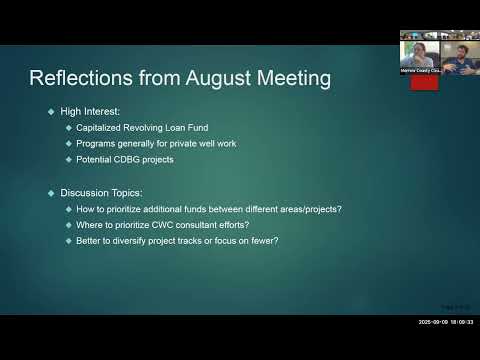
The consultant closed by asking the consortium for direction on which areas to prioritize so staff and engineers can focus feasibility work and funding applications.
Ending: The presentation concluded with a request that the consortium prioritize neighborhoods or project types so consultants can prepare targeted feasibility analyses and funding packages; consultancy teams will refine cost assumptions and prepare next-step recommendations for the consortium’s review.