Get Full Government Meeting Transcripts, Videos, & Alerts Forever!
Get email alerts on the Historic Preservation Depot topic
No spam. Unsubscribe anytime.
High-Speed Rail Authority details $20M depot rehab, plaza and Chinatown mobility hub
Summary
California High-Speed Rail Authority officials briefed the Fresno Historic Preservation Commission on plans to retrofit and reuse the 1889 Southern Pacific Depot, funded by a February 2023 RAISE grant and designed to include public space, parking, EV charging, solar and a Chinatown mobility hub.
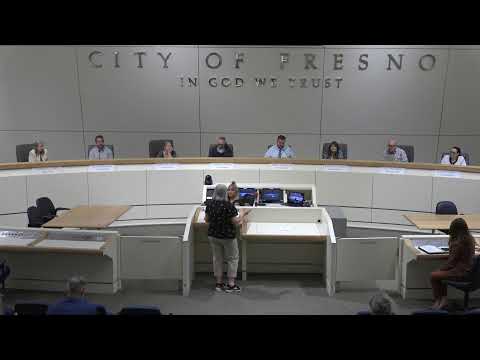
Ben Lichty, principal transportation planner for the California High‑Speed Rail Authority, told the Fresno Historic Preservation Commission Monday that the authority has designed a rehabilitation of the 1889 Southern Pacific Depot centered on a seismic retrofit, accessibility upgrades and a downtown plaza with parking and a Chinatown mobility hub.
The project is funded in part by a February 2023 RAISE grant from the Federal Railroad Administration; Lichty said the authority received $20,000,000 for the depot rehabilitation. "We are sharing an update today," Lichty said. The authority expects design review and comment resolution by October, advertise and award contracts by the end of 2025, and to begin construction in early 2026, with an overall renovation timeframe of about two years.
According to the presentation, the work breaks into three main components: restoration of the Historic Depot (a retrofit to make the building fully occupiable), a new downtown plaza in front of the depot, and a Chinatown mobility hub on the G Street side. The design includes roughly 4,000–4,500 square feet of finished public space for the depot lobby and waiting room, about 22,000 square feet returned to "warm shell" condition for near‑term office use, and a Pullman shed left as an open‑air structure (presenter figures: warm shell ≈22,000 sf; Pullman shed ≈12,500 sf).
Page & Turnbull preservation consultant Melissa Goudreau said the rehabilitation will emphasize retaining and repairing historic fabric in the former waiting room: mosaic tile, terrazzo, Tennessee marble base, carved wood trim and plaster ceilings. "Our goals for the Historic Depot renovation are primarily a seismic retrofit to bring it up to code for full occupancy," Goudreau said. She described removal of nonhistoric interior fabric, restoration and selective reconstruction of damaged features (including two chimneys), installation of new mechanical, electrical and plumbing systems and new public restrooms off the waiting room. The freight depot will receive accessibility upgrades and a security office.
Amy McKinnon, state staff with the High‑Speed Rail Authority, said the authority received concurrence from the State Historic Preservation Office under Section 106 of the National Historic Preservation Act and under the applicable state review (reported in the presentation as a Section 5024 report). "We did receive concurrence on the proposed design from SHPO's office," McKinnon said.
Project site work beyond the depot includes a downtown plaza with native landscaping and shade, about 40 parking stalls proposed adjacent to the depot, and EV charging and photovoltaic arrays in the parking area. The Chinatown mobility hub plan shows four bus bays between Tulare and Kern streets with electrical bus charging intended to serve Fresno County Rural Transit and other regional operators. The mobility hub concept also envisions bike parking and charging for small electric vehicles.
Lichty said the RAISE grant itself is not in jeopardy; the authority packaged this as the Fresno Station early works and identified roughly $25–30 million specifically for building rehabilitation within a larger federal‑state grant package. He acknowledged other components of the larger grant allocation are subject to funding decisions but said the authority is working to backfill where needed.
Commissioners pressed for details on timelines, public access and parking. Lichty said the lobby and waiting room will be public and that office areas will be secured by badge control and a security guard when occupied. He said the authority owns nearby parking that could accommodate staff and contractors in the near term. On funding and schedule he said there is no firm date for full tenant fit‑out of the 22,000 square feet and that future handoffs or alternate uses would require procurement and public processes.
The authority said it has been coordinating with Union Pacific and other stakeholders during plan check; formal comments from Union Pacific had not been received at the time of the presentation but the railroad was an active reviewer. The presenters also described outreach with Chinatown stakeholders, Fresno County Rural Transit and the Chinatown Fresno Foundation on mobility hub siting and amenities.
The presentation concluded with the authority saying it anticipates using the depot as office space for High‑Speed Rail for the next several years while remaining open to community requests for retail or food uses in the longer term, subject to procurement and public processes.
No formal commission action was taken at the meeting on the project update; the presentation was an informational workshop.