Get Full Government Meeting Transcripts, Videos, & Alerts Forever!
Get email alerts on the Land Use Development topic
No spam. Unsubscribe anytime.
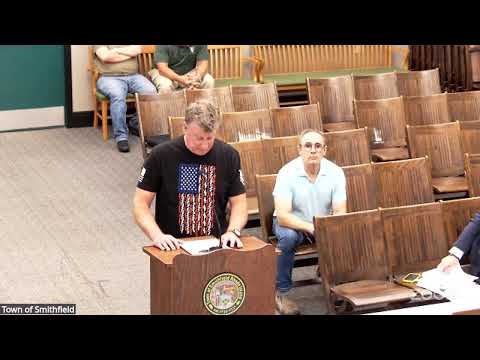
Smithfield council approves zone change for Putnam Pike site with conditions after hours-long public hearing
Summary
The Smithfield Town Council voted 3–2 Sept. 2 to amend the Putnam Pike/Esmerald Street Planned Development District to allow a four‑story medical office and a reduced residential component, after a public hearing that centered on traffic, wetlands and infrastructure worries.
The Smithfield Town Council voted 3–2 Sept. 2 to amend the Putnam Pike/Esmerald Street Planned Development District to allow a four‑story medical office building and an accompanying residential component, subject to conditions the council added during the meeting.
Supporters said the medical facility would bring specialty orthopedic diagnostics and an ambulatory surgical center to the town, while residents and some council members pressed for sharper limits on housing density, traffic mitigation and stronger documentation of wetlands and infrastructure impacts.
The amendment was sponsored by the applicant and presented by attorney Joelle Rocha, who said the ordinance change would not increase the previously approved residential density for the site but would add the medical‑facility use to the zoning for the parcel. Developer representative Michael Antiglia described the proposed medical building as a 4‑story, roughly 25,000‑square‑foot‑per‑floor facility intended for outpatient orthopedic care, imaging and an ambulatory surgical center; he said the facility would have dedicated diagnostics (MRI, x‑ray, EOS) and a walk‑in orthopedic clinic for nonhospital care.
The council’s action was the most consequential of the night: it clears one statutory hurdle (the local zoning amendment) but does not approve any engineering, traffic or environmental permits. Rocha and the project team told the council they would next submit updated traffic studies, engineering designs and wetlands verifications to the planning board for peer review and public hearings.
Why it matters: the site near Route 44 and Esmerald Street has been under various proposals and approvals for more than a decade. Residents told the council they are already seeing severe traffic congestion and frequent flooding in adjacent neighborhoods, and many said they feared increased demand on schools, water and sewer systems.
What the council approved and the conditions: the council voted to permit the medical facility use and to carry forward residential development with a reduced unit total and an age‑targeting condition offered by the applicant at the meeting. As presented to the council during the vote, the developer agreed to a condition to cap the residential component at 100 units and to provide age‑restricted units (a percentage the applicant offered to make 20% age‑restricted as part of a negotiated condition). Council members framed that change as a compromise to lower the likely school, traffic and service impacts compared with the larger apartment counts previously discussed for the parcel.
Public concerns and planning process: more than a dozen residents and local stakeholders spoke during the hearing. Common concerns included: - Traffic: numerous residents and at least one fire‑service speaker said Putnam Pike/Esmerald Street and nearby connections to Route 295 are already congested; several urged the council to require up‑to‑date traffic modeling that includes evening travel times (5–6 p.m.) as well as weekend peaks. - Flooding and wetlands: speakers described flooding on nearby properties and asked that wetlands verification and 100‑year‑flood analyses be completed and published before approvals beyond zoning. - School capacity, sewer and water: speakers said the town’s schools and municipal infrastructure are strained and asked for fiscal‑impact analysis and assurance about who would pay required off‑site infrastructure upgrades.
Several residents explicitly supported the medical use while opposing or asking limits on dense residential development. Others said the medical building would be preferable to a hotel or big‑box retail, which are allowed under current zoning.
Next steps: the council’s zoning amendment does not authorize construction. The developer and applicant told the council they will complete and submit site engineering, final traffic studies and wetlands work to the planning department; those materials will be subject to planning‑board hearings, peer review and state permitting (DOT and environmental reviews) before any building permit is issued.
Quotes (selected): "This building...will be a referral center for patients with back pain, joint pain, sports medicine," developer representative Michael Antiglia said, describing the medical program planned for the site. "There are traffic operational and safety issues that exist…adding major development to the site will substantially increase traffic," planning and longtime resident Tom Hodgkins said during public comment.
Ending: The council’s approval removes one local zoning obstacle for the site but leaves the most technical reviews — traffic, civil engineering and wetlands — to the planning board and state agencies. The applicant said it would move quickly to complete those studies; neighbors signaled they will press for thorough peer review and careful enforcement at the planning‑board stage.