Get Full Government Meeting Transcripts, Videos, & Alerts Forever!
Get email alerts on the Charter Review topic
No spam. Unsubscribe anytime.
Miami‑Dade task force advances mixed package of charter edits tied to Amendment 10
Summary
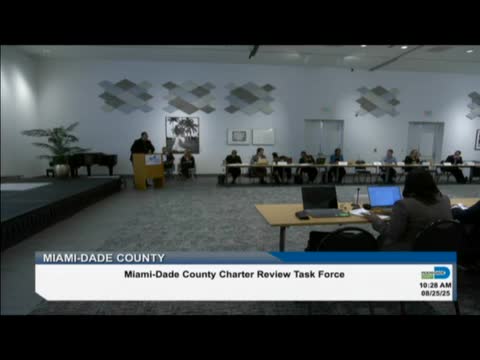
The Miami‑Dade County Charter Review Task Force on Aug. 5 considered staff research on how five large Florida charters treat constitutional officers and approved a series of targeted edits to local charter language in response to Amendment 10.
The Miami‑Dade County Charter Review Task Force on Aug. 5 took up a staff comparison of other large Florida home‑rule charters and debated several proposed edits to local charter language following the adoption of Amendment 10 to the Florida Constitution. The panel heard presentations from county staff and counsel, questioned legal risks and approved a series of narrowly tailored changes and follow‑ups while tabling at least one controversial drafting item for further review.
Ryan Lafarga, who identified himself as representing the Office of Management and Budget, told the task force the staff analysis focused on the five most populous home‑rule counties in Florida and how their charters treat the five constitutional offices. "We... examined each county charter for how it defines the roles, responsibilities, and structural integration of the 5 constitutional offices," Lafarga said during his slide presentation. He noted Orange County has the closest structural comparison to Miami‑Dade, in that it has a strong mayor and an appointed county administrator.
The nut of the session was how Amendment 10 alters what a county charter may require of or assign to county constitutional officers — the clerk, property appraiser, tax collector, supervisor of elections and sheriff — and which charter provisions therefore must be revised. Counsel and staff repeatedly cautioned the task force that many existing charter clauses predate Amendment 10 and that case law addressing those provisions is limited. As one attorney summarized, "We are in uncharted waters" on several questions about whether charters can continue to require audits or assign duties that state law or the constitution now reserves to elected constitutional officers.
On public‑safety language in the charter, Transportation and Public Works senior official Phil Edwards urged the task force to preserve the phrase "traffic control" because, he said, in practice traffic control refers to infrastructure — signs, signals and markings — rather than law enforcement. "Traffic control in this context refers to traffic infrastructure," Edwards said, adding that traffic enforcement remains the sheriff's responsibility. The task force adopted a motion to retain language authorizing the county to "provide traffic control," to strike a specific reference to "central crime investigation," and to limit the county role to municipal police standards (rather than general law‑enforcement functions). The change was approved by voice vote.
Task force members debated how to reflect long‑standing operational arrangements elsewhere in the charter. For example, participants discussed whether the clerk or the supervisor of elections should be named as the official to qualify county candidates; multiple attorneys warned that moving qualification away from the supervisor could expose future elections to legal challenge because state law assigns signature‑verification duties to the supervisor of elections. The task force voted to table a proposed change to Section 3.04 (candidate qualification language) and asked county counsel to return with recommended wording that would avoid creating litigation risk; the clerk's office and other counsel told the panel a safe option would be to "qualify in accordance with general law."
On tax and revenue language, the task force agreed to revise the charter to make explicit that the tax collector will collect county and municipal ad valorem taxes "in accordance with state law," while leaving other county tax collections to general law or specific ordinances. Members intended the change to avoid unintentionally assigning to the tax collector responsibility for non‑ad valorem taxes the county otherwise retains or may authorize by law.
Other actions approved at the meeting included language clarifying timing for special elections (the charter will say an election may be held "at the earliest possible time as the supervisor of elections confirms availability") and a requirement that newly incorporated municipalities contract with the Miami‑Dade County Sheriff’s Office for local police patrol services for a minimum of three years. The task force also asked the county attorney to draft a definitional subsection to clarify the charter term "county constitutional officers" so references to "county officers" and other phrases are consistent throughout the document.
A central policy fight at the meeting concerned whether constitutional officers should have a specific charter right to appear and request the placement of agenda items. The task force voted to strike one proposed sentence (section 9.B) that would have allowed constitutional officers to place items on the board agenda; the panel retained language guaranteeing a reasonable opportunity for constitutional officers to be heard. Supporters of a placement right argued the limited language sought only to ensure time‑sensitive, statutorily required matters could be presented to the commission; opponents said the county commission must retain control of its agenda to prevent gaming of the process. The motion to remove the proposed section carried.
The task force also set follow‑up work: county counsel will draft clarifications on definitions and the county administration will return with positions on whether to create or require a charter department (for example, a budget office) to carry functions no longer vested in the clerk after Amendment 10. Several items were deferred so counsel and staff could produce precise replacement text that avoids litigation risk.
The panel scheduled two further meetings to continue discussion of governmental structure, the technical changes packet and outstanding charter language. The next meetings were set for Sept. 5 and Sept. 17, each to start at 1 p.m. in the county commission chambers.
Ending: The task force wrapped a four‑hour session with a mix of targeted approvals, several follow‑ups for legal drafting and one tabling for further review. Members repeatedly emphasized avoiding new litigation risks while making the charter consistent with Amendment 10 and current state law. Several substantive items — including the precise qualification officer language and how to reconcile audit roles — will return to the committee with proposed draft language from county counsel and interested constitutional officers.