Get Full Government Meeting Transcripts, Videos, & Alerts Forever!
Get email alerts on the Final Plat And Recording topic
No spam. Unsubscribe anytime.
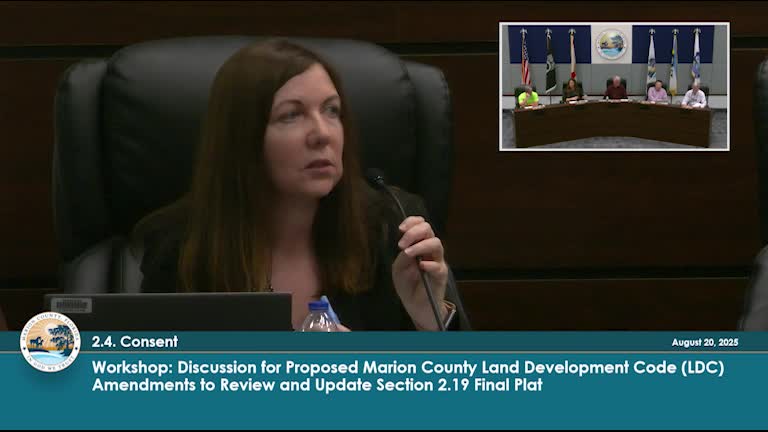
Marion County workshop examines final-plat rules, clerk recording and floodplain and ag-label concerns
Summary
The Marion County Land Development Regulation Commission held a workshop to review proposed Land Development Code revisions that would allow administrative final-plat approvals and to clarify recording and plat-content rules.
The Marion County Land Development Regulation Commission held a workshop on proposed Land Development Code revisions affecting final plats, administrative approval, and the county—lerk recording process. Presenters from county engineering described proposed changes and sought feedback on several technical provisions, including who handles final mylar scanning and recording, how old a title opinion may be when a plat is recorded, and whether certain changeable data (flood zones, setbacks, agricultural exemptions) should appear on an immutable recorded plat.
Steve King, county engineer, and Aaron Pool, land development manager, led the discussion and distributed follow-up materials they said were submitted by the clerk—or the record. Pool said a clerk—hange had prompted some of the edits: "That was a suggestion by the clerk's office. They returned it back to us. I can ask that specific question to them, but they were looking to follow a state statute, which is how they have that section structured." He also said the clerk's office no longer accepts certain paper mylar procedures that had previously been in the code.
Commissioners and private-sector participants raised multiple concerns. A recurring issue was the clerk—ile process: several speakers questioned why a large final plat (mylar) must be taken to an external printer to be scanned and returned to the clerk rather than scanned by the clerk or county staff. King and others said they would ask the clerk's office ("I'll ask Miss Vincent to clarify how they would do that") and report back. The practical concern cited by county staff was file quality and file-size limits at the clerk's recording process; one commenter said the clerk had re-recorded plats in the past because scanned files were not legible.
Commissioners debated age limits for documents submitted with a final plat. Several attendees supported keeping a 30-day limit for the title opinion to ensure recent encumbrance information at recording; others said boundary surveys can be older and that requiring frequent updates would produce routine waiver requests. One participant recommended differentiating the two documents in the code so the title opinion would be required within 30 days of recording while the boundary survey could be allowed to be older (speakers suggested one to two years as plausible thresholds).
Staff also discussed assurances and subdivision improvement agreements. County staff said state law requires certain assurances before final plat recording; however, some improvement agreements may still require Board of County Commissioners action. "I think the intent would be that nothing having to do with the final plat has to go before the board anymore," a staff speaker said, but they also acknowledged remaining "straggler items" that must be resolved before adoption.
Commissioners objected to placing changeable or operational information on a recorded final plat. Multiple speakers said depicting 100-year floodplains, stormwater details, evolving setbacks or zoning designations and other items that can change over time can mislead future users because a plat is a permanent record. One commissioner said plat notation for an adjacent property gricultural exemption is convenient because it spares every lot owner from filing a separate affidavit, but others warned that an exemption can lapse and later be inaccurate on a recorded plat.
Daniel Lehi, chief assistant county attorney, summarized the statutory affidavit requirement around agricultural property and adjacent permits: the statute requires, as a condition of issuing a local land-use permit or building permit for nonagricultural land adjacent to agricultural land, that the applicant sign a recordable written acknowledgement (the affidavit) stating they understand the neighboring agricultural uses; Lehi noted putting the information on the plat can reduce the need for many individual affidavits.
The workshop concluded without a vote. The commission asked staff to: (1) verify the clerk's scanning/recording constraints with Miss Vincent and report back; (2) clarify whether and how the code should separately treat title opinions and boundary surveys (including suggested time thresholds); (3) map the internal administrative process and outstanding items related to subdivision improvement agreements; and (4) identify which items on the proposed final-plat checklist could appropriately be removed because they are subject to change after recording. Staff said they would circulate marked comments to county staff and the commission ahead of the next workshop and the subsequent public hearing.