Get Full Government Meeting Transcripts, Videos, & Alerts Forever!
Get email alerts on the Cannabis Regulation topic
No spam. Unsubscribe anytime.
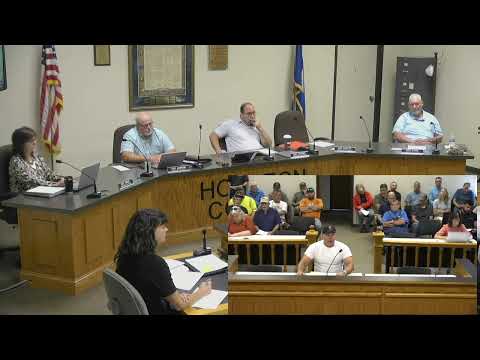
Board narrowly approves interim use permit for cannabis microbusiness in flood-prone Ag Protection District
Summary
After a split planning commission recommendation and extended discussion about floodplain, security and state licensing, the county board approved an interim use permit for a cannabis microbusiness with cultivation endorsement and attached conditions and review steps.
The Houston County Board of Commissioners approved an interim-use permit allowing a proposed cannabis microbusiness with a cultivation endorsement to operate in an Agriculture Protection District, despite a tied recommendation from the county planning commission and significant concerns about floodplain risks.
Applicants Seth Brown and Dorian Keenan appeared before the board to describe plans for greenhouse cultivation on a small parcel in Houston Township. County planning staff said the parcel is constrained, with a limited building envelope that lies partially in mapped floodplain; the Minnesota Department of Natural Resources had preliminarily classified the parcel as flood fringe, which may permit certain elevated or wet-floodproofed structures. The applicants said they were willing to adapt greenhouse construction and security measures and to work with county staff and state regulators.
Planning commission members had split 3–3 on a recommendation after debate; commissioners who opposed on the planning commission cited the parcel’s history of high water and expressed concern about future flooding risks and the potential need for substantial fill. The board heard from residents and planning-commission members who said the site has flooded in prior high-water events.
The board’s approval was made contingent on conditions and further reviews the members requested: an operational and environmental plan, installation of carbon filtration for greenhouses, an eight-foot perimeter security fence with angled barbed wire, scent-masking plantings, and a county review of the final building and floodplain elevation work as part of the building-permit process. Commissioners also asked staff to seek input from local soil-and-water officials and to require applicants to secure any necessary state permits; the board noted that the state Office of Cannabis Management (OCM) still must issue final licensing and may conduct its own site inspection.
Commissioners split in public remarks about balancing the county’s cannabis ordinance (which permits cultivation in agricultural districts) against site-specific flood risks. At the end of the roll call the motion passed by a 3–2 vote; commissioners who voted in favor cited ordinance compliance and the extensive conditions attached; those opposed cited flood history and potential downstream effects.
The permit applies to the particular applicants’ proposal and includes conditions that county staff will enforce through the building‑permit and zoning-compliance processes. If the applicants fail to meet conditions or the state declines final licensing, the conditional interim use permit could lapse.