Get Full Government Meeting Transcripts, Videos, & Alerts Forever!
Get email alerts on the Child Care Costs topic
No spam. Unsubscribe anytime.
Assembly hearing spotlights child-care costs, provider pay and gaps in access
Summary
A first hearing of the California State Assembly Select Committee on Child Care Costs gathered parents, providers, labor and policy experts who described high fees, low wages and a shortage of subsidized slots while state officials outlined ongoing reforms and a tentative union agreement.
SACRAMENTO — The California State Assembly Select Committee on Child Care Costs opened its first hearing with parents, family child‑care providers and policy experts testifying that child care in California remains unaffordable and unstable for families and workers despite recent state investments.
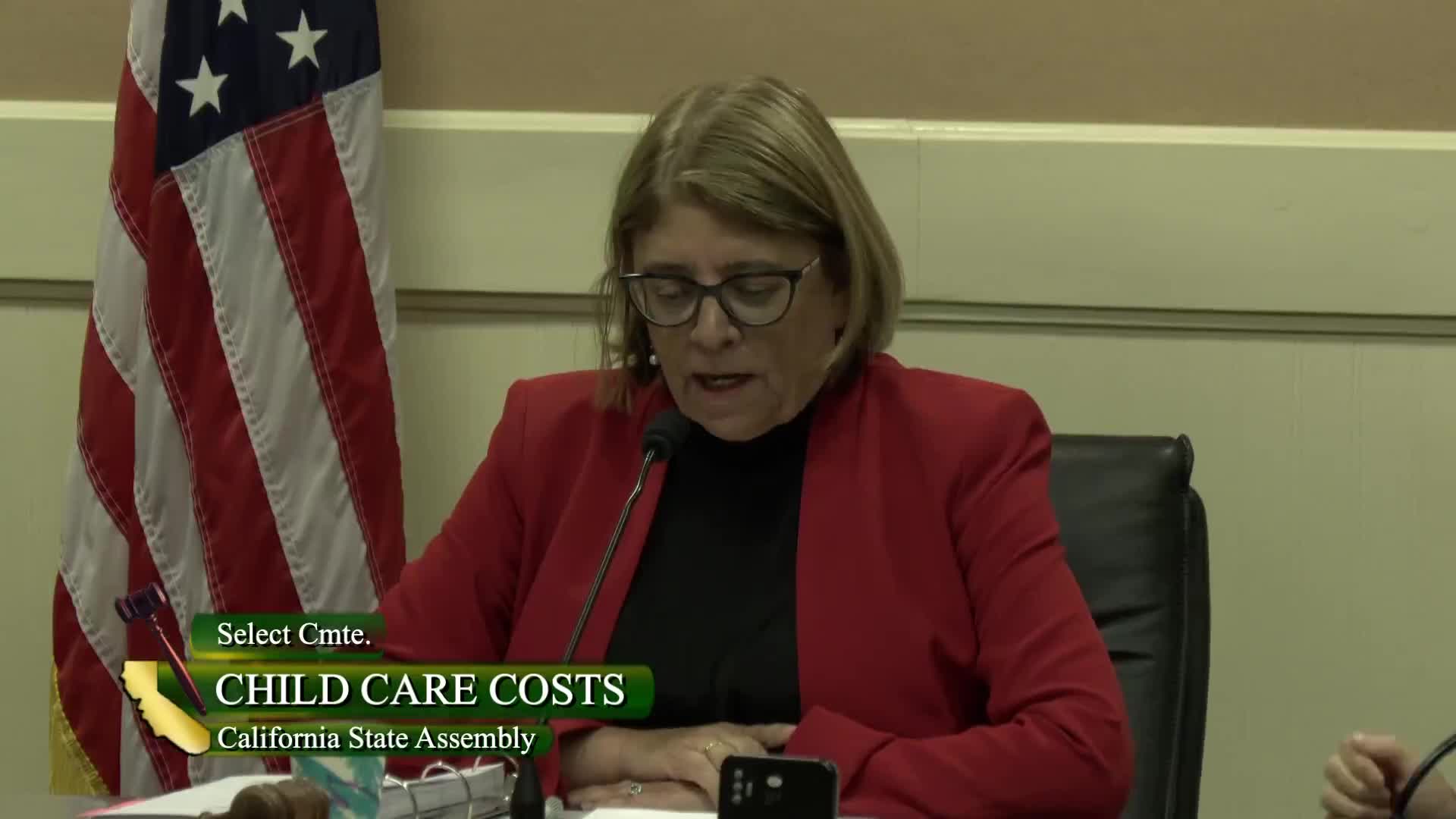
Chair Cecilia Aguiar Curry, Assemblymember and co‑chair of the select committee, told the panel that “child care is a critical support for working families and for our economy here in California,” and urged lawmakers to consider long‑term funding and policy changes.
The hearing brought repeated examples of how costs and pay interact. Parent voices leader Quinn Chung described leaving nursing and losing income because of the lack of dependable child care, saying, “I love being able to be there with my daughter, but it’s been really frustrating to not have child care.” Licensed family provider Anita Vicini gave a month‑by‑month tally of operating costs and revenue: “My check was $12,276.42 for 14 full time children in my care,” she said, then listed monthly expenses — housing, utilities, groceries, transportation and staff — that left her little margin and will shrink further when school‑age children shift to after‑school schedules.
Why it matters: California spends billions on early care and has expanded subsidies in recent years, but advocates and researchers told legislators that funding remains insufficient, reimbursement rates lag the “true cost of care,” and provider wages are among the lowest in the state’s workforce. Laura Pryor, research director at the California Budget & Policy Center, said subsidy supply falls far short of need: only about 11 percent of eligible children were enrolled in 2022 and 14 percent in 2023 — “only 1 in 7 children eligible for subsidized child care actually receive it,” she said — leaving thousands of families on waiting lists.
State officials and the union: Jennifer Troia, director of the California Department of Social Services, detailed recent budgetary increases and administrative steps. “In the last 5 years, together, we have nearly doubled the total funding for childcare and development programs, from $3,300,000,000 in 2019‑20 to $6,400,000,000 total funds in 2024‑25,” Troia said, and described efforts to unify reimbursement structures and consolidate CalWORKs stages. Troia also noted the state and Child Care Providers United (CCPU) reached a tentative three‑year agreement on Aug. 8 that includes steps toward an alternative methodology for setting rates, a single rate structure, health care and retirement commitments, a cost‑of‑living adjustment and a one‑time stabilization payment pending ratification.
Union and provider priorities: Alexa Frankenberg, executive director of Child Care Providers United, urged faster adoption of a rate system tied to providers’ cost of care and said the current workforce “earns currently as little as $7 per hour” in some settings. Frankenberg outlined priorities for rate reform: pay that covers all hours worked (including prep and clean up), meaningful paid time off, disaster response supports, and enhanced payments for hard‑to‑serve hours and transportation. Family child‑care providers and center directors testified that current subsidy rates cover a fraction of actual costs for infant care and that turnover is high because of low pay; one center director said losing preschool slots to transitional kindergarten (TK) that is free for families destabilized center budgets and reduced cross‑subsidies for expensive infant care.
Economic and equity consequences: Research witnesses framed child care as an economic issue. Sarah Bohn of the Public Policy Institute of California said expanding access would raise workforce participation among mothers and reduce poverty: “Poverty among families with preschoolers would be 24% lower if they had access to subsidized care,” she said. Pryor emphasized racial disparities: Latinx, Native and Black children are disproportionately eligible for subsidized care, so underinvestment widens inequities. Parent and provider speakers added that the child‑care workforce is overwhelmingly women of color and that low pay reflects “racist and sexist stereotypes” that devalue caregiving.
Policy choices and questions: Officials described a two‑part policy path now under discussion: measure the true cost of providing care using an alternative methodology and then decide how quickly to phase reimbursement up to that cost. Troia and other witnesses stressed that cost measures vary regionally and by age group; the alternative methodology will include regional salary benchmarks and other variables, but lawmakers must still choose salary targets and phase‑in options. Panelists also discussed middle‑income families who do not qualify for subsidies but cannot afford market rates, and public‑private partnership pilots in other states (tri‑share and employer‑match models) as possible complements to state action.
Rural and local impacts: Several lawmakers and witnesses urged additional attention to rural counties and Central Valley communities, where access is limited and centers and family providers face distinct challenges. Providers from San Diego, Tuolumne County and the Central Valley described long wait lists, heavy reliance on home‑cooked meals and locally paid staff, and the distinct financial fragility of small facilities.
Committee next steps: Committee members asked for timelines and firm deliverables around the alternative methodology and the joint labor‑management workgroup. CCPU said the labor‑management committee will recommend a rate structure and amounts (including enhanced rates) with final recommendations by Nov. 30 to inform 2026 budgeting and investments. Lawmakers emphasized the need to examine the unintended consequences of policy changes such as universal TK and consider parity or parallel funding to protect community providers.
What the hearing did not decide: The hearing was strictly informational; no motions or votes were taken. Panelists and legislators agreed on the need for further research, concrete timelines for the cost‑of‑care work, and multiyear funding commitments to stabilize the workforce and expand subsidized slots.
The hearing closed after more than two hours of testimony from parents, providers, researchers and state staff. Committee co‑chairs said they will continue hearings and working sessions — including plans for a Central Valley session — to refine policy options before budget season.