Get Full Government Meeting Transcripts, Videos, & Alerts Forever!
Get email alerts on the Trade And Investment topic
No spam. Unsubscribe anytime.
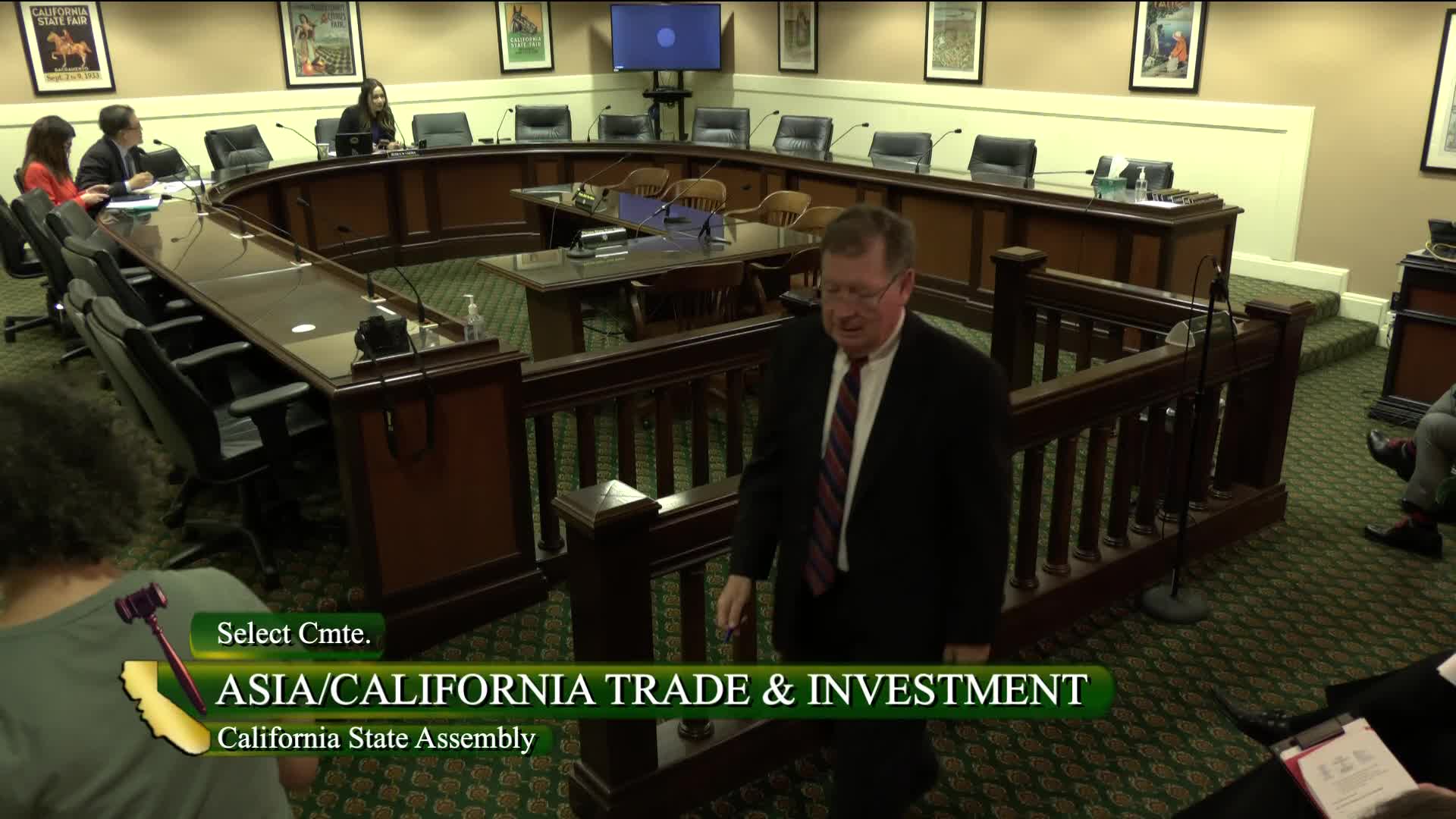
Assembly select committee hears how federal tariffs and shifting trade patterns are hitting California businesses
Summary
Lawmakers and industry leaders told the California State Assembly’s new Select Committee on Asia, California Trade and Investment that recent federal tariffs and trade-policy uncertainty are raising costs, slowing investment and reducing tourism, and urged state-level steps to strengthen trade ties with Asia and support small businesses.
Assemblymember Jessica Colosa convened the first hearing of the California State Assembly Select Committee on Asia, California Trade and Investment to examine the state’s economic ties with Asia and the effects of recent federal tariffs. The committee heard testimony from the lieutenant governor, consular officials, chamber leaders, economic researchers and small-business representatives about how tariffs and policy uncertainty are affecting ports, manufacturers, tourism and education programs across California.
“What is in our control? What are the bridges that we can build, to really advance California and to lead?” Colosa asked at the opening of the hearing, framing the meeting’s focus on state-level responses rather than federal policymaking.
California lieutenant governor Eleni Kounalakis told the committee that the state’s economic links with Asia are large and growing and that federal trade actions are imposing measurable costs. Quoting an Axios analysis, she said, “California consumers and businesses have paid $11,300,000,000 in tariff related costs or tariff taxes just in the first 6 months of this year.” Kounalakis described longstanding trade ties and recent state-level engagement—trade missions, subnational agreements and APEC hosting—that she said position California to sustain and expand Asia relationships.
Industry witnesses described practical effects on the ground. Steven Chung of the Los Angeles County Economic Development Corporation and World Trade Center Los Angeles warned that ports and logistics are sensitive to tariff-driven shipping changes and gave examples of manufacturing projects delayed because essential equipment or component machinery would face high import levies. Rodney Fong, president of the San Francisco Chamber of Commerce, and Carolyn Beteta, president of VISIT California, said tourism and business travel are down and that uncertainty about customs, visas and costs is discouraging visitors and international students who contribute to local economies.
“Tariffs are taxes on imports and they are paid by the importer of record,” said Kyle Handley, director of the Center for Commerce and Diplomacy at the University of California, San Diego. Handley and other economists told the committee that higher import costs and policy uncertainty depress investment decisions, slow hiring and can re-route freight away from California ports.
Panelists and lawmakers discussed specific impacts and opportunities: ports and freight-dependent sectors (longshore, trucking, warehouses) face volume and scheduling changes; manufacturing that relies on imported machines and parts can be delayed or canceled; tourism and higher‑education enrollment of international students have fallen, reducing service exports; and small and minority‑owned businesses lack the technical assistance and capital to shift supply chains quickly.
Speakers recommended state-level responses that do not require federal authority. Proposals included coordinated, mission-driven trade outreach by California agencies and regional partners; expanded export and investment assistance for small and medium enterprises; targeted investments to speed port throughput and reduce permitting delays for business expansions; and stronger state support for trade- and tourism-promotion to sustain airline lift and inbound visitation. Several witnesses urged renewing and scaling programs that help small firms access foreign markets and capital, including expansion of Small Business Development Center services.
Representatives of consular and business organizations from Japan and other Asian partners highlighted decades-long private and public ties and encouraged more state delegations and sister‑city activity. Glenn Fukushima, a senior fellow at the Center for American Progress, urged subnational engagement with Asia and warned that unilateral, long‑term federal trade actions can open space for other actors to step into regional economic leadership.
Small-business leaders and the SBDC regional director told the committee that practical needs on the ground include easier access to trade missions, grants or matching funds for export readiness, and technical help to navigate customs and supply-chain changes. “Small and minority owned businesses are often left behind,” said Alvin Lai of the Asian Business Association, urging compressed events and conventions that bring concentrated visitor spending to local merchants.
Colosa closed the hearing by saying the committee would continue the work: members asked staff to gather more stakeholder input and announced a second hearing scheduled for Los Angeles the following month. The committee did not take any formal votes at the session.
The hearing assembled state and regional officials, business representatives, economists and trade diplomats to document near‑term harms and to explore state actions that could strengthen California’s role in Asia trade even amid federal policy shifts.