Get Full Government Meeting Transcripts, Videos, & Alerts Forever!
Get email alerts on the Alcohol Policy topic
No spam. Unsubscribe anytime.
Collierville board advances overhaul of beer and liquor rules
Summary
The Collierville Board of Mayor and Aldermen approved on second reading two ordinances that rewrite chapter 1-16 of the town code to modernize beer and intoxicating liquor permitting, add a temporary-event permit, remove distance restrictions, tie liquor‑store caps to population, and allow provisional permits.
The Collierville Board of Mayor and Aldermen on second reading approved two related ordinances to modernize the town’s beer and intoxicating liquor code, a multi-year staff effort intended to simplify permitting, clarify enforcement, and better align local rules with current business models.
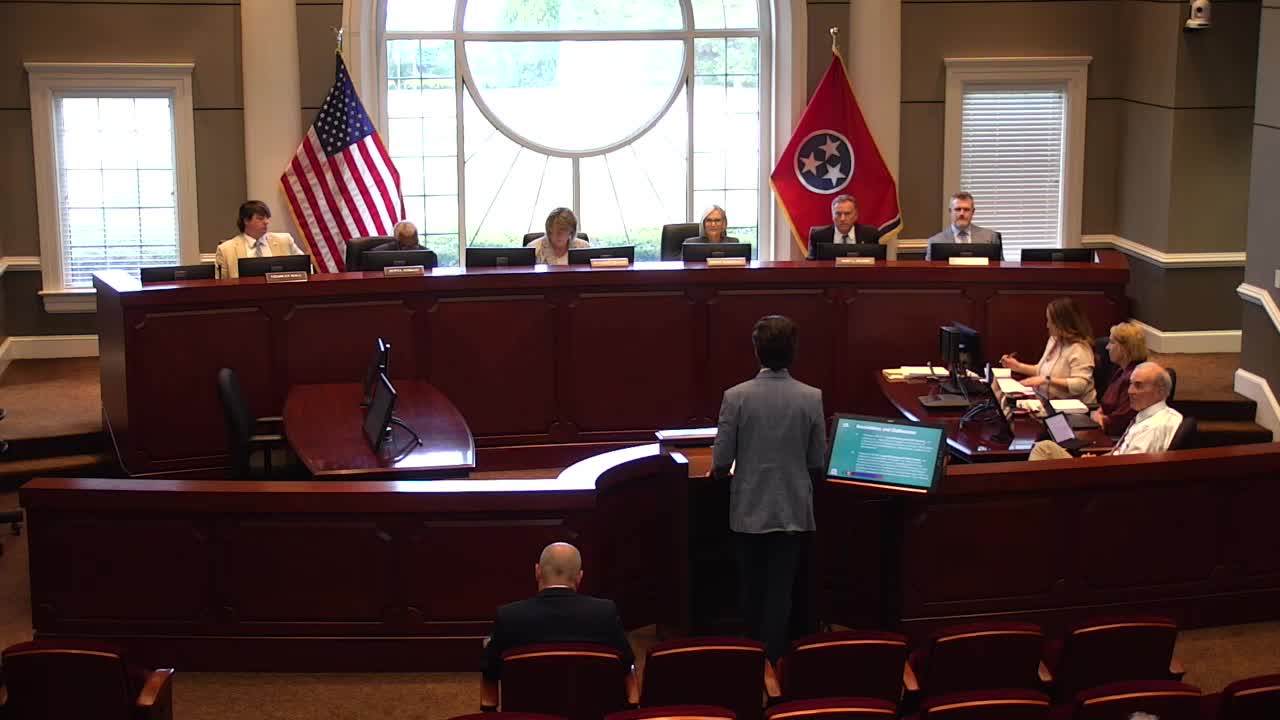
Assistant Town Administrator Adam Hamrick told the board the update — ordinance 2025‑O9 (beer/intoxicating liquor code) and a companion zoning amendment 2025‑O8 — results from work that began after the board’s annual retreat and included two work sessions earlier this year. “The original beer ordinance was adopted in 1983, and it absolutely served its purpose at the time,” Hamrick said during his presentation, noting the ordinance had been amended piecemeal 21 times since and needed comprehensive revision.
The changes staff highlighted include: restructuring permit categories around how beer is consumed (on‑site, off‑site, event), creating a new short‑term/event permit (up to 30 days, up to four permits per applicant per year), eliminating fixed distance restrictions from sensitive uses (such as churches and schools) in favor of existing zoning/site review tools, linking the number of liquor store permits to population (one per 10,000 residents, using the most recent U.S. Census), allowing provisional permits to be issued administratively by the town clerk pending formal beer board approval, removing a U.S. citizenship/residency waiting period for applicants, and cleaning up obsolete rules (telephone‑line requirements, bans on pool tables/dancing, mandatory food sales, brown‑bagging prohibitions). The ordinance also updates the town’s liquor privilege tax to reference state classifications rather than fixed dollar amounts.
Two businessmen who spoke during the public hearing supported the changes as beneficial to local commerce. Mark McMinn, who said he operates a business on the Town Square, told the board that allowing beer service would help attract customers to downtown restaurants. “Anything that we can do to try to enhance or bring people to that to our area is better for us,” McMinn said. Adam Clay, owner of Pickleball 901, argued the change would let new local businesses offer amenities that keep customers in Collierville instead of elsewhere: “Beer and pickleball go together the same way beer and golf do,” Clay said, citing examples from other markets.
Hamrick and town staff said the rework intends to reduce uncertainty for applicants (particularly nonprofits and event organizers), speed up business openings through provisional permits, and remove regulatory language that is duplicated by state law or other town codes. Jamie Gross, the town planner, noted the companion zoning amendment aligns the zoning code with the updated permit categories so land‑use and alcohol permitting operate together.
Both ordinances passed on second reading with affirmative roll‑call votes from all members present. Staff told the board any final adoption would occur at third reading, currently scheduled for Aug. 25; if adopted, some provisions would take effect on that date. Town staff will update permit forms and train employees to implement the new rules.
The board’s action on second reading does not itself change existing permits; it advances the ordinances toward final adoption and sends the updated language back to staff for administrative steps needed before the law becomes effective.