Get Full Government Meeting Transcripts, Videos, & Alerts Forever!
Get email alerts on the Groundwater Monitoring topic
No spam. Unsubscribe anytime.
Monterey County board approves year‑one rollout of groundwater monitoring program with subsidy for small well users
Summary
The Monterey County Board of Supervisors approved a Water Resources Agency consent item to begin rolling out a state-required groundwater monitoring program, adding a one‑year subsidy to reduce costs for de minimis (very small) well users while staff pursue longer‑term funding or legislative fixes.
The Monterey County Board of Supervisors on Aug. 5 approved a Water Resources Agency consent item to begin rolling out a groundwater monitoring and fee program required under state law, with a board condition that de minimis well users be relieved of initial costs through one‑year subsidies while staff seek alternative funding or a legislative fix.
The vote cleared the consent item after supervisors asked staff to return with options to prevent small well owners from bearing the program's ongoing costs. Supervisor Church moved the motion to approve the consent item with clarifying direction to staff; the board carried the motion (motion carries). The board also directed the Water Resources Agency to bring the fee back to the board annually for review.
The item implements a state mandate referenced repeatedly during debate and aims to expand monitoring of groundwater levels across basins in Monterey County. Supporters said monitoring is essential to comply with state requirements and to provide the data needed for future management actions. Critics argued the cost structure, as written, places a disproportionate burden on de minimis well users — people who use small amounts of groundwater for domestic or livestock purposes — and urged subsidies or other funding sources to prevent undue hardship.
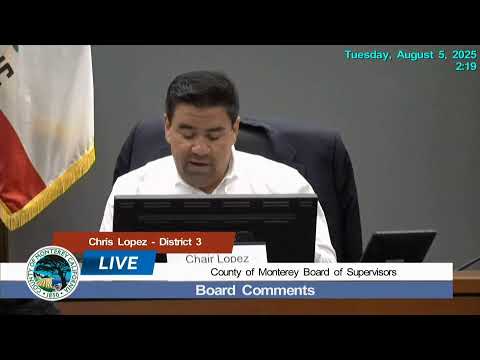
Supervisor Church said she would support the rollout only if the county used available GSA (Groundwater Sustainability Agency) funding and other options to subsidize de minimis users for year one, then select a solution for future years during the upcoming twelve months. Supervisor Lopez said staff should be given a runway to start public outreach and to return with options, and acknowledged that the letters and notification to well owners would likely generate more public inquiries and requests for meetings.
During public comment before closed session, resident Bill Lipe asked the board to keep water policy discussions in view of public trust and transparency; Michelle Clary urged broader public disclosure on how new water fees and taxes are being spent.
The board's approval includes the following directions and conditions: staff will pursue identified alternatives to avoid charging de minimis users after the first year, including legislative amendments if possible; the Water Resources Agency will return annually to the board to review fees; and staff will implement outreach to help residents understand the program and the county's role in administering it. The board did not adopt any immediate long‑term funding source; instead it approved the rollout with a one‑year subsidy/offset and a directive to return with options.
What the action does not do: the board did not adopt a permanent exclusion for de minimis users today; it asked staff to pursue changes and to return with options. The program's monitoring obligations will proceed as directed by state requirements.
Public reaction at the meeting included concerns about fairness, questions about how shared wells would be metered or billed, and requests that large agricultural users and new developments be the primary focus of conservation and monitoring. The board members acknowledged those concerns and asked staff to prioritize clear public communications as notices are mailed to well owners.
Next steps: staff from the Water Resources Agency will prepare and bring back funding options and legislative pathways for board consideration, and will return annually to review the fee schedule and implementation results.