Get Full Government Meeting Transcripts, Videos, & Alerts Forever!
Get email alerts on the County Assistance District topic
No spam. Unsubscribe anytime.
Waller County holds workshop on proposed county assistance district sales tax for unincorporated areas
Summary
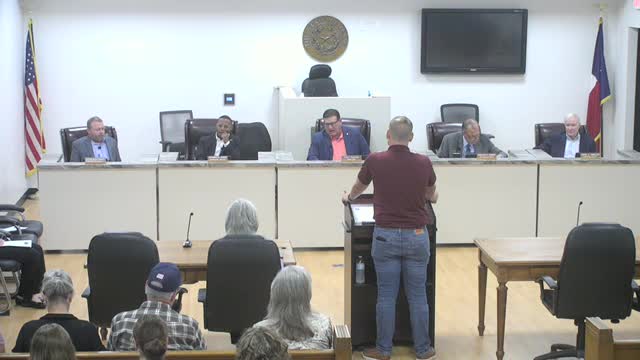
Waller County held an informational workshop before its commissioners court meeting to explain a proposed county assistance district (CAD) measure that commissioners plan to ask voters to approve in November. The measure would establish a CAD in the county's unincorporated areas and permit a local sales tax within that district; no final vote on placing the measure on the ballot was taken at the workshop.
Waller County held an informational workshop before its commissioners court meeting to explain a proposed county assistance district (CAD) measure that commissioners plan to ask voters to approve in November. The measure would establish a CAD in the county's unincorporated areas and permit a local sales tax within that district, county leaders said; no final vote on placing the measure on the ballot was taken at the workshop.
County Judge said the workshop was the county's opportunity to provide factual information about the proposal because “once the county votes to put that on the ballot, we cannot advocate for or against the measure. We can only provide information to people.” The judge and staff urged public questions and discussion at the session held before the court's regular meeting.
The presentation, led by Robert (presenter), summarized how CADs operate and what the sales tax could pay for. Robert said, “County assistance district, they are local governmental entities. They collect a sales tax.” He told the group that CADs are created by a county commissioners court and that revenues are levied only inside the district's boundaries. He added that the enabling rules are set out in Local Government Code Chapter 387 and that CADs may fund many county activities, including road and highway maintenance and improvements, law enforcement and related personnel costs, museum and park maintenance and public-health services.
Why it matters: County leaders framed the proposal as a revenue tool to help the county respond to rapid population growth and the immediate demand for roads, law enforcement and other services in newly developed unincorporated neighborhoods. County staff and commissioners said sales-tax revenue arrives monthly through the Comptroller's office and could be used for both short-term repairs and longer-term capital projects.
Key technical points and timeline
- Rate and geography: Officials explained the CAD would capture a local sales tax penny (1 percentage point) in unincorporated areas only; residents inside municipalities would not vote on or pay the tax via the CAD.
- Start date: Robert said that if the county holds a November election and notifies the Comptroller in December, collections would begin April 1 following the election.
- Use tax and direct-payment permits: Staff described the state sales-and-use tax system and a direct-payment permit that builders can file so sales taxes on construction materials are remitted to the point of use. Robert said builders “fill out a form” and that the county's tax assessor-collector would handle remitting those payments if the CAD is approved.
What the money could fund and local context
County leaders emphasized flexibility: Robert listed road and bridge work, law enforcement (including salaries), fire and emergency services, parks and economic-development activities. He told the workshop, “we were able to do everything that that that you would need. So salaries, benefits, vehicles, and, and equipment. Okay. That can all be funded through County Assistance District.”
Officials used recent local figures to illustrate potential revenue and need. The county's emergency services district (ESD 200) already collects a penny in parts of the county; Robert noted the ESD's 2024 penny produced a bit more than $7,000,000 for the district, which had a total 2024 budget near $20,000,000. The judge and other speakers said that rapid housing growth creates immediate service needs — deputies, inspectors, road maintenance — and that property tax revenues lag new development.
Speakers repeatedly contrasted the CAD option with other local taxing authorities. One commissioner pointed out that if an ESD or a municipal management district (MMD) captures a penny, that revenue can be restricted to their purposes (for example, emergency services or the MMD's projects) and not be available for broader county needs such as roads or workforce training.
Public-comment and commissioner discussion
Commissioners and several attendees asked technical questions about debt, exemptions and commercial construction. When asked whether a CAD may issue debt, Robert said he believed CADs could not themselves incur debt but that CAD revenues could be used to offset bond payments; he said he would double-check the point. The workshop also covered how development agreements could require builders to file direct-payment permits so use taxes on construction materials are remitted to Waller County rather than where the retail purchase was made.
Several commissioners and residents emphasized workforce training as a priority use if the CAD passes. Commissioner Vince asked that development of a community technical training center be prioritized; he said preliminary legal review suggested the county could build and maintain such a facility and use CAD revenue to reduce overhead for a training provider. Vince said the plan under discussion would not use CAD money for scholarships but could lower operating costs to make training more affordable.
Concerns about other districts and ETJs
John (commissioner) warned that special districts and municipal extraterritorial jurisdictions could capture the penny if the county does not take action. He described a hypothetical where a developer seeking a theme park would use an MMD or a MUD plus a special agreement with the City of Houston to redirect sales-tax revenue away from Waller County. John said that scenario, and similar cases in other counties, provided a rationale for establishing a countywide CAD in unincorporated areas.
Outreach and next steps
County staff said they plan public education but emphasized legal limits: the court can inform voters about the measure and the law but cannot advocate once it formally places the item on the ballot. Jamie (staff) and the judge said staff would present an outreach plan to the commissioners at an upcoming meeting; Jamie said the county would consider town halls and online materials.
Formal actions at the workshop
The court approved the workshop agenda and later approved adjournment by motion and second; neither vote produced a detailed tally in the workshop record. The workshop did not include a final vote to place a CAD measure on the ballot. Commissioners said that vote is scheduled for the regular commissioners court meeting that follows the workshop.
Ending
Speakers closed the meeting by urging clear public information if the county proceeds. As one commissioner put it during the workshop, “For Waller County. Let's let our money stay in Waller County.” The county's commissioners indicated they will return to the CAD question at their next formal court meeting, where they said they will consider a motion to place the measure on the November ballot and present an outreach plan beforehand.