Collin County administrators present long-term capital plan for courthouse campus and jail expansion
Loading...
Summary
County administrators presented a long‑range campus capital plan at the Aug. 5 Commissioners Court budget workshop that includes office fit‑outs in an ARPA‑funded healthcare building, a $30 million public works facility, a proposed $190 million jail expansion and other records, elections and central plant projects.
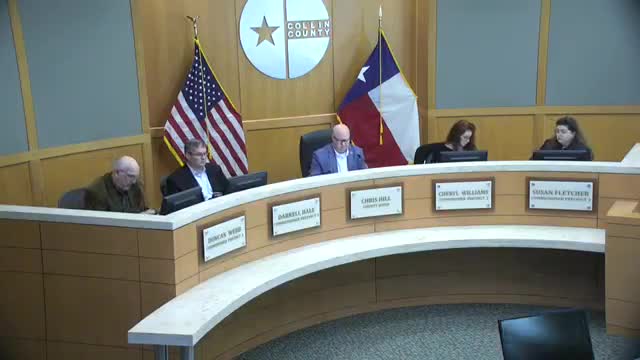
County Administrator Yoon Kim and Deputy County Administrator Russell Schoffner presented a high-level capital plan to the Commissioners Court that lays out needs and potential funding sources for multiple campus projects including offices, records storage and a proposed jail expansion. The planning documents presented Aug. 5 propose a mix of ARPA funds, general obligation bonds and special funds to address space shortages driven by county growth.
Kim said departments report they are running out of space and that the county will need to finish shell space in the Healthcare Building (an ARPA-funded vaccine hub/parking structure) to accommodate health‑records storage and, later, offices for IT, purchasing and the auditor. The presentation outlined a staged approach: finish third‑floor records storage now (circa 26,000 sq ft), finish an IT fit-out later in the warranty period, and then convert other vacated space in the main administrative building for engineering, development services and the fire marshal.
Major greenfield and bond projects in the presentation include an approximately $30 million new Public Works facility closer to the northeast part of the county (potentially to replace the aging Wilmeth site and paid from the Road & Bridge fund), a new county office building for the tax assessor and community supervision (approx. $30 million, GO bonds), a 50,000‑square‑foot Elections building (approx. $30 million, GO bonds), a 25,000‑square‑foot county records and storage facility (approx. $20 million) and a central plant renovation and two‑story addition estimated at $6 million. Kim said financing options include general obligation bonds and ARPA interest; several projects were timed for 2028–2031 construction depending on warranty and sequencing constraints.
The presentation also proposed a major jail expansion: finishing two “clusters” with 180 beds each and a medical/mental‑health wing expansion (135 beds) to respond to rising average daily population. Kim estimated that cluster expansion at roughly $190 million and suggested part of it could be financed with GO bonds and existing bond capacity. Commissioners noted concern about timing; Judge Hill and several commissioners discussed whether a bond election could be set for November and how soon construction could start if a bond were approved. Kim said staff were preparing an agenda item to consider a GO bond issuance for a November ballot, with legal timelines that would require action in mid‑August to meet the November ballot schedule.
Commissioners pressed for clarity on ongoing operational costs — maintenance, staffing and debt service — that will accompany new buildings. Several members stressed that bond funding covers construction but not long‑term operations, and the court discussed how future tax rate constraints (including a potential 2.5% cap on revenue increases) would affect the county’s ability to staff and operate new facilities.
Ending: Commissioners asked staff to return with firmer cost breakdowns, maintenance and operating estimates, and potential bond timing so the court can weigh construction priorities against operating budget constraints as it finalizes the FY‑2026 budget schedule.