Get Full Government Meeting Transcripts, Videos, & Alerts Forever!
Get email alerts on the Government Operations Rule Review topic
No spam. Unsubscribe anytime.
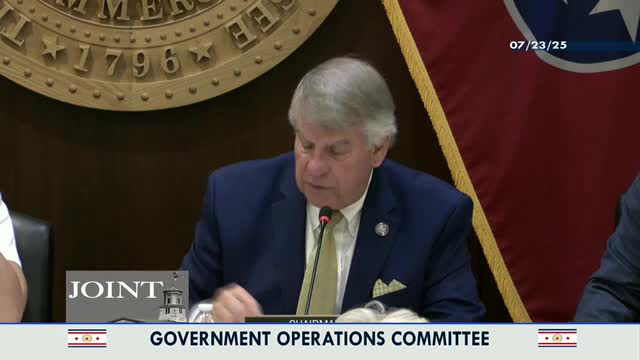
Joint Government Operations Committee advances broad package of agency rule updates; housing choice voucher change draws questions
Summary
The Joint Government Operations Committee met July 23, 2025, and gave positive recommendations or advanced a series of agency rule changes affecting utilities oversight, housing choice vouchers, public records, professional licensing, health facility abuse reporting and K–12 charter school rules.
The Joint Government Operations Committee met July 23, 2025, and gave positive recommendations or advanced a series of agency rule changes affecting utilities oversight, housing choice vouchers, public records, professional licensing, health facility abuse reporting and K–12 charter school rules. Lawmakers asked detailed questions on a proposed Tennessee Housing Development Agency (THDA) change to allow project-based vouchers and on enrollment and funding details for newly authorized "opportunity" public charter schools.
Committee members advanced the majority of rules with positive recommendations; a few items recorded split recommendations between the House and Senate. The package moved rules intended to modernize agency procedures, align rule language with statute or federal guidance, and repeal outdated regulatory language.
The meeting opened with the Tennessee Board of Utility Regulation (TBOR) presenting rules that repeal and replace the regulations formerly governing two predecessor boards consolidated by a 2023 law. Edwin Carter, legislative senior auditor with the comptroller’s office and a TBOR appointee, explained the rules govern board operations. Lawmakers asked about board composition and subject-matter specialties; Rachel Buckley, general counsel, said appointments typically include representatives from municipal utilities, utility districts and members with finance backgrounds. The committee voted to recommend the rules positively in both chambers.
THDA officials summarized proposed changes to the agency’s Housing Choice Voucher (HCV) administrative plan to add a project-based voucher (PBV) chapter. Jeremy Hyde, THDA director of government affairs, and Pascual McLeod, assistant director for Section 8, told the committee that HUD permits a public housing agency to project-base up to 20% of its HCV allocation and that THDA intends to start with an initial 5% allocation and seek authority to increase toward the 20% cap. McLeod said THDA serves more than 6,200 families in 72 counties and that about 600 voucher holders statewide are currently unable to find landlords willing to accept vouchers. Committee members pressed for detail on the percentage, effects on housing density, whether vouchers would be used for new construction or condo units, vacancy payment policies, Davis-Bacon wage implications for construction costs, and whether federal funding could be clawed back. THDA stated PBV rental payments continue to go directly to landlords, that voucher subsidy amounts are set by HUD, that vacancy claim payments were not adopted in the administrative plan (landlords are responsible for their own waiting lists), and that administrative fee reserves can hold unused HUD administrative funds. Lawmakers requested follow-up materials on several operational and contingency items. The committee approved the rule package with a positive recommendation.
Other agency items moved with little or no public comment. The Department of Children’s Services updated its public-records rules to align with the Office of Open Records Counsel’s model policy and to codify electronic-copy procedures and standardized fee schedules; the department confirmed it will certify authenticity of records it provides and said fee waivers for low-cost requests (under $50) remain at the agency’s discretion, with fee-waiver requests considered for larger amounts. The State Board of Real Estate Appraisers proposed changes after a 2023 federal audit, including easing some trainee inspection restrictions and eliminating certain rarely used fees; the commission said no public comments were received and the committee recommended the rule changes.
Regulatory housekeeping and retrospective reviews were common themes. The Tennessee Emergency Communications Board removed obsolete references to a one-time local 911 funding increase that concluded in 2016 and updated a definition of "special distribution"; the board reported no public comments and the committee recommended its rule changes. The Tennessee Fish and Wildlife Agency clarified terminology relating to tier 3 hunt locations (quota-permit areas) and reported no public comments; the committee recommended that update. The Tennessee Board of Optometry updated advertising rules, added definitions separating vision-measurement encounters from ocular-health encounters, and added a 30-day address/name-change reporting requirement for licensees; the board said the changes were unanimously adopted and the committee recommended them.
The Health Facilities Commission amended abuse-registry language to match federal definitions and to add "willful" as an element for placement, and to make explicit that technology-based exploitation (for example, live-streaming or misuse of images) can be basis for placement on the registry. Nathaniel Flinchbaugh, deputy general counsel for the Health Facilities Commission, said the changes reflect what the agency had been doing in practice and make definitions and processes clearer. Committee members asked how civil judgments intersect with registry placement; Flinchbaugh said civil judgments themselves are not automatic bases for placement but can prompt agency complaints and investigations; criminal convictions or substantiated investigations can lead to placement. The committee recommended the changes.
The State Board of Education and the Tennessee Public Charter School Commission presented several charter-related rule changes tied to 2024 legislation authorizing "opportunity" public charter schools. State Board staff described new rules that define opportunity public charter schools (serving grades 6–12 with at least 75% of enrolled students meeting the statute’s "at risk" criteria) and that set enrollment-preference order and funding-treatment rules for students who transfer across LEAs. The rules also removed outdated BEP references and clarified verification and residential-model requirements. Committee members pressed the State Board and the Department of Education about how TISA funding follows students midyear, how interim allocations and true-ups are calculated and transmitted, and whether residential charter schools would receive additional funding beyond per-student TISA allocations. Department of Education staff explained that the Office of Local Finance calculates interim and adjusted allocations several times a year and provides adjustments to authorizers to reflect enrollment changes. The committee recorded mixed chamber recommendations for some charter-related rules (in at least one case, the Senate took "no recommendation" while the House issued a positive recommendation) and in other charter-rule votes the committee paused or took mixed action for further follow-up.
Votes at a glance
- Tennessee Board of Utility Regulation (TBOR) rules — positive recommendation (House and Senate). Provenance: presentation began with Edwin Carter (transcript s=195.87); vote recorded s=468.565. - Tennessee Housing Development Agency (THDA) HCV/PBV administrative-plan rule — positive recommendation (House and Senate). Provenance: presentation began with Jeremy Hyde (s=492.12) and Pascual McLeod (s=519.85); vote recorded s=1517.505–1535.4199. - Tennessee Fish and Wildlife Commission wording update — positive recommendation (House and Senate). Provenance: Blair Beatty presentation began s=1559.65; vote recorded s=1661.885. - Department of Children’s Services public-records rule update — positive recommendation (House and Senate). Provenance: Jim Layman presentation began s=1679.22; vote recorded s=2058.0051. - Tennessee Real Estate Appraiser Commission rule changes — positive recommendation (House and Senate). Provenance: Reed Wisher/Glenn Kopchak presentation began s=2083.545; vote recorded s=2383.465. - Tennessee Emergency Communications Board rule cleanup — positive recommendation (House and Senate). Provenance: Benjamin Glover presentation began s=2417.3552; vote recorded s=2496.045. - Board of Optometry rule amendments — positive recommendation (House and Senate). Provenance: Lydia Johnson presentation began s=2530.625; vote recorded s=2784.085. - Board of Communication Disorders and Sciences (hearing instruments rule repeal) — positive recommendation (House and Senate). Provenance: Olivia Johnson/Michael Barnell presentation began s=2818.5898; vote recorded s=2912.455. - Health Facilities Commission abuse-registry update — positive recommendation (House and Senate). Provenance: Katie Thomas presentation began s=2949.7249; vote recorded s=3379.005. - Tennessee Public Charter School Commission rule correction (reconciliation period language removed from renewal appeals) — Senate: no recommendation; House: positive recommendation. Provenance: Hayden Pendergrass presentation began s=3398.62; Senate roll-call and House voice recorded s=3616.1301–3636.84. - State Board of Education: Opportunity public charter-school rules — in some cases the committee paused or recorded mixed recommendations; House issued positive recommendations on some items while Senate recorded no recommendation on other items. Provenance: Nathan James/Rachel Soupey presentation began s=3668.3; procedural action recorded s=4974.78–4996.975. - State Board of Education school-safety rule repeal (removes duplicative rule; safety requirements remain in statute) — House: positive recommendation; Senate: no recommendation. Provenance: Nathan James presentation began s=5035.41; vote recorded s=5445.8296–5447.51.
What lawmakers asked for next
Lawmakers requested follow-up materials and clarifications on several items before implementation: detailed operational and contingency information from THDA about PBV percentages, vacancy payment policy, Davis-Bacon impacts, and federal funding contingencies; documentation from DCS and the Office of Open Records Counsel on fee-waiver guidance and indigency considerations; specifics from the Department of Education and Office of Local Finance about timelines and mechanisms that ensure midyear funding adjustments reach authorizers and LEAs in time to educate transferred students; and additional detail about residential-model funding and safeguards for students affected by prior Achievement School District placements.
Why this matters
The rule changes move procedural and operational policies closer to current practice, federal requirements and model state guidance. They affect how regulators run boards and programs (TBOR, Emergency Communications), how public benefits are administered (THDA’s HCV/PBV changes), how professional licensing and fees are handled (appraisers, optometry, hearing-instrument licensing), and how health and education systems identify and respond to abuse and school-safety requirements. Several changes also carry implementation risk or raise funding and equity questions that lawmakers flagged for further follow-up, particularly where federal funding rules and interlocal funding flows affect services delivered to vulnerable populations.
For now, the committee advanced the package with mostly positive recommendations and recorded several requests for written follow-up. The committee adjourned after representatives offered a moment of remembrance for a Nashville nonprofit leader.