Get Full Government Meeting Transcripts, Videos, & Alerts Forever!
Get email alerts on the School Finance topic
No spam. Unsubscribe anytime.
New state property-tax law will lower IPS property-tax revenue, presenters say
Summary
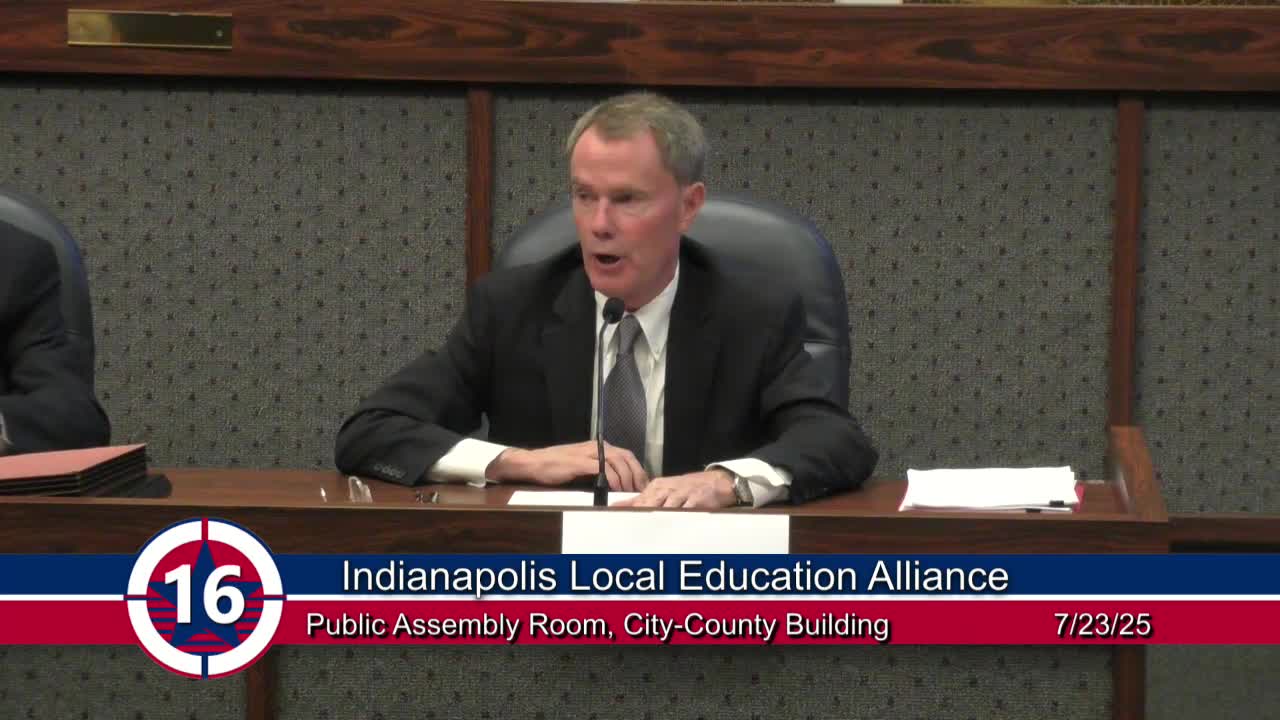
Speakers at an Indianapolis Local Education Alliance meeting outlined how Senate Enrolled Act 1 will reduce local property-tax revenue for Indianapolis Public Schools, shift more operations funding to charter schools over time and increase reliance on tax-base growth to raise future revenue.
At a meeting of the Indianapolis Local Education Alliance, policy analysts and Indianapolis Public Schools officials warned that Senate Enrolled Act 1 — the property-tax legislation passed this year — will reduce property-tax revenue available to the district and change how operations funding is allocated to charter schools.
Jason O'Neil, managing director of Policy Analytics, told the alliance that SEA 1 creates new homeowner credits and deductions that will lower assessed value and local property-tax receipts. He cited an estimate from the Legislative Services Agency projecting about a $5,000,000 reduction in IPS property-tax revenue in 2026 compared with the prior baseline.
The changes O'Neil summarized include a state-provided homestead credit equal to 10% of tax liability (capped at $300), a phased increase in homestead deductions that will reduce taxable value over time, a new non‑homestead residential deduction and exemptions for some depreciable personal property. He said the law also restructures local income-tax mechanics and changes how operations fund dollars are shared with charter schools.
"The dollar property-tax dollars coming into I.P.S. as a corporation will continue to decrease both due to the property-tax effects of SEA 1 and also the way that operations fund revenue is allocated to charter schools," O'Neil said during the presentation.
Andrew Stroh, IPS deputy superintendent, walked alliance members through basic funding sources for schools, noting the district relies on three revenue streams: federal grants, state tuition support and local property taxes. Stroh said IPS received about 43% of its revenue from state tuition support in 2024, roughly 35% from property and other local taxes, and about 22% from federal sources.
Presenters also detailed how SEA 1 phases in a proportional, per‑student share of the operations fund for charter schools. Under the new allocation methodology, O'Neil said, charter schools within IPS boundaries will receive a share of operations-fund dollars that phases in through the late 2020s; the presentation showed a transition beginning in 2028 from the prior method to a full proportional allocation.
O'Neil and other presenters flagged two consequences for fiscal planning: first, local taxing units should expect reduced property-tax revenue compared with prior law once the credits and deductions phase in; and second, because the law reduces taxable base per property, future revenue growth will depend more heavily on growth in the overall tax base rather than increases in tax rates. He said legislative estimates and the alliance's projections show continuing downward pressure on non‑debt property-tax revenue for IPS under current assumptions.
Weston Young, IPS chief financial officer, responded to a question about the charter school grant by saying he was not aware of any legislative plan to phase out the per-pupil charter school grant currently in statute. Alliance members asked for additional data, and city staff said maps and TIF district boundaries within IPS would be circulated to members for fiscal analysis.
The alliance did not take formal action on the item. Presenters told members that further financial and budget detail would be included in future meetings and that the operating referendum currently in place will expire in 2026; IPS will still receive roughly half of that referendum revenue in its 2027 fiscal year because of the district's fiscal calendar.