Get Full Government Meeting Transcripts, Videos, & Alerts Forever!
Get email alerts on the Bill 9 Tvr Apartment Phaseout topic
No spam. Unsubscribe anytime.
Maui committee debates Bill 9 to phase out short‑term rentals in apartment districts; housing, lending and rezoning questions remain
Summary
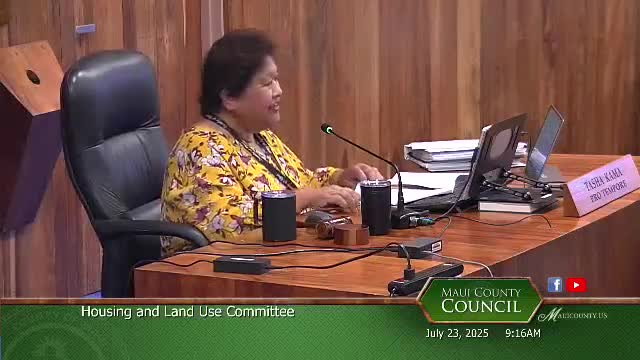
The Housing and Land Use Committee on July 23 continued a days‑long review of a mayoral proposal — commonly called Bill 9 — that would remove transient vacation rental (TVR) use from apartment districts and phase out existing TVR activity over a multi‑year period.
The Housing and Land Use Committee on July 23 continued a days‑long review of a mayoral proposal — commonly called Bill 9 — that would remove transient vacation rental (TVR) use from apartment districts and phase out existing TVR activity over a multi‑year period.
Committee members and administration officials focused much of the hearing on how the measure would play out in practice: whether banks would finance purchases of former TVR units, how first‑time homebuyer and CDBG‑DR recovery funds could be used, whether properties could rezone to hotel use, and how the county would handle buildings that claim existing variances or sit in sea‑level‑rise exposure areas.
Why it matters: County planners, the housing director and lenders said the proposal would change how thousands of units can be used and could make some apartments available for long‑term housing. Supporters say Bill 9 is one tool to increase housing attainable by local residents. Opponents warn of short‑term economic disruption for neighborhoods that rely on vacation rental visitors and legal risk that could cost the county money.
The administration identified about 6,127 units on the “minutoya” list at the center of the bill and favors a phased approach. “If the bill passes, we will look at all of those programs and find ways to make them available to the community,” said Richard Mitchell, director of the Department of Housing, referring to rental assistance, voluntary deed‑restriction programs and first‑time homebuyer tools the department could adapt to support residents who buy units.
Lenders and mortgage brokers who testified said litigation, condo association disputes and assessments can freeze or derail typical mortgage underwriting. “The simple answer to your question is yes,” mortgage banker Kara Beltran told the committee when asked whether litigation complicates financing. “If there is litigation in a complex, there will be difficulty.” She described the industry practice of requiring a completed condo questionnaire (often called the RR105C) and working with association attorneys before underwriting can finish.
Hawaii Community Lending executive director Jeff Gilbreth, who was designated a committee resource during the hearing, told members some tools already exist. “Buy down, interest rate, not an issue,” Gilbreth said, describing deferred‑payment and down‑payment assistance programs his nonprofit has delivered elsewhere. He said the county could use deferred‑payment loans or point‑buy downs to reduce monthly payments for local buyers, and that such programs can be structured so public funds are recycled when properties resell.
Committee members pressed for concrete numbers and timelines. The housing department said its first‑time homebuyer fund currently has about $970,000 available and 300 people on its wait list; the department said it typically provides up to about $30,000 per household in its existing program but will evaluate expansions should Bill 9 pass. The administration also pointed committee members to federal CDBG‑DR recovery programs that include a first‑time homebuyer component and a single‑family homeowner reimbursement program; testimony at the hearing cited a $600,000 figure for a first‑time buyer opportunity program and up to $400,000 for homeowner reconstruction reimbursement under separate CDBG‑DR components.
Rezoning and variances: Planning staff said property owners can pursue a change of zoning to hotel or resort if they want to retain visitor‑oriented use, but that the normal zoning‑change process is more time‑consuming than a council‑initiated rezone. “If the council initiates that, it goes much faster,” said Greg Post, Administrative Planning Officer, noting the council can propose changes that bypass environmental assessment triggers that an applicant‑initiated community‑plan amendment would create. Post also told members that five properties on the county list show mismatched community‑plan and zoning designations, which complicates how those parcels would be treated.
Several members asked about properties that claim older approvals or variances — for example, Kuau Plaza and Maui Kaanapali Villas — and whether those sites would be exempt from Bill 9. Deputy corporation counsel Kristin Tarnstrom told the committee that the draft ordinance would remove TVR rights from the zoning code but would not automatically strip other lawful authorities. “If you have other lawful authority to operate a transient vacation rental, that would still be respected,” Tarnstrom said, meaning variances or other existing permits could be asserted by owners as a legal basis to continue TVR use.
Insurance, HOA assessments and leaseholds: The committee heard repeated warnings about rising HOA assessments and insurance costs and how those expenses affect buyers and lenders. Mortgage broker Kara Beltran illustrated a $445,000 mortgage example with a roughly $4,100 monthly payment when taxes, HOA dues, mortgage insurance and an HO‑6 were included — a number that many residents said they cannot afford. Committee members also asked how leasehold tenure (as opposed to fee simple) would change underwriting; lenders explained that leasehold term length can restrict the available loan term and raise monthly payments.
Fiscal concerns: Director of Finance Marcy Martin told the committee that the change could reduce some tax revenue but said those losses should be understood as part of a broader housing strategy. “This bill may result…in a revenue decrease provided there weren’t offsets, but this revenue change isn’t in a silo,” Martin said, adding that policy options — such as vacancy taxes or other tax changes — could be studied and used to offset county revenue impacts.
Process and next steps: Committee members debated timing and scope. Planning commissioners had recommended discussion about shorter windows in places with acute housing need and faster phase‑outs in West Maui, while allowing a longer transition in other areas. Committee members and staff agreed the current draft and planning analysis left significant technical and legal questions. The committee designated Jeff Gilbreth as a resource person to help model financing alternatives and deferred further action, planning to reconvene the discussion the next day to consider members’ proposed amendments and any legal recommendations.
What the committee did (procedural): Chair designated Jeff Gilbreth as a resource; the designation passed with no recorded objection and his participation was allowed for this meeting.
The committee recessed until its scheduled reconvene time; members said they expect to consider amendments and to continue deliberations as necessary at the reconvened session.
Ending: The hearing produced no final vote on Bill 9. Members signaled they want additional legal vetting and more granular fiscal and lending analyses before moving the ordinance forward, and the committee planned to take up amendments and further testimony when it reconvened.