Get Full Government Meeting Transcripts, Videos, & Alerts Forever!
Get email alerts on the Rezoning topic
No spam. Unsubscribe anytime.
Denton planning panel recommends rezoning of Springside property amid resident opposition
Summary
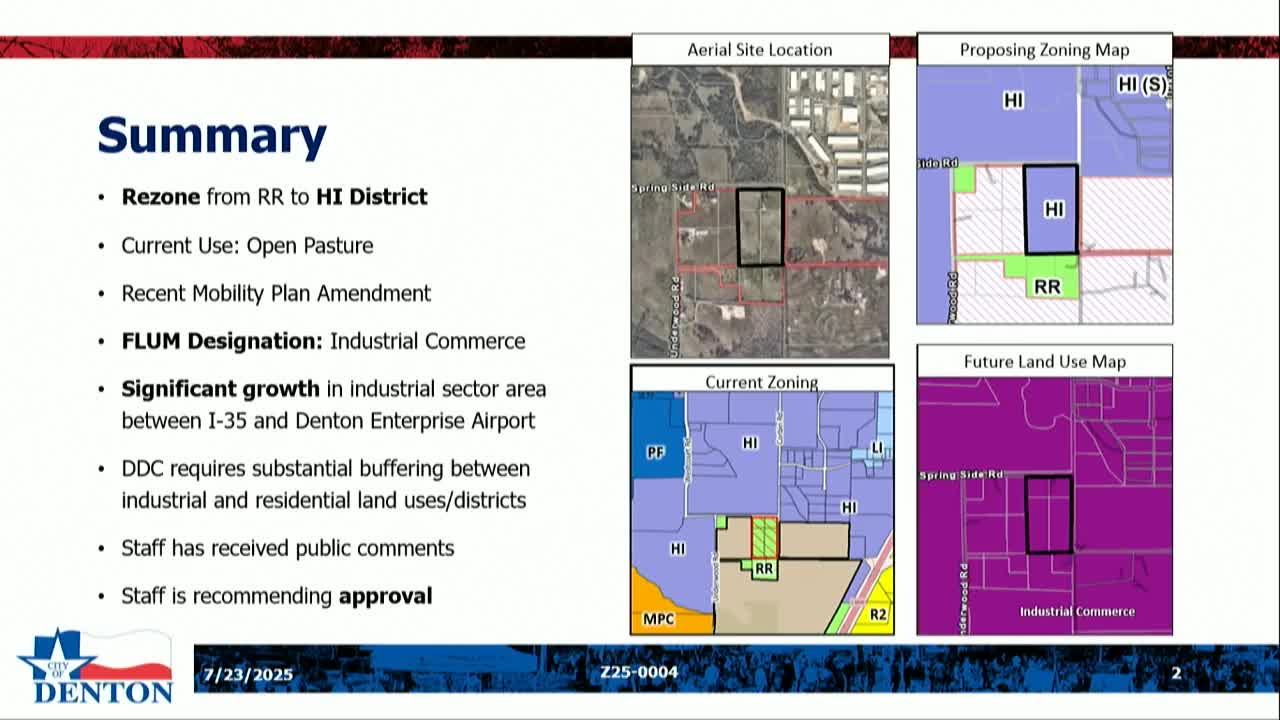
The Planning and Zoning Commission voted 3-1 on July 23 to recommend rezoning about 22 acres at Springside and Corbin from rural residential to heavy industrial; residents raised concerns about noise, lights and property impacts; the case goes to City Council Aug. 19.
DENTON, Texas — The Denton Planning and Zoning Commission on July 23 recommended that about 22 acres at the corner of Springside Road and Corbin Road be rezoned from rural residential (RR) to heavy industrial (HI), a move staff says is consistent with the city’s comprehensive plan but that neighbors opposed during a public hearing.
Staff told the commission the property’s future-land-use designation is “industrial commerce” in the Denton 2040 comprehensive plan and that the area west of I‑35 is developing with industrial projects. Assistant planner Matt Bodine said the rezoning would help ensure the city has adequate land reserved for future economic growth in the industrial sector.
Neighbors said the change would bring noise, night lighting and traffic to a long-standing rural community. Barbara Whitworth, who said she has lived on Corbin Road since 1995, told commissioners that a large industrial development directly in front of her house would “ruin” the quiet character of the area. Kelly Holtsclaw and another resident cited similar concerns and said several impacted properties either did not receive mailed notice because they are in the extraterritorial jurisdiction (ETJ) or had only recently received notice.
Nathan Toon, who identified himself as an owner of the property and the applicant for rezoning, told the commission he had no immediate development plans and described the request as an effort to make the site “shovel ready” for a future buyer. He said existing county neighbors operate warehouses and heavy equipment on their lots and that, as a city property owner, he was seeking to align the parcel with the city’s adopted plan and neighboring industrial uses.
Staff and city attorneys also explained procedural details raised by speakers: only property owners inside the city limits are included in the 200‑foot mailed-notice and 20% protest calculation used under state law. Bodine said the proportion of land area in city limits that submitted written opposition reached 37 percent, which triggers a supermajority (three-fourths) vote requirement at city council if the commission’s recommendation is forwarded.
Commissioner John McDuff moved to recommend approval; Commissioner Riggs seconded. The commission approved the rezoning recommendation 3–1. The record does not show a roll-call of individual commissioner votes. The rezoning will be presented to City Council with the commission recommendation; staff said the earliest council hearing date available is Aug. 19.
Why it matters: The rezoning would expand the city’s inventory of industrially zoned land near the Denton Airport and I‑35 corridor at a time when the area is seeing growth in distribution and manufacturing uses. Opponents say the change threatens long-standing rural residential uses nearby and raises concerns about buffers and other site-specific mitigation that would be set when or if a development plan is submitted.
What’s next: The item will go to Denton City Council for final action on Aug. 19. If approved at council it would be subject to the city’s development-review standards (setbacks, landscaped buffers, lighting and performance standards) during later site-level review.
Details and context: The staff report referenced the Denton Development Code and the Denton 2040 comprehensive plan in recommending approval. Commissioners asked staff how code-required buffers apply where properties abut county land under non-annexation agreements; staff said the city’s buffering and performance standards apply to city property but that the ETJ and non-annexation status affects notice and some jurisdictional points. Several speakers said existing uses on nearby county parcels include warehouses and water-well drilling equipment.
Provenance: Commission hearing and public commentary occurred at the July 23 Planning and Zoning Commission meeting; staff presentation and public hearing on the Springside rezoning were the principal sources for the facts reported here.