Get Full Government Meeting Transcripts, Videos, & Alerts Forever!
Get email alerts on the Clean Energy Transition topic
No spam. Unsubscribe anytime.
UN secretary-general calls clean-energy shift "unstoppable," urges action ahead of COP30
Summary
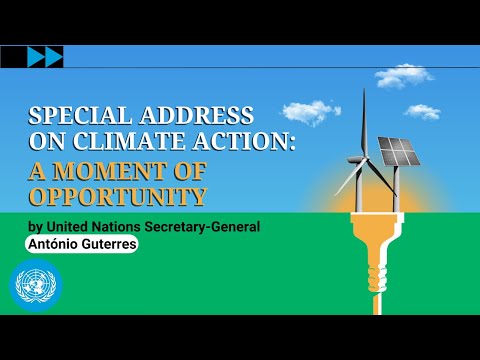
United Nations Secretary-General António Guterres told attendees at a Time-hosted report launch that the global shift to renewable energy is now inevitable and urged immediate, coordinated action from governments, businesses and financiers ahead of COP30.
United Nations Secretary-General António Guterres told attendees at a Time-hosted report launch that the global shift to renewable energy is now inevitable and urged immediate, coordinated action from governments, businesses and financiers ahead of COP30.
Guterres said the economics underpinning the shift are decisive: "$2,000,000,000,000 went into clean energy last year. That's $800,000,000,000 more than fossil fuels and up almost 70% in 10 years," and later added, "Fossil fuels are running out of roads and the sun is rising on a clean energy age." He used the event to release a multi-agency report backed by UN partners, the International Energy Agency, the IMF, IRENA, the OECD and the World Bank.
The report and Guterres' remarks framed the transition as an economic and security imperative, not solely an environmental one. Guterres said renewables now nearly match fossil fuels in global installed power capacity, that nearly all new power capacity added last year came from renewables, and that "the clean energy future is no longer a promise. It's a fact." He warned, however, that the transition remains uneven: "OECD countries and China account for 80% of renewable power capacity installed worldwide... Africa, just 1.5%."
Shaila Raghav, chief climate officer at Time, opened the event and introduced the report as a "defining moment for clarity, for leadership, and for purpose." Raghav noted the event was complemented by more than 70 concurrent events and multilingual livestreams to promote the report's findings.
Guterres outlined six opportunity areas to accelerate a just energy transition. Key recommendations he emphasized included: stronger and clearer national climate plans (nationally determined contributions, or NDCs) to be submitted before the UN General Assembly high-level week; major investments in grids, storage and charging infrastructure; market reforms that remove fossil-fuel market distortions; reforms to trade and investment treaties to support diverse clean-energy supply chains; and substantial increases in finance to developing countries, including larger multilateral development bank lending capacity and debt relief tools such as debt-for-climate swaps.
He pressed governments to align policies with the goal to "double energy efficiency and triple renewables capacity by 2030" and called on major technology firms to power data centers with "100% renewables by 2030." Guterres also highlighted social justice and human-rights concerns tied to critical minerals, saying extractive models "digging deeper holes of inequality and harm" must end and calling for value-chain diversification that respects rights and local benefits.
The secretary-general used several data points from the report to stress urgency and opportunity: the clean-energy sector contributed to growth in 2023 (he said clean energy sectors drove 10% of global GDP growth), global clean-energy employment ("almost 35,000,000 people worldwide"), and the mismatch in investment flows to developing regions ("Africa received just 2% of global clean energy investments last year"). He called for reforms to risk models and capital costs that currently lock developing countries out of the transition.
Guterres framed energy security as integral to geopolitics and public welfare, saying renewables reduce exposure to price shocks and supply disruptions that accompany fossil fuels: "There are no price spikes for sunlight and no embargoes on winds." He also tied climate change to insecurity, citing displacement, increased poverty, and instability in regions such as the Sahel.
Event organizers and Guterres urged political leaders to submit more ambitious NDCs in the months ahead and to present them at an event during the UN General Assembly high-level week. The launch concluded with audience Q&A and a final appeal from Guterres to younger generations, whom he said "will accelerate and consolidate a new way for human beings to live in harmony with nature." The report will accompany COP30 preparations, with Guterres and the president-designate of COP30 in attendance.
No formal votes or binding commitments were recorded at the event; speakers presented recommendations and calls to action rather than enacted policies.