Get Full Government Meeting Transcripts, Videos, & Alerts Forever!
Get email alerts on the Strategic Framework topic
No spam. Unsubscribe anytime.
MMSD board approves three strategic performance objectives for 2026–27 school year
Summary
The Madison Metropolitan School District Board of Education on Aug. 25 voted to adopt three strategic-framework performance objectives — belonging, academic achievement and college credit/credentials — that will begin in the 2026–27 school year.
The Madison Metropolitan School District Board of Education on Aug. 25 voted to adopt three strategic-framework performance objectives — belonging, academic achievement and college credit/credentials — that will begin in the 2026–27 school year.
Board President Nichols moved the first motion to approve the belonging objective; Maya Pearson seconded it. The board later approved the academic achievement and the college credit and credentials objectives in separate motions. Each motion passed unanimously.
Why it matters: The objectives reframe how the district will report progress. The belonging objective directs the district to increase the percentage of students who report they feel they belong at school, measured primarily by the district climate survey. The academic achievement objective ties required state assessments, early reading readiness measures and GPA into a broader picture of student learning. The college credit and credentials objective focuses on expanding measurable postsecondary value through college credits, industry credentials, work-based learning and the seal of biliteracy.
Measurement and debate: Board member Ali Muldrow asked how student belonging will be measured across K–12; Cindy Green said the district will use the climate survey (administered to students beginning in third grade and to families across K–12), with a pre- and post-survey cadence and more detailed KPIs to be developed after approval. "We are going to use our climate survey as the major measure of how we're assessing belonging across 4K–12," Green said.
Vice President Maya Pearson pressed whether the district has the staffing capacity to implement and sustain school-level culture and climate work. Cindy Green described central office allocations for culture-and-climate work and building-level positions (positive behavior supports coaches, behavior education assistance and deans) and said schools receive a standard allocation with some flexibility.
Board members discussed measurement choices for academic achievement. The approved language lists required state assessments, 4K–2 reading readiness measures, the ACT for high school and GPAs for grades 6–12. Board member Mosner Feltham supported inclusion of GPA as a classroom-proximate indicator, while Board member Nikki VanderMeel urged that Individualized Education Program (IEP) goals be tracked as part of KPIs so special education students are not omitted.
On ACT timing and preparedness, staff said the district administers the ACT in the spring of students' junior year; most juniors will have completed Algebra II by that time and the ACT’s math coverage is generally aligned through early Algebra II. "On average that would be Algebra II," Cindy Green said.
Implementation timeline and accountability: The objectives become effective in 2026–27. Board members asked for baselines and annual targets; staff indicated a baseline year will be established in consultation with the district’s RAI and strategic teams and that more specific KPIs and targets will be returned to the board as part of the strategic implementation work and annual budget cycle.
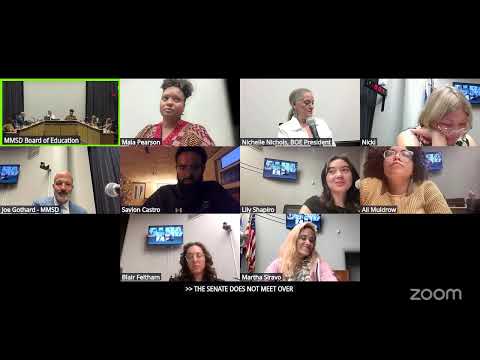
Voices in the meeting: Board members who took part in the discussion included Ali Muldrow, Maya Pearson, Nikki VanderMeel, Martha Sarabo, Board Member Castro and others; Superintendent Dr. Gothard and staff member Cindy Green led implementation answers. Muldrow said she was "excited to vote enthusiastically" for the belonging objective; Mosner Feltham described GPA as "a unique choice" that connects to classroom learning.
Votes at a glance (formal actions taken Aug. 25): - Belonging strategic-framework performance objective — motion approved unanimously (board vote recorded as unanimous). Motion read by Board President Nichols; second by Maya Pearson. - Academic achievement strategic-framework performance objective — motion approved unanimously. (motion seconded by Nikki VanderMeel) - College credit and credentials strategic-framework performance objective — motion approved unanimously. (motion seconded by Nikki VanderMeel)
Context and next steps: Staff will develop KPIs, establish baselines and propose annual targets; the board signaled interest in reviewing KPIs and targets collaboratively and asked staff to report implementation details as part of the district’s annual planning and budget cycle. The board also emphasized continued attention to attendance and graduation as important system-level indicators even though they are not the headline performance objectives.
Ending: Board members said the approvals mark a transition from goal-setting to implementation. "I just wanna say thank you, and now it's time to get to work, getting strategies together," Superintendent Dr. Gothard told the board near the close of the meeting.