Get Full Government Meeting Transcripts, Videos, & Alerts Forever!
Get email alerts on the Taxes And Finance topic
No spam. Unsubscribe anytime.
Avon introduces wheel-tax and vehicle surtax ordinance to qualify for new state road funding
Summary
Town leaders introduced an ordinance to adopt a wheel tax ($40) and motor-vehicle excise surtax ($25) after state law tied additional Community Crossing-style distributions to municipalities that enact the levies.
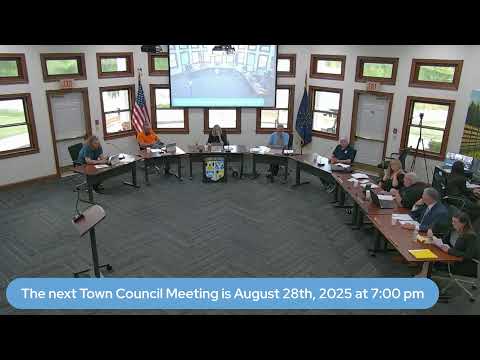
Avon council members on Aug. 14 introduced an ordinance to enact two new local vehicle levies — a wheel tax and a motor vehicle excise surtax — as required by recent state law changes tied to distribution of Community Crossing grant funds.
The proposed ordinance sets a $40 wheel tax and a $25 excise surtax, with proceeds restricted for road construction, maintenance and repair. Town legal staff and finance consultants told the council the Bureau of Motor Vehicles will collect the levies at registration if the town adopts the ordinance and delivers the certified ordinance to the BMV before Sept. 1. Town staff emphasized there is a statutory linkage: certain lane‑mile distributions and additional state funding streams will be available only to municipalities that adopt a wheel tax.
"You have to pass the wheel tax if you want to be eligible for that red box," the presentation said, referring to state distribution categories shown in staff slides. Financial forecasts provided to the council estimated revenues ranging from roughly $127,000–$198,000 annually at lower rate choices up to $477,000–$726,000 annually at maximum rates; staff presented the $40/$25 option as the upper bound in the model.
Why it matters: the legislature restructured Community Crossing matching distributions and created new lane‑mile allocations that favor municipalities that adopt local vehicle levies. Staff said some of the additional state money could be eligible beginning in 2027 but that the town must adopt the tax before Sept. 1, 2025, to participate in the new distribution timeline. Staff also noted that the new law shifts some responsibility for small culverts and drainage features (under 20 feet) to towns, which increases the need for local road funding.
Council members discussed geography and collection mechanics. Staff and the BMV have been using ZIP-code based estimates for revenue projections, but meeting presenters and legal counsel said the BMV is required to capture residency declarations at registration and that final revenue may differ from ZIP-code estimates. Town staff said they are pursuing geofencing and discussions with the USPS to better align ZIP codes with municipal boundaries but that the BMV will ultimately collect based on declared residency at registration.
Next steps: the ordinance was introduced on Aug. 14; adoption would require a later vote to finalize rates and deliver the certified ordinance to the BMV so collections could start in 2026.