Get Full Government Meeting Transcripts, Videos, & Alerts Forever!
Get email alerts on the Metro Health Budget topic
No spam. Unsubscribe anytime.
Metro Health flags grant “fiscal cliff,” proposes fee changes under new state law
Summary
Metro Health Director Dr. Claude Jacob told council that while Metro Health remains nationally accredited and continues core services, FY2026 faces a risk from waning grant support — notably Medicaid 1115 waiver funds that expire in September 2026 — and presented proposed food‑establishment fee changes to comply with Texas Senate Bill 1008.
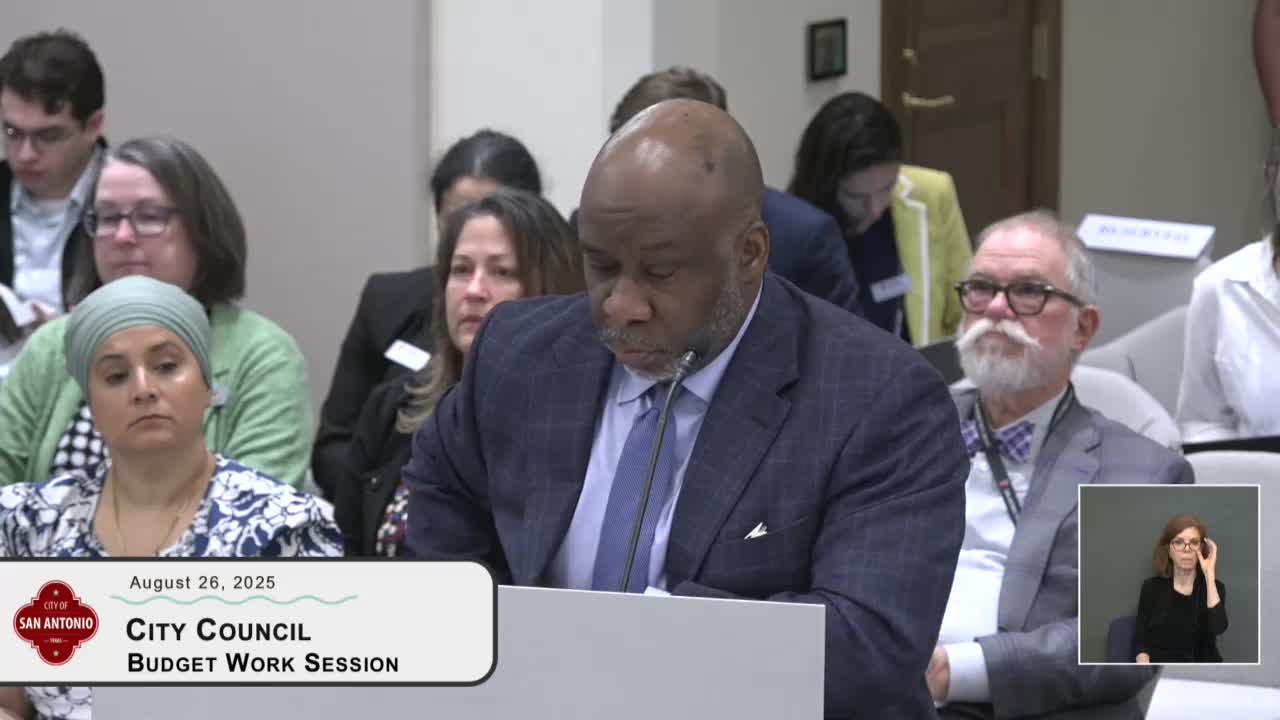
Dr. Claude Jacob, director of Metro Health, presented the department’s FY2026 budget overview and program priorities to the City Council budget work session on Aug. 26, describing both continued public‑health investments and fiscal vulnerabilities tied to shifting grant support.
Jacob said the department seeks approximately $79.2 million for FY2026 with an authorized staffing complement of about 593 positions; the city’s General Fund contribution was presented at roughly $46.5 million with nearly $33 million in grant support. He noted that grants now support a substantial share of department operations and warned that the impending end of Medicaid 1115 waiver reserves in September 2026 — roughly $7.8 million in support this year — creates a “fiscal cliff” that will affect programs and more than 80 grant‑supported staff.
Why this matters: Metro Health runs regional clinical and public‑health services — immunizations, WIC clinics, food‑safety inspections, the Metro Health laboratory, violence prevention and school‑based mental‑health contracts — that are in part grant‑funded. Reductions in grant support could disrupt ongoing programs and require council choices about what the city should underwrite with the General Fund.
Key program highlights and CBR findings
- Accreditation and organizational changes: Jacob reminded council that Metro Health is nationally accredited by the Public Health Accreditation Board and described recent organizational expansions (the Center for Policy and Health Improvement, epi‑analytics and a chief mental health officer) created or grown during the pandemic.
- Core service goals: For FY2026, staff said Metro Health expects to complete at least 22,000 case investigations within 30 days, administer about 10,000 vaccines, and conduct roughly 120,000 lab tests. The Metro Health laboratory serves as a regional lab across a 29‑county area and performs rabies and other specialized testing, Jacob said.
- Violence prevention and mental health: The department’s Stand Up SA community violence intervention program was described as the longest‑running such program in Texas; Metro Health cited expected community encounters in which staff will link people to services and support. Jacob said Metro Health manages two school‑based mental‑health contracts that serve a minimum of 250 students and that the department is coordinating a countywide school safety and mental‑health summit this fall.
- Comprehensive budget review (CBR): Metro Health staff said the CBR identified roughly $4.4 million in proposed reductions and a net reduction of 22 general‑fund supported positions. Specific changes discussed included reducing staff tied to a paid‑sick‑leave enforcement function (4 positions), eliminating the city component of an “unlock” reentry case‑management program (4 positions) in favor of community providers, and moving some youth‑services positions to Human Services (Project WERF). Staff said affected employees would be offered placements elsewhere in the city where possible.
Food‑establishment fee changes to comply with SB1008
Jacob told council that, in response to Senate Bill 1008 (89th Texas Legislature), Metro Health completed a review of its food‑establishment fee schedule and proposes revisions that align local fees with state limits. Staff said the proposed ordinance would be presented to council and, if approved, would take effect Dec. 1. Key proposed changes outlined in slides include a shift from employee‑count tiers to gross food‑sales brackets for some permit fees, a standardized $150 reinspection fee, a $150 one‑time change‑of‑ownership fee (replacing a $52 clip fee), and a $52 per‑booth fee for single‑event temporary food permits. Metro Health said it will run an education campaign for businesses if the ordinance is adopted.
Council questions and staff follow up
Council members asked for further district‑level detail (for example, which neighborhoods rely most heavily on immunization, domestic‑violence and asthma programs) and for written analyses of how the department would allocate additional funding (one council member asked hypothetically how Metro Health would use a 20% budget increase). Staff agreed to provide memos with requested breakdowns and to return to the Community Health Committee for additional briefings.
Quotes
“We remain deeply committed to minimizing disruption in services to area residents,” Dr. Claude Jacob said, noting the department’s intention to preserve core programs while addressing fiscal pressures.
Ending
Jacob said Metro Health will continue monitoring grant awards and federal/state guidance and will work with council to identify priorities as grant support declines; staff will return with additional data requested by council, including district‑level service breakdowns and impact analyses related to the Medicaid waiver timing.