Get Full Government Meeting Transcripts, Videos, & Alerts Forever!
Get email alerts on the Animal Welfare topic
No spam. Unsubscribe anytime.
Williamson County shelter marks 14 years of 90%+ save rate, cites flood response and seeks expansion
Summary
Williamson County Regional Animal Shelter celebrated a national “no kill” recognition, described a surge in transfers and fosters after regional flooding, and said it is planning expansion after Georgetown joined its regional sheltering agreement.
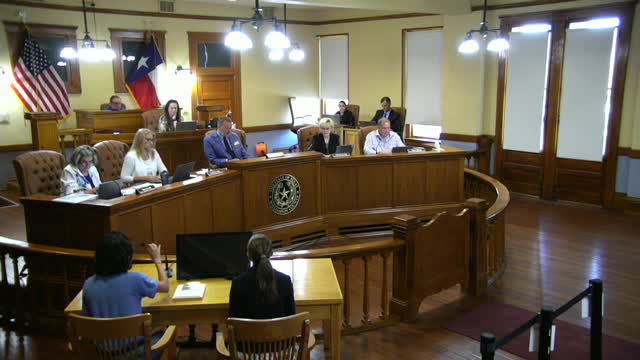
The Williamson County Regional Animal Shelter on Aug. 26 presented the court with a national ‘‘no kill’’ recognition and described a week in which the shelter helped evacuate and rehome hundreds of animals after regional flooding.
Misty Valenta, director of the Williamson County Regional Animal Shelter, told the commissioners the shelter temporarily received animals from the Georgetown and Lampasas shelters during July flooding, fostered about 300 animals within days, and later transferred roughly 250 animals through national rescue networks. “Within 3 hours, that shelter was empty and all of their pets came to our shelter,” Valenta said.
The award cited the shelter’s save rate of 90 percent or higher — a common benchmark for ‘‘no kill’’ status — and Valenta said Williamson County has met that standard since December 2010. “Decisions aren’t made at the shelter because of numbers,” she said. “Decisions are made at the shelter because of each individual pet and their needs, medical condition, and safety of the community.”
Laura Donahue, senior director with Best Friends Animal Society, presented the plaque and praised the shelter’s programs and leadership. “This shelter community has…achieved this life saving standard now for 14 years in a row,” Donahue said, and she singled out Williamson County staff for national leadership roles and conference presentations.
Valenta outlined programs the shelter credits for its outcomes: a transfer program that ships animals north to areas with higher demand, a finder-to-foster pathway that lets people keep found animals at home while the shelter handles intake paperwork and medical workups, and post-adoption support including a 30-day Pet Academy training and text-based trainer access. She also described community support programs such as a pet pantry and targeted rehoming work to avoid shelter surrenders.
The shelter said it added Georgetown to its regional agreement (the presentation noted an earlier urgent evacuation date of July 5 during the floods) and is planning a kennel expansion to accommodate the larger service area. Valenta and commissioners encouraged public support for the shelter’s November fundraiser, the 16th annual “Fur Ball,” scheduled for Nov. 8 at the Sheraton, and for adoption and foster volunteerism.
The presentation included operational context: the shelter uses data reported to Shelter Pet Data Alliance and Best Friends to benchmark performance and emphasized that high intake of stray animals demonstrates the shelter remains open to community needs. Valenta said the shelter also reduced returns by providing adoption follow-up and that its national partnerships have helped place animals in regions with greater adoption capacity.
The court paused afterward for a photo with the award and the shelter’s life‑saving manager and board representatives.
Looking ahead, Valenta said the shelter will pursue additional kennel space to support Georgetown and continue using transport grants and donor funding to expand transfer capacity.