Get Full Government Meeting Transcripts, Videos, & Alerts Forever!
Get email alerts on the Human Services Budget topic
No spam. Unsubscribe anytime.
San Antonio staff outline FY2026 human services budget, recommend short-term delegate‑agency awards
Summary
Human Services Department staff presented a proposed FY2026 spending plan focused on children, seniors and youth, recommended 12‑month designated awards for eight agencies and eight‑month extensions for 40 agencies, and described efficiency targets and program transfers to limit service disruption.
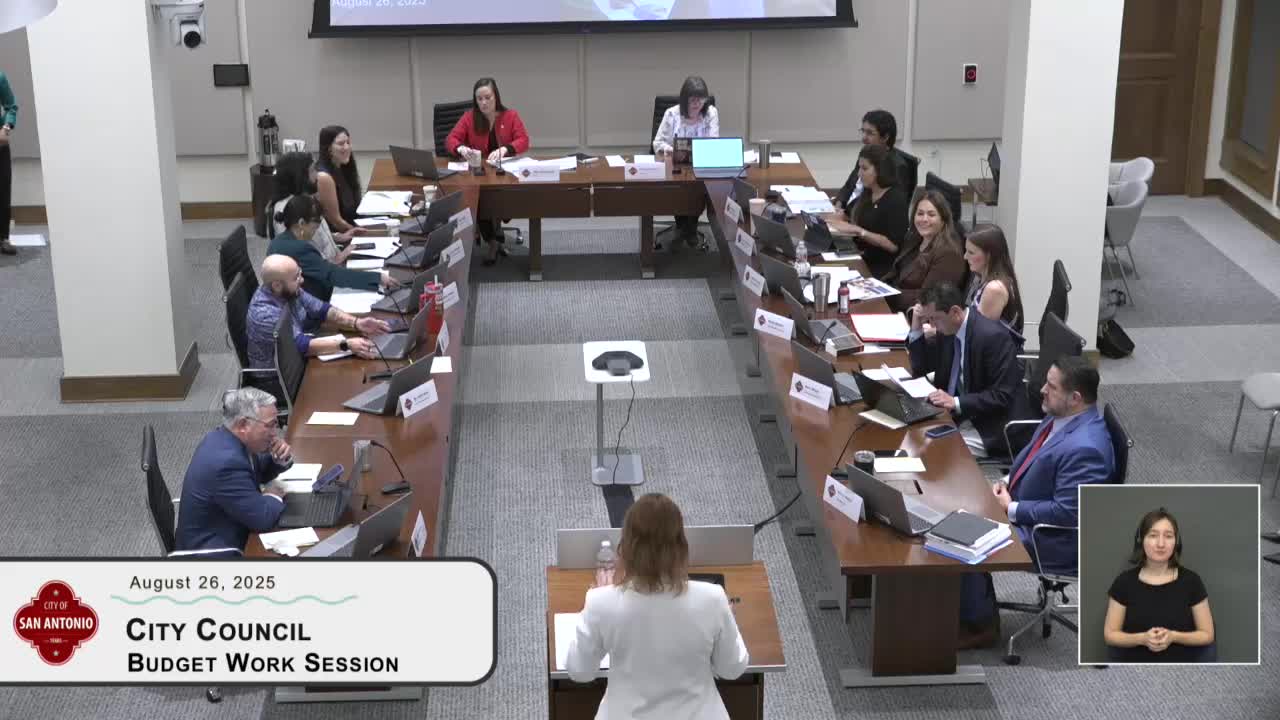
San Antonio Human Services Department Director Melody Woosley on Aug. 26 presented the department’s proposed priorities and funding approach for fiscal year 2026 at a City Council budget work session, including recommendations for delegate‑agency contracts and program realignments.
Woosley told the council that department programs serve vulnerable residents across a range of needs — Head Start, youth success programs, senior centers and emergency utility assistance — and emphasized the department’s aim to “work upstream” to prevent homelessness and other harms. She said the department’s children’s services are primarily supported by federal grants, while older‑adult and operational services rely mostly on the General Fund.
The presentation described a proposed FY2026 Human Services budget of roughly $94.8 million, split roughly between a General Fund contribution of about $42.4 million and approximately $52.4 million in federal/state grants. Staff said Head Start and Early Head Start serve about 3,330 children and the department’s programs reach nearly 50,000 individuals and families annually. The recommended delegate‑agency pool shown to council totaled about $24.38 million, and staff proposed holding $4.5 million in reserve for the next competitive funding cycle beginning June 1, 2026.
Why this matters: Human Services funding supports direct services used by low‑income families, older adults and youth. Changes to how delegate agencies are funded and to which city programs are managed affect partner nonprofits and service continuity for residents who depend on those programs.
What staff recommended and why
- Delegate‑agency treatment: staff proposed executing 12‑month designated funding agreements with eight agencies that provide core services supporting city programs, and issuing eight‑month contract extensions for 40 competitively funded agencies so funding continues while a retooled RFP and policy process is developed. The extensions would bridge agencies until the new competitive cycle begins; contract renewals for years two through four would be contingent on funding availability and performance.
- Consolidated funding process changes: staff said they will separate designated and competitive funding streams, publish a “soup‑to‑nuts” policy document for applicants, standardize and reduce performance metrics, expand engagement with stakeholders and explore outsourcing discretionary funding to a local funder.
- Program transfers and transitions: staff proposed transferring the Child Care Services Grant program to Workforce Solutions Alamo effective Oct. 1 to avoid service disruption for providers and families. They also proposed transitioning Project WERF (a youth program) from Metro Health to Human Services to consolidate youth services.
- Efficiency and right‑sizing recommendations: the comprehensive budget review (CBR) recommended roughly $683,000 in FY2026 efficiencies and identified additional FY2027 opportunities. Proposed steps include adjusting line‑item budgets to reflect actual spending, eliminating duplicative contracts, and consolidating low‑attendance part‑time nutrition sites (staff said about 206 participants across four part‑time sites would be moved to comprehensive senior centers).
What council members asked and next steps
Council members asked staff to provide more district‑level data on who is served (for example, seniors and youth by council district), and to clarify how proposed changes would affect the most vulnerable residents. Mayor Jones asked for greater “fidelity” in the data so the council can overlay need by district when evaluating reductions.
Woosley said staff will return after budget adoption with additional policy direction in October and community engagement sessions in November to inform the next competitive cycle. She reiterated that the proposed short‑term contract extensions are intended to preserve services while the city implements a redesigned delegate‑agency process.
Quotes
“Our goal for this coming year is to help participants reduce at least $1,400,000 in debt,” Melody Woosley, Human Services Department director, said during the presentation.
“I find it a little bit difficult to understand the true nature of some of the cuts … without a greater level of fidelity,” Mayor Jones said as he urged staff to show impacts by council district.
Ending
Staff emphasized that recommended changes are intended to limit service disruption while the city reforms the delegate‑agency process and prepares a competitive RFP cycle; council members asked for more granular data before making final budget decisions.