Get Full Government Meeting Transcripts, Videos, & Alerts Forever!
Get email alerts on the Housing topic
No spam. Unsubscribe anytime.
State housing experts tell Lakeville committee CPA can fund preservation, small-scale construction and predevelopment work
Summary
Massachusetts Housing Partnership and regional housing staff briefed the Town of Lakeville Preservation Committee on Community Preservation Act (CPA) uses for housing, options to preserve expiring affordability, and steps to activate the town's dormant affordable housing trust.
Shelley Goering of the Massachusetts Housing Partnership told the Town of Lakeville Preservation Committee on Aug. 21 that communities can use Community Preservation Act (CPA) funds to acquire, create, preserve and support affordable housing — and that those flexibilities include predevelopment work, rent assistance and targeted acquisitions to extend affordability.
"What I wanted to do tonight is talk a little bit about how you can use CPA funds to support housing in your community," Goering said during a presentation that drew questions from committee members and staff about local capacity and expiring affordability.
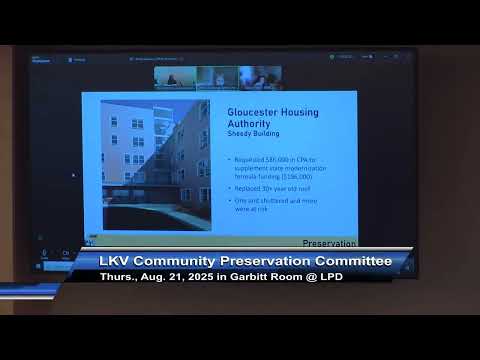
The presentation outlined examples from across Massachusetts in which local CPA funds helped close financing gaps for rental developments, purchased existing multifamily properties to keep units affordable in perpetuity, and supported adaptive reuse of nonresidential buildings into age-restricted rental housing. Goering repeatedly emphasized the difference between ordinary rehabilitation and the CPA concept of "preserve," saying it means protecting property from "injury, harm, or destruction," not merely replacing fixtures.
Committee members raised local concerns. Town staff and committee members said Lakeville does not have a functioning housing authority and that the community has a dormant Affordable Housing Trust with a small balance. Goering and Taylor Perez of SERPed advised the committee to prioritize near-term expirations and to open early conversations with property owners about their intentions before pursuing costly acquisitions.
Key clarifying details from the discussion: committee members said roughly 100 affordable rental units in town have long-term restrictions that the presenters identified as expiring in 2039; smaller clusters of units reportedly have earlier expirations (some cited in the discussion as expiring in 2026–2027). Committee members said the town's Affordable Housing Trust currently holds about $122,000, funds that originated from a prior sale where the resale premium was directed to the trust. Goering noted that CPA funds may be bonded to address larger preservation costs and that town meeting can attach conditions or timelines if funds are transferred to a housing trust.
Goering and Perez recommended practical next steps: (1) identify and confirm the ownership and financing of expiring restricted properties and ask owners about their intentions; (2) prioritize short-term expirations for immediate planning; (3) activate the town trust by appointing trustees so the trust can act more quickly than the committee, which must defer some decisions to town meeting; and (4) consider targeted public education and tours of smaller-scale affordable developments to build broader community support.
Committee members discussed using a warrant article at town meeting to transfer CPA funds to the trust for specific, time-limited preservation work and including explicit terms in any grant agreement so funds revert to the CPC if objectives are not met. Goering offered technical assistance opportunities through MHP, including an application-based program that supports 3–4 communities annually and training resources on the MHP housing toolbox.
The committee did not take a formal vote to authorize funding or to activate the trust during the meeting; members agreed to draft a memo to the select board asking that select board members review the presentation before the committee returns with a recommended memo and, later, a vote.
The committee also scheduled follow-up steps: ask the town treasurer and planning staff to help assemble the subsidized housing inventory and expiring-use lists; consider a short-term consultant or MHP technical assistance if staff capacity remains limited; and put formation and recommendations for the housing trust on the September agenda.
Ending
The committee thanked the presenters and agreed to circulate the presentation and resources to the select board and other local boards. Goering and Perez offered to continue advising Lakeville staff and trustees as they move from planning to concrete steps.