Get Full Government Meeting Transcripts, Videos, & Alerts Forever!
Get email alerts on the Energy topic
No spam. Unsubscribe anytime.
Council hears debate on battery energy storage zoning; proposal sent to zoning committee
Summary
Revere planning officials proposed zoning language to allow large battery energy storage systems (BESS) by special permit in specified districts; councilors discussed economic benefits, fire and flood risks, host-community agreements and safeguards. The matter was referred to the zoning committee (Sept. 8) for further review.
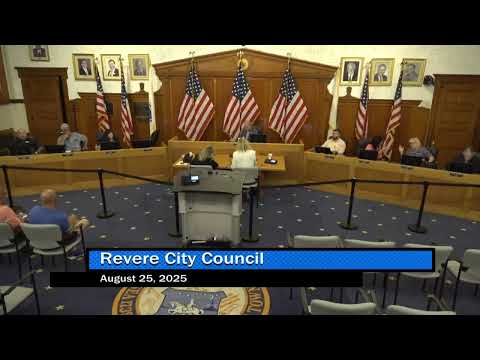
Tom Skorowski, Revere’s chief of planning and community development, presented an ordinance amendment on Aug. 25 to add battery energy storage systems (BESS) as a regulated use in the city’s zoning ordinance. The council referred the proposal to the zoning committee for a Sept. 8 hearing.
Skorowski said the amendment would add BESS as a new use in the zoning use table and would permit such systems by special permit in the Highway Business (HB) and TED districts. He described BESS as facilities that store power during low-demand periods and discharge it during peak hours and said the use is growing across Massachusetts. “This is a use that's rapidly growing throughout the Commonwealth and will only begin to grow even more as, you know, we're grappling with issues of energy affordability,” Skorowski said.
Councilors and members of the public raised safety and siting concerns. Resident Jim McCarrier said BESS can pose fire risks and asked about floodplain siting, emergency response needs and the sizes of systems under consideration. “These battery facilities do catch on fire…The risk, you know, fire, thermal runaway, and first responder safety,” McCarrier said, noting that facilities must be elevated above flood plains and that local emergency equipment and training could be required.
Skorowski noted that the proposed ordinance would not apply to small systems (it referenced systems above 30 megawatts in the staff presentation) and that the planning team worked with the solicitor, the fire department and industry professionals on draft standards. He also pointed to possible revenue through host community agreements and pilot agreements; he cited a Chelsea project with a pilot payment reported at $1.5 million per year for 20 years and a roughly $5.55 million host/community payment as examples of potential local revenue.
Several councilors said they supported a cautious local approach that allows BESS projects but requires strong safety conditions, setbacks and coordination with the fire department. Councilor Kelly asked that the council consider added constraints on proximity to residences because HB and TED districts can be close to homes in a dense city.
Outcome: The council ordered the matter to the zoning committee for Sept. 8 to allow technical review of safety, setbacks, emergency response, and possible host-community agreement terms.
Next steps: Zoning committee review on Sept. 8, followed by public hearings and technical review with the fire department and other stakeholders.