Get Full Government Meeting Transcripts, Videos, & Alerts Forever!
Get email alerts on the Cannabis Regulation topic
No spam. Unsubscribe anytime.
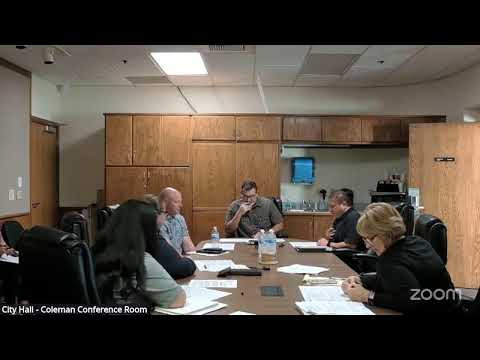
Porterville committee reviews microbusiness license, fees and security rules for dispensaries
Summary
Porterville's Cannabis Committee on Aug. 25 discussed whether to amend local dispensary ordinances (Ordinance Nos. 18-53 and 18-54) to allow state microbusiness licenses that combine cultivation, manufacturing and retail at a single site, and considered related changes to annual fees and security requirements.
Porterville's Cannabis Committee on Aug. 25 discussed whether to amend local dispensary ordinances (Ordinance Nos. 18-53 and 18-54) to allow state microbusiness licenses that combine cultivation, manufacturing and retail at a single site, and considered related changes to annual development fees and security requirements.
The committee's interim city manager, Ridge Tree, opened the item as a staff review of proposed amendments to permit a "micro business" license under state law and to align local development agreements with state regulations. "A micro business can be a variety of things," staff attorney Julia said, describing that the state license allows a single establishment to hold at least three activity types (for example, cultivation, manufacturing and retail) but requires the city's permission before the applicant seeks state approval.
Why it matters: allowing microbusinesses would let a dispensary cultivate, package and sell product on-site, which proponents say can reduce wholesale costs and create local jobs. Opponents and some committee members raised concerns about location, potential oversaturation and ensuring local zoning and security standards. The committee did not adopt an ordinance; members directed staff to prepare draft language and research other jurisdictions for the committee's next meeting.
Key points from the discussion
- License structure and facility size: Owner Garrett described a proposed facility of roughly 6,000 square feet with an in-house cultivation area of about 1,500'to 2,000 square feet. "We would have a small grow on-site," Garrett said, adding that state licensing requires the activities to be confined to the single licensed premises.
- Licensing pathway: Julia explained that the state issues the microbusiness license only after the local jurisdiction indicates it will permit that use. "If the state will grant a micro business license, then we can decide we're going to permit it as well within the local jurisdictions," Julia said.
- Taxes and local fees: Committee members discussed Porterville's current cannabis tax scheme. Julia summarized the local approach as a combination of a per-square-foot cultivation rate and a gross-receipts tax on other activities: "We do have $25 per square foot, or 10% annual gross receipts depending on the type," she said. The committee also reviewed a separate development-agreement annual fee that staff described as established as $30,000 minimum or 1% of gross receipts in existing documents; members asked staff to return with financials showing how a change to a straight 1% or removal of the $30,000 minimum would affect dispensaries.
- Caps and limits: Councilmember Raymond Beltran and other members argued for retaining the existing cap on the number of dispensaries. Beltran said he favored keeping the city's cap at three retail permits. Members discussed ambiguous ordinance language that could permit additional permits tied to population thresholds; several said the council should clarify whether the cap is a firm "hard cap" or left to council discretion.
- Security requirements: Julia advised that security staffing and certification requirements are set by state law and the Bureau of Security and Investigative Services (BSIS). She said local development agreements previously required contracting for security and that staff proposes changing development agreements to say only that licensees must comply with state security requirements so local agreements remain aligned as state law evolves. "The statute says ... security personnel hired or contracted for by the licensee shall be licensed by the BSIS," she said.
- Local impacts and jobs: Garrett estimated the microbusiness expansion could add "about 5, 5-6 more employees." Committee members cited potential economic benefits but also noted the local cannabis market is tight and profits are not guaranteed.
Direction to staff and next steps
Committee members agreed to direct staff to: - Draft specific ordinance language to add the state microbusiness license type to Ordinance Nos. 18-53 and 18-54, including options on whether to allow microbusinesses for existing dispensary permits or only for new permits; - Clarify population-based permit language and provide options for a firm cap versus council discretion; - Prepare financial impact analysis showing the effect of removing or retaining the $30,000 minimum annual fee, and show revenue scenarios for 1% versus other rates; and - Update development agreements to require compliance with state security law rather than a fixed contract requirement.
Committee members generally favored returning to the committee in roughly 30 days with draft language and comparative policies from other cities. No ordinance changes were adopted at the meeting.
Sources and attribution: statements above quote or paraphrase Porterville staff and committee members during the Aug. 25 committee meeting. Direct quotes and attributions come from the transcript excerpts listed in the article's provenance.