Get Full Government Meeting Transcripts, Videos, & Alerts Forever!
Get email alerts on the School Resource Officer Policy topic
No spam. Unsubscribe anytime.
Overland Park revises school resource officer policy to limit role in school discipline
Summary
The Public Safety Committee reviewed changes to the School Resource Officer (SRO) policy aligning local practice with recent U.S. Department of Justice guidance: SROs will no longer enforce ordinary school rules, will use force or arrests only as a last resort, and training and transparency requirements were strengthened.
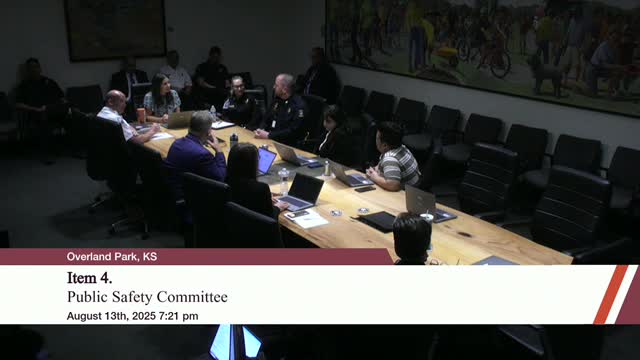
The Overland Park Public Safety Committee on an August night reviewed a revised School Resource Officer policy that narrows SRO responsibilities and formalizes training and transparency standards.
Captain Joshua Taylor, Overland Park Police Department, told the committee that the department updated its policy after the U.S. Department of Justice Office of Community Oriented Policing Services issued revised guiding principles for SRO programs in December 2024. “The principles in this document are offered as a guide to those jurisdictions that have opted to implement a school resource officer program,” Taylor said, reading from the DOJ text presented to the committee.
The police department’s changes include a firm instruction that SROs will not intervene in school-rule violations that would normally be handled by school staff, such as dress code or parking without a permit. Taylor said officers will now “refer it to an administrator and let them handle it through their own internal processes without taking action themselves.” The policy keeps SRO involvement for criminal acts or immediate safety threats.
The revisions also add explicit language that SROs should detain, arrest, or use force only as a last resort; expand and formalize required initial and recurring training (including NASRO basic course, child abuse and sexual-assault investigations, juvenile contacts, and care of persons with mental illness); and require that SRO-specific performance evaluations be tailored to the unit’s duties.
Taylor said the department will post annual SRO program data on the police transparency webpage and continue quarterly reporting to partner districts. He described operational rules intended to reduce impropriety risks: SRO communications with students must use department devices or school-approved platforms, one-on-one meetings should occur in visible spaces, and participation in extracurriculars such as coaching must be approved by a division commander and follow both department and district policies.
Committee members asked how the policy would handle gray areas such as a student found carrying a concealed knife that does not meet the statutory definition of a weapon on school grounds. Taylor said those situations would be treated as potential safety issues and directed SROs to intervene while clarifying that some circumstances will require judgment and further review.
Captain Taylor also provided unit staffing details: five SROs plus one sergeant assigned to Shawnee Mission School District (Antioch division), and 10 SROs plus one sergeant assigned to Blue Valley School District (Parkway division). The department no longer assigns SROs to elementary schools; district officers or other arrangements cover those campuses.
Council members pressed on funding and staffing. The department said school districts pay a portion of officer time; officers report hours and the city invoices districts quarterly. Taylor said SROs typically remain in assignments for multiple years and that the department recruits from existing staff through a selection board that identifies specialized qualifications.
The presentation emphasized that the policy changes largely codify practices already in place, while strengthening language on student protections, social-media and device use, training requirements, and public reporting.
The committee took no final action on policy language at the meeting; the presentation was informational with questions and discussion recorded.