Get Full Government Meeting Transcripts, Videos, & Alerts Forever!
Get email alerts on the Cultural Preserve Naming topic
No spam. Unsubscribe anytime.
Council hears mixed testimony on naming Mapulehu and Hamakualoa cultural preserves; action deferred
Summary
On Aug. 21 the Maui County Committee on Aloha ʻĀina took testimony on Bills 106 and 107 to name two county-owned Molokai parcels — Mapulehu and Hamakualoa — as cultural preserves and deferred further committee action for additional community consultation.
The Maui County Council Committee on Aloha ʻĀina received a departmental presentation and public testimony on two bills (Bill 106 and Bill 107) that would name two county-owned parcels on Molokai as cultural preserves: Mapulehu (a county parcel off Kamehameha V Highway near Kaunakakai) and Hamakualoa (lots in the Haʻiku Sugar East subdivision). The Office of ʻŌi? Resources (department staff identified in the record as the director and deputy director) provided maps, summarized site characteristics and described the department mission to protect cultural resources.
Department presentation and parcels Deputy director and staff outlined parcel boundaries and described the sites as county-owned property with archaeological sensitivity and community stewardship activity. The department presented the preserves under existing Title 12 (parks/facilities) code language as an initial vehicle for protection while acknowledging Title 12 is not an exact fit for every desired use or rule set.
Community testimony and central issues Multiple testifiers, including lineal descendants and community stewards, supported protection but requested stronger, place-based language and protections that enable living stewardship rather than passive preservation. Joycelyn Costa, who testified in support, urged healing-based stewardship and use of traditional names and practices. "I think our language and our intentions need to be what our culture represents," Costa said, calling for names and protections that reflect kuleana and legacy.
Other testifiers pressed for clarity on how naming would interact with existing land titles and rights. Kaneali‘i Williams, who identified family land commission awards overlapping the proposed preserve area, urged that lineal descendants be included at the center of planning and warned that county action should not criminalize Kanaka exercising kuleana on their lands.
Several speakers, including representatives of local stewardship groups, asked the committee to consider a “biocultural reserve” model or similarly tailored designations that allow active restoration, native plant propagation and customary practice. Some testified that the current “cultural preserve” language in Title 12 is broad and may not provide the specific protections or management rules the community seeks.
Legal and administrative context Corp. Counsel advised that the bills under consideration would rename county-owned parcels and do not, by themselves, change zoning or transfer land titles. Committee members and staff discussed that more-tailored code language, administrative rules or separate ordinances may be required to define permitted uses, access rules, and funding/maintenance mechanisms for each preserve.
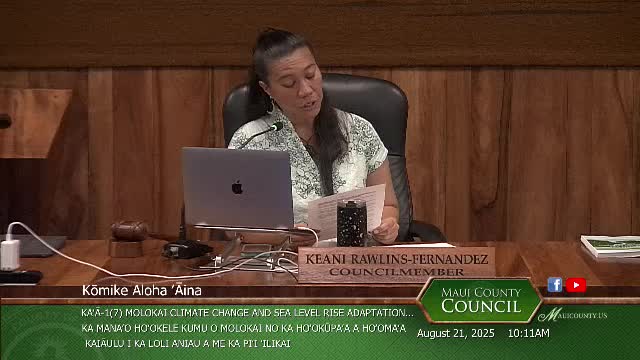
Committee action and next steps Chair Kiani Rollins Fernandez said the department should consult with community stewards and the office would return with refined language and options; the committee deferred the bills. Director-level staff asked for time to convene internal teams and provide recommended phrasing so the committee can consider definitions that match community intent.
Ending Committee members and testifiers agreed on the need for place-based definitions and ongoing consultation. The committee closed oral testimony and deferred action on Bills 106 and 107 to permit further engagement between department staff, lineal descendants and stewardship groups prior to a future committee report-back or ordinance drafting session.