Get Full Government Meeting Transcripts, Videos, & Alerts Forever!
Get email alerts on the Climate Adaptation topic
No spam. Unsubscribe anytime.
Molokai community presents climate adaptation master plan; council defers action
Summary
The Maui County Council Committee on Aloha ʻĀina on Aug. 21 heard a presentation on the Molokai Climate Change and Sea Level Rise Adaptation and Resiliency Master Plan, a community-led study completed by Sustainable Molokai and partners and submitted in April 2024.
The Maui County Council Committee on Aloha ʻĀina on Aug. 21 heard a presentation on the Molokai Climate Change and Sea Level Rise Adaptation and Resiliency Master Plan, a community-led effort completed by Sustainable Molokai and partners and submitted in April 2024. Tyronee Williams, former executive director of Sustainable Molokai, presented the project’s process and findings and said the plan was grounded in sustained community outreach across Molokai’s districts.
The plan, funded initially by a county grant awarded in 2020 and restarted after pandemic delays, documents existing conditions, compiles vulnerability assessments, and identifies priority adaptation strategies for coastal assets. "This plan is the first of its kind, and the purpose of it is to give our community an opportunity to determine what critical infrastructure we'll need to relocate or rebuild or re-envision for our future," said Tyronee Williams, identified in the record as the project presenter and former executive director of Sustainable Molokai.
Why it matters: Molokai residents and department staff told the committee that the island’s main town and many lifeline services sit in low-lying areas that are increasingly exposed to flooding, erosion and episodic roadway failures. The plan aims to provide a locally driven, actionable roadmap so work on design, funding and construction can proceed in the coming years rather than waiting for crisis conditions.
Plan scope and methods - The contractor conducted initial district meetings in Maunaloa, Ho‘olehua, Kaunakakai and Mana‘e and held at least five community workshops, one in each district, supplemented by focus groups, pop-up outreach and a do-it-yourself (DIY) sea-level-rise tour with on-site signs and QR codes. Presenters said the outreach counted overlapping attendance carefully and estimated broad island representation. - Technical work included mapping of coastal inundation, identification of critical assets (roads, wastewater, transmission lines, fishponds), site surveys by engineering consultants (Sea Engineering), and layered mapping of existing land uses, habitat and vulnerable properties. - The project team developed options for short-term (1–3 years), mid-term (3–10 years) and long-term (up to 20+ years) mitigation and adaptation strategies for 13 priority locations (the original scope anticipated 5–10). - The plan calls for cost–benefit analyses for proposed projects and directs that analyses consider ecosystem services, property values, public works values and benefits to disadvantaged communities where appropriate.
Community, indigenous and agency engagement Presenters and multiple public commenters said the plan was designed to be “by Molokai, for Molokai,” and to integrate traditional ecological knowledge with technical science. "The goal of the plan is to create an action based document that is indigenous and community driven and community led," said a project presenter.
Nancy McPherson, a planner with the Department of Hawaiian Home Lands (DHHL), testified that DHHL participated in the planning and will use the plan’s data for its Molokai Coastal Homesteads Community Resilience Plan. "We were really pleased that even though this is a county project, DHHL was included in the planning process and we were consulted with," McPherson said.
Key community concerns and technical issues - Wastewater facility vulnerability: County staff and residents flagged the town wastewater treatment facility as a priority site. Presenters said county inundation studies show the facility will be affected when sea level rise reaches several feet; community concerns focus not only on facility equipment but also access to the site during floods and the broader service area. - Cemeteries and burial sites: Committee members asked about protected burial sites such as Kapaakea Cemetery. Presenters said the plan addresses assessment steps, family notification, and potential relocation as a lengthy, multi-step process involving county, state and family coordination. - Access and evacuation: Residents from East Molokai described changing evacuation practices as roads erode; one local testifier said the community had subdivided evacuation zones because some roads are no longer passable.
Implementation and next steps Presenters emphasized that the plan is phase one: identifying priority sites, evaluating options with engineers, and documenting community priorities. The project team and county staff said additional work will be needed to design projects, identify funding, and coordinate with state agencies — actions that could take years.
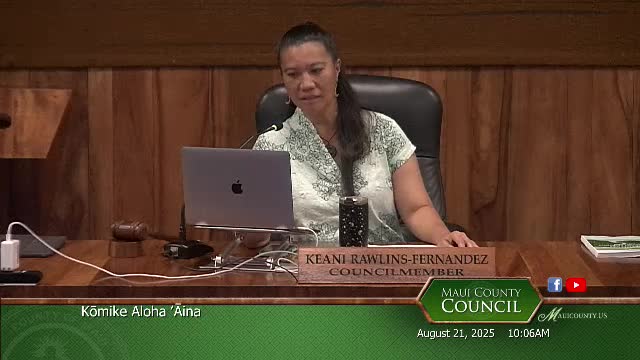
Committee action Committee chair Kiani Rollins Fernandez said the item would be deferred for later deliberation after members and staff had time to follow up with resource contacts. There was no vote recorded on the plan; the committee closed public testimony and deferred further committee action to a later meeting.
Ending: The project team and multiple testifiers told the committee they want funding and administrative support to move identified projects from plan to implementation. Presenters said they will continue coordinating with county departments, state agencies and community groups to refine designs and funding strategies.