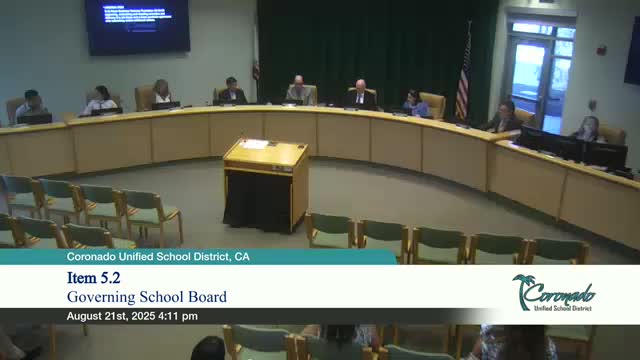
Coronado Unified approves lease‑purchase financing to bridge budget shortfall
Loading...
Summary
The Coronado Unified School District board approved Business Services Resolution 25‑08‑02 authorizing lease/lease‑purchase financing and related actions intended to relieve near‑term budget pressure while the district transitions to basic aid.
The Coronado Unified School district board approved Business Services Resolution 25‑08‑02, authorizing site lease and lease‑purchase financing to address a near‑term budget shortfall and refinance older debt.
Deputy Superintendent Drew Salamanca told the board the financing is intended as a short‑term bridge while the district transitions to a “basic aid” revenue structure. “To put it plainly, at least purchase financing is essentially loan,” Salamanca said, describing taxable and tax‑exempt options the district reviewed.
Salamanca presented two primary structures the district considered. For a taxable option he described a roughly $1,000,000 loan and said, “If we were to keep the loan alive, dollars 1,000,000 would cost us 1,150,000.00 if we pay it off in 2027. If we keep it all the way to maturity, which is 09/11/2040, the total cost would be about 1,570,000.00.” He said a tax‑exempt structure would allow a larger principal at a lower rate: “We’re suggesting, about a $2,100,000 loan, significantly lower interest rate of 4.03%,” and added later that the tax‑exempt option carries different prepayment timing and total cost assumptions.
Trustees pressed staff on alternatives and on how the numbers were developed. One trustee summarized the tradeoff and the likely interest cost: “So basically, by my math, we are gonna commit to spend about $570,000 in interest charges to have access to $3,110,000.” Salamanca said the district ran a competitive process for financing, receiving responses from multiple agencies, and presented the staggered structure to preserve short‑term flexibility while lowering long‑term cost where possible.
Salamanca framed the financing as a tool to avoid deeper, immediate program reductions: the district has been covering an approximately $550,000 annual certificates of participation payment in part from developer fees and in part from the general fund. The proposed structure would shift some of that burden and create a buffer for one‑time or unanticipated costs, such as HVAC repairs, carpeting and roofing work, and emergency maintenance, he said. He noted the district is opening the year with lower enrollment and that staff expects staffing reductions to align with enrollment declines rather than be triggered by the financing.
Board members asked when prepayment options would be available and how quickly the district could extinguish debt once new revenues arrive under basic aid. Salamanca described prepayment windows tied to each financing component and said the district’s plan would be to pay down debt as soon as practical to minimize total interest paid: “The recommendation…and why the prepayment option was so important, the September 27 prepayments, coincides with our first year as basic aid.”
The board voted to approve the resolution authorizing the lease and lease‑purchase financing. There was no roll‑call tally in the public record excerpt.
The district will proceed with documentation and the staff said it will report further budget details at the district’s September board meeting and at first interim in December.