Get Full Government Meeting Transcripts, Videos, & Alerts Forever!
Get email alerts on the Street Maintenance topic
No spam. Unsubscribe anytime.
Abilene street board approves four 2026 paving projects, including College Heights and Barrow Street
Summary
The Street Maintenance Advisory Appeals Board voted unanimously to fund four paving projects and a contingency preventive-maintenance item from a $7.5 million budget, selecting projects from a list that totals roughly $110 million.
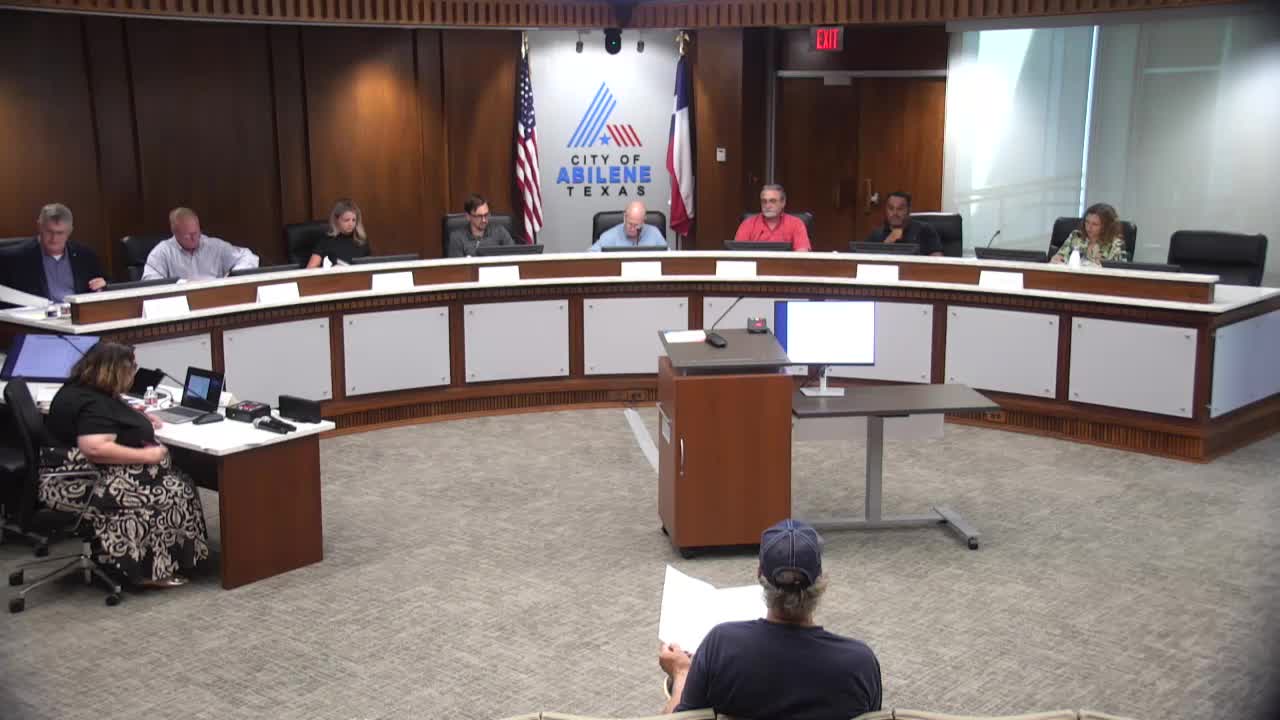
At a meeting of the Street Maintenance Advisory Appeals Board in Abilene, members voted unanimously to approve four street projects and a preventive-maintenance contingency from roughly $7.5 million in available funds.
The board approved full-depth work on College Heights (Work Zone 9) with an estimated cost of about $2.4 million; a preventive maintenance package for the Soda District downtown at about $1.1 million; a linear/collector project on 20 Fifth Street from Ross to Buffalo Gap (estimated about $330,000); and Barrow Street from South Second to South Eleventh at an estimated $3.7 million. The board also approved a contingency preventive-maintenance item for Lone Star. The motion was made by Brock, seconded by Branson, and carried on a roll call with all members voting yes.
Why this matters: city staff said the committee’s candidate list totals roughly $110 million while the program has about $7 million to $7.5 million to spend this cycle, forcing prioritization between neighborhood rebuilds, collector widening and lower-cost preventative treatments.
City staff presented the board with a layered approach to pavement work: full-depth rehabilitation (replacement down to failed subgrade), partial-depth rehabilitation (spot repair and overlay) and preventative maintenance (seal coats and similar treatments intended to extend service life). "A full depth rehabilitation will typically last between 15 and 25 years with proper maintenance," engineering technician Michael Miller said, citing pavement-condition-index surveys performed as recently as 2021.
Max, a public-works staff member who led the program presentation, said three of five previously approved projects are ongoing or about to start and that two were delayed by a recent cyberattack that affected utility plans. The attack erased or delayed designs on one neighborhood project; staff said utility plans are being redrawn and that some projects will shift into next year as a result.
Board members and staff discussed tradeoffs between tackling large, costly full-depth neighborhood projects and spreading funds across more preventative maintenance and linear-collector improvements. Assistant City Manager Michael Rice said capacity is available in the local contracting market: "They laughed at us," Rice recalled, referring to early worries about overloading contractors; he said local contractors told staff they could handle additional work alongside other local clients.
Public commenters urged the board to evaluate specific streets not currently prioritized, including North 20 First Street (a short gravel block used by several residents with mobility limitations), Waldrop Drive (residents described narrow pavement and high school-bus traffic), and other neighborhood streets. Staff said citizen requests can be added for evaluation and that some streets mentioned—including North 20 First and Waldrop Drive—will be reviewed for placement on future lists.
The board also reviewed program-level data showing how projects move between categories: several partial-depth projects from earlier lists have since escalated to full-depth status as conditions worsened. Staff said project cost estimates are updated annually and noted material-cost inflation of roughly 3.5–4 percent this year.
The vote: Brock made the motion to adopt the slate of projects as presented; Branson seconded. Shelley (staff) called the roll. The recorded vote was: Mister Bailey — Yes; Miss Martinez — Yes; Mister Hurt — Yes; Mister Isbell — Yes; Mister Polaris — Yes; Mister Todd — Yes. The motion carried unanimously.
Looking ahead, staff recommended holding a second board meeting later in the calendar year to reconcile any changes and to review project progress; the board scheduled its next meeting for Oct. 30.
Ending: Board members emphasized the program’s limited funding relative to identified needs and encouraged residents to continue submitting locations for evaluation so staff can place them on future rankings or recommend alternative funding paths such as council-directed or economic-development- earmarked dollars.