Get Full Government Meeting Transcripts, Videos, & Alerts Forever!
Get email alerts on the Rezoning Rowan Ranch topic
No spam. Unsubscribe anytime.
Benbrook council denies Rowan Ranch rezoning after floodplain and developer-conduct concerns
Summary
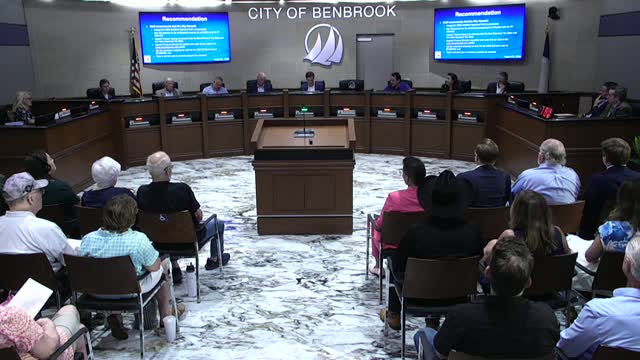
After more than three hours of presentations and public comment, Benbrook City Council voted unanimously Aug. 21 to deny a request to rezone roughly 80 acres for the Rowan Ranch development, citing floodplain, neighborhood-compatibility and public-confidence issues raised by residents and staff.
The Benbrook City Council on Aug. 21 voted to deny a rezoning application for about 80 acres known as Rowan Ranch, rejecting a plan that would have rezoned roughly 62.4 acres to BR (one-family reduced) and 17.5 acres to D (multi-family).
The request, filed as PZ-2025-037-25-06, would have changed the property at 4501 West Loop 820 South from a CPD (plan development district) adopted under Ordinance 1490 to standard base zoning. The Planning and Zoning Commission had recommended approval, but dozens of residents spoke in opposition at the council meeting and staff noted a formal written protest within 200 feet that triggered the city’s protest threshold under Texas law.
Why it matters: roughly 55 acres of the site lie in the FEMA-designated floodplain; citizens and several engineers warned that changes to Mary's Creek could increase downstream velocities or water surface elevations. Council members and staff stressed that a rezoning would only change the property’s zoning classification and would not itself authorize construction or creek work — but opponents argued rezoning would remove the flexibility the prior PD ordinance provided to preserve open space and require site-specific mitigation.
Developer presentation, engineering claims Corey Waldrop, the applicant, told council the rezoning would align zoning with the city’s 2020 comprehensive plan and said Rowan Ranch would deliver a mix of single-family housing, walking trails and private amenities. He said the concept plan shows about 178 proposed lots and a target build start in 2026. Builder partner David Weekley Homes described home prices “starting in the mid-$500,000s and extending into the $700,000s.” Beau Pedigo of David Weekley and Jake Bridal of RW Jones Heavy Construction spoke in favor of the project and its private infrastructure commitments.
Samantha Renz, a professional engineer and certified floodplain manager with Evolving Texas Engineering, told council her team reran hydrology and hydraulic models and that, for the portion of the site they modeled, they “have not increased water surface elevations. There is no increase in velocity. We have increased valley storage and in some areas have lowered the water surface elevations as much as, I believe, 1.6 feet.” Renz also said the project would require approvals from the City of Fort Worth, the U.S. Army Corps of Engineers and FEMA before any construction that alters the floodplain could proceed.
Staff context and history City planner Doug Howard reviewed the site’s zoning history: a previous CPD (Ordinance 1490) adopted in 2023 had reserved roughly 60 acres as preserved open space and limited development to the frontage area. Howard told council that rezoning does not change FEMA floodplain constraints and said, “Rezoning land that contains floodplain does not remove or change the floodplain constraints.” Howard also reported that he received 17 direct emails (three in support, 14 in opposition), and that the formal written protest submitted by property owners within 200 feet exceeded the 20% land area threshold that, under state law, would require a three‑fourths council vote (six of seven council members) to approve a protested rezoning.
Public comment and expert opposition Dozens of residents spoke at the council meeting. Concerns focused on flood risk to existing downstream homes, loss of tree and riparian buffers, long-term maintenance and insurance impacts, and the appropriateness of replacing a PD that explicitly preserved floodplain open space with base zoning that provides fewer site-specific conditions. Opposition included technical critiques: consulting engineer Spencer Sundstrom, retained by area residents, said the developer’s study used a much lower hundred‑year flow for Mary’s Creek (about 33,000 cubic feet per second) than several other recent studies and argued that discrepancy warranted further independent review. Sundstrom said that other, more recent studies estimate substantially higher flows than FEMA’s model.
Other public speakers raised concerns about the applicant’s business history. Attorney Kyung Lee — who said she represented creditors in an involuntary bankruptcy against the applicant’s prior company — described litigation and creditor claims in the record; those statements were offered as part of public comment and attributed in the meeting transcript to Lee.
Council action and vote Councilmember Dr. Marshall made a motion to deny the rezoning application; Councilmember Phillips seconded. The motion passed unanimously. Because a formal protest had been filed, Howard reminded the council that approval (the opposite outcome) would have required six favorable votes under Texas protest statutes. The final action on the rezoning application was to deny the request; no development approvals, permits, engineering plans or floodplain modifications were granted by tonight’s action.
Votes at a glance: - Approval of minutes (regular meeting 08/07/2025): motion by Councilmember Tyner, seconded by Dr. Marshall; carried by voice vote. - Acceptance of finance report for period ending 07/31/2025: motion by Councilmember Mackey, seconded by Councilmember Franklin; carried unanimously. Staff reported fiscal‑year‑to‑date general fund revenues of $25,437,570 and expenditures of $22,759,536. - Acceptance of the 2025 certified appraisal roll and setting tax‑rate procedures (preliminarily setting maximum proposed property tax rate at the voter‑approval rate of 0.609754): motion by Councilmember Tyner, seconded by Councilmember Phillips; council took the required roll call vote and approved the administrative steps to publish tax data and set the maximum rate for budget notice purposes (the adopted tax rate will be set later in the budget process).
What council members said Councilmembers acknowledged strong emotions and wide public turnout. Several council members and city staff reiterated that rezoning does not itself authorize creek work and that future development would require engineering, city review, Fort Worth involvement as appropriate, Army Corps and FEMA approvals (CLOMR/LOMR processes) and standard bonding and inspection requirements.
Next steps The denial means the property remains zoned under the city’s existing framework (the CPD established in 2023). The applicant may choose to revise proposals or reapply in accordance with city rules; under the city’s ordinance and state law, reapplication procedures and any waiting periods depend on the specific prior actions and whether the denial is made with prejudice.
Closing note Council members thanked staff and residents for the large turnout and detailed input. The council did not take any action tonight that would authorize floodplain alterations, infrastructure construction or subdivision plats; those proposals would require separate, project‑level engineering review and federal and regional approvals before any on‑the‑ground work could begin.