Get Full Government Meeting Transcripts, Videos, & Alerts Forever!
Get email alerts on the Education Freedom Scholarship topic
No spam. Unsubscribe anytime.
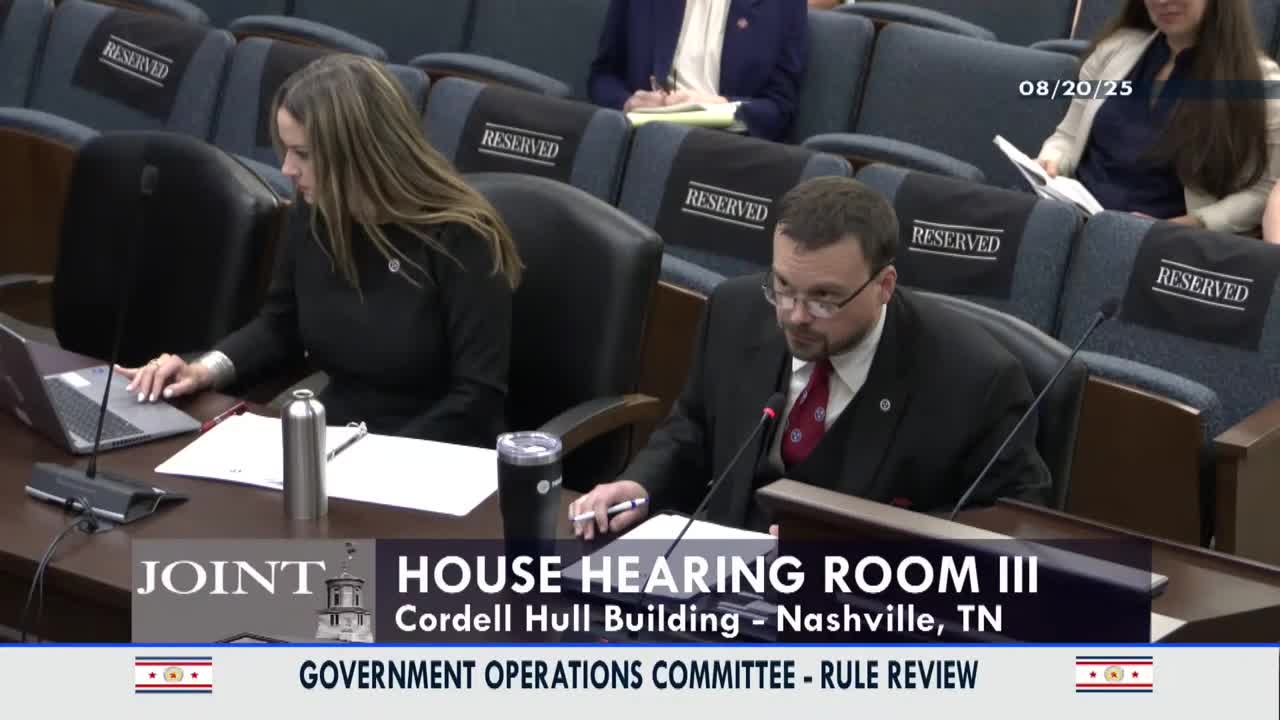
State Board’s EFS rules advance amid questions over data collection, timing and allowable uses
Summary
The State Board of Education’s rules to implement the Education Freedom Scholarship advanced from committee, but lawmakers pressed department staff on data collection, eligibility definitions and how funds may be used.
The committee advanced rules to implement the Education Freedom Scholarship (EFS) program but raised multiple questions about how the program will be administered, what data will be collected, the timing of awards, and allowable uses of scholarship funds.
The EFS statute (Public Chapter 7, 2025 First Extraordinary Session) directs the State Board of Education to adopt rules “narrowly tailored to enforce the requirements of this program,” according to presenters. Nathan James, representing the state board, said the board held a rulemaking hearing and received comments but did not change the rule where comments conflicted with statutory language.
Key points and concerns from lawmakers: - Who benefits: Several lawmakers, including Chairman Clemens and Representative Parkinson, asked whether the program would primarily serve students already enrolled in private schools or would expand access for students currently in public schools. Presenters said the legislation did not require that historical comparison data be collected for the initial award year; the department said the application for next year will include additional questions required by the statute (for prioritization tiers). Emily Cornute, director of legislative affairs at the Tennessee Department of Education, said the department did not collect historic private‑school enrollment data for this first cycle because the statute did not require it, but that future applications will include fields required for prioritization under the law. - Program eligibility and private-school definitions: Lawmakers raised questions about the rule’s definition of a nonpublic school and whether a virtual provider or an entity that only leases space could qualify. Presenters said a school must meet the category 1, 2 or 3 definitions in the department’s nonpublic-school rules and have a physical location in Tennessee where students may receive testing or services. - Use of funds and curriculum oversight: Members asked whether state funds provided via EFS could be used for textbooks, curricula and instructional materials that local public-school rules might prohibit. Presenters responded that private schools retain autonomy and that the statute limited the board’s rulemaking to items “narrowly tailored” to the program; statute-specific prohibitions that apply to LEAs do not, as drafted, automatically apply to participating nonpublic schools. - Return of funds: Department staff said that if a student’s participation terminates, the recipient’s EFS account will be closed and remaining funds returned to the state; the department indicated it would follow statute and existing finance procedures for remittance.
Votes and procedure: The House voted to give a positive recommendation at the committee hearing; the Senate lacked a quorum at the time and the clerk was to record Senate votes later. Lawmakers requested additional documentation on timelines, sampling for assessment data and how the department will schedule awards relative to private-school admission cycles.
Provenance: Discussion and Q&A recorded at 5214.6753–5470. (State Board presentation and extended questioning on the EFS rules.)