Get Full Government Meeting Transcripts, Videos, & Alerts Forever!
Get email alerts on the Zoning Infrastructure topic
No spam. Unsubscribe anytime.
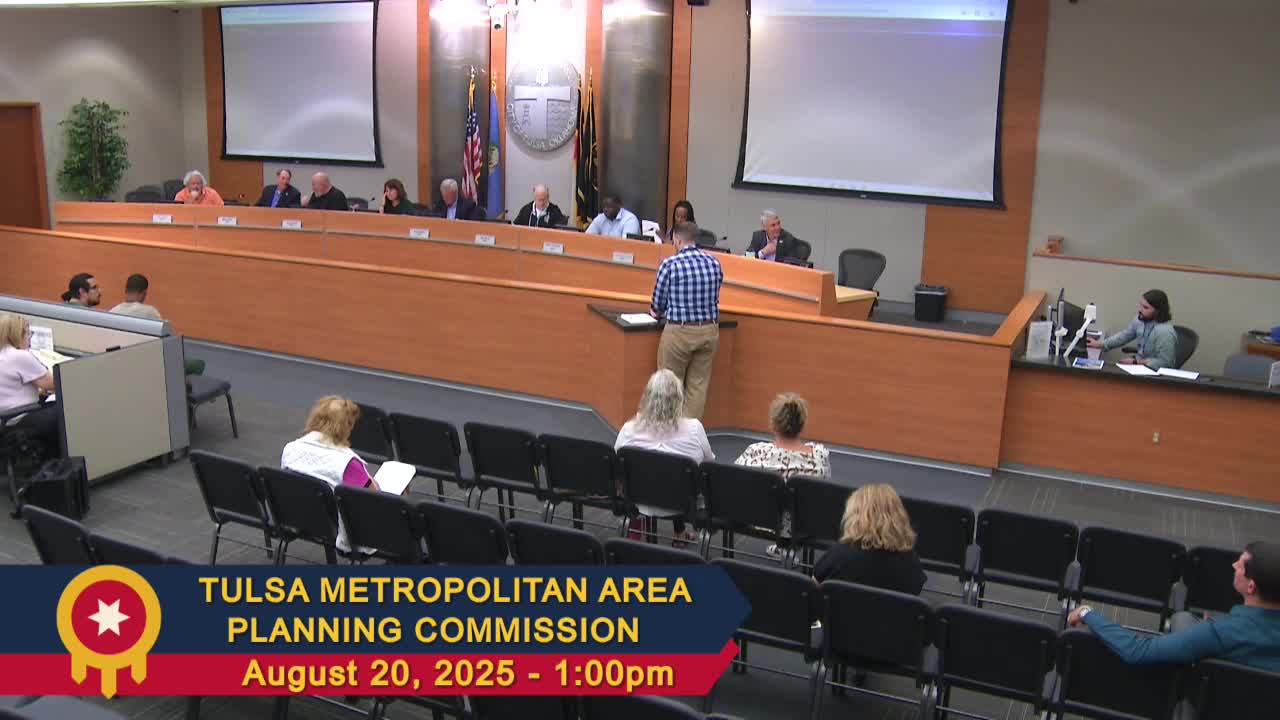
TMAPC denies request to waive sewer 'dry lines,' citing future public cost and capacity plans
Summary
The Tulsa Metropolitan Area Planning Commission on Aug. 20 denied a developer’s request to waive a subdivision rule that requires installing stubbed public sewer mains (“dry lines”) even if new lots will use on‑site septic systems in the short term.
The Tulsa Metropolitan Area Planning Commission on Aug. 20 voted to deny a requested modification to the city subdivision and development regulations that would have exempted a 47-acre proposed subdivision from installing public “dry” sanitary lines while relying on on-site septic systems.
The denial came after staff and Tulsa water and sewer officials said the area drains to the Rose Dew lift station and the Spunky Creek interceptor basin, which the city plans to relieve in coming years as part of a larger sewer investment. City staff recommended denial, saying the dry-line requirement prevents expensive, later retrofits that would be paid with public dollars.
Planning staff explained at the hearing that the modification request sought to waive subdivision regulation section 5‑1130.1.D.1 (the requirement to install stubbed sanitary mains or “dry lines” for future connections) so the developer could proceed with septic systems without installing the normally required public mains in easements. Joan Gosvick, planning manager for utility planning at the Tulsa water and sewer department, told commissioners the utility is finishing a wastewater study and expects the Rose Dew interceptor extension to appear in the five‑year plan "probably, towards the end of the 5 years to extend that interceptor." She said the city’s experience shows it costs roughly $120,000 per lot in public dollars when the city later has to bring sewer to subdivisions that developed on septic and whose systems failed.
Megan Pascoe of Tanner Consulting, representing the potential developer, said the developer’s first preference is to bring RS‑4/RS‑5 lots served by city sewer, but the Rose Dew lift station has no capacity now. Extending the Spunky Creek interceptor two miles to reach the site would be a $2.5 million to $3 million undertaking, Pascoe said, and the developer cannot bear that cost alone. "We want to connect to City of Tulsa sanitary sewer. That's what the developer wants to do, but we are being told we cannot do to sanitary there is not capacity in the system today," Pascoe said.
Pascoe explained the developer’s interim proposal: build half‑acre lots served by on‑site systems and, in lieu of installing dry public mains, ask for the waiver. She said doing so would avoid a steep per‑lot cost increase that otherwise makes the project financially infeasible. "If we were to do that, it takes a $75,000 half acre lot to a $100,000," she said, describing the cost for on‑site disposal plus dry‑line obligations.
City engineers and utility staff pushed back on the proposal, arguing dry lines have been required since 1988, have been used successfully in earlier South Tulsa subdivisions and reduce later public expense and homeowner disruption. Sandy Sillman, lead engineer in Development Services, said the subdivision standard is to install a public sanitary main in the rear easement with future taps available. Joan Gosvick emphasized that public investments already planned — including a roughly $50 million ARPA‑funded investment in the Lower Bird Creek wastewater plant and interceptors — are intended to open the Spunky Creek basin for development and that the dry‑line rule preserves the ability to connect without digging up backyards later.
Local residents who live along E. 11th Street and nearby neighborhoods spoke in opposition to the waiver, saying the area has flooding, difficult soil (limestone and springs), and existing septic problems. Susan Frederick, who said she has lived on East 11th Street for nearly 40 years, referred to annexation obligations and local soil conditions when arguing against approving the waiver.
After extended discussion, a commissioner moved to deny the modification request consistent with staff recommendation; the motion was seconded and adopted. The denial preserves the subdivision regulation requirement that public dry sanitary mains be installed in new plats within city limits even where developers plan interim on‑site disposal.
Commission staff and utility representatives noted the denial does not prevent the landowner or developer from pursuing alternative approaches: seek off‑site trunk extension (with recapture mechanisms), wait for planned interceptor capacity, or propose a different subdivision concept that complies with existing regulations. Pascoe and the developer representatives said they will continue to pursue options but that the decision effectively requires either capacity in the immediate sewer system or the developer to shoulder the multi‑million‑dollar trunk extension to proceed with denser lots.
The commission’s decision was framed as preserving long‑term public cost control and protecting neighborhoods from future disruptive retrofits when public sewer becomes available.