Get Full Government Meeting Transcripts, Videos, & Alerts Forever!
Get email alerts on the Opioid Treatment Rules topic
No spam. Unsubscribe anytime.
State updates rules for outpatient and opioid treatment programs; committee advances both chapters
Summary
The Department of Mental Health and Substance Abuse Services presented rule updates for outpatient buprenorphine-prescribing programs (OBOTs) and federally certified opioid treatment programs (OTPs), citing federal regulatory alignment and increased enrollment. The committee gave both rule chapters positive recommendations.
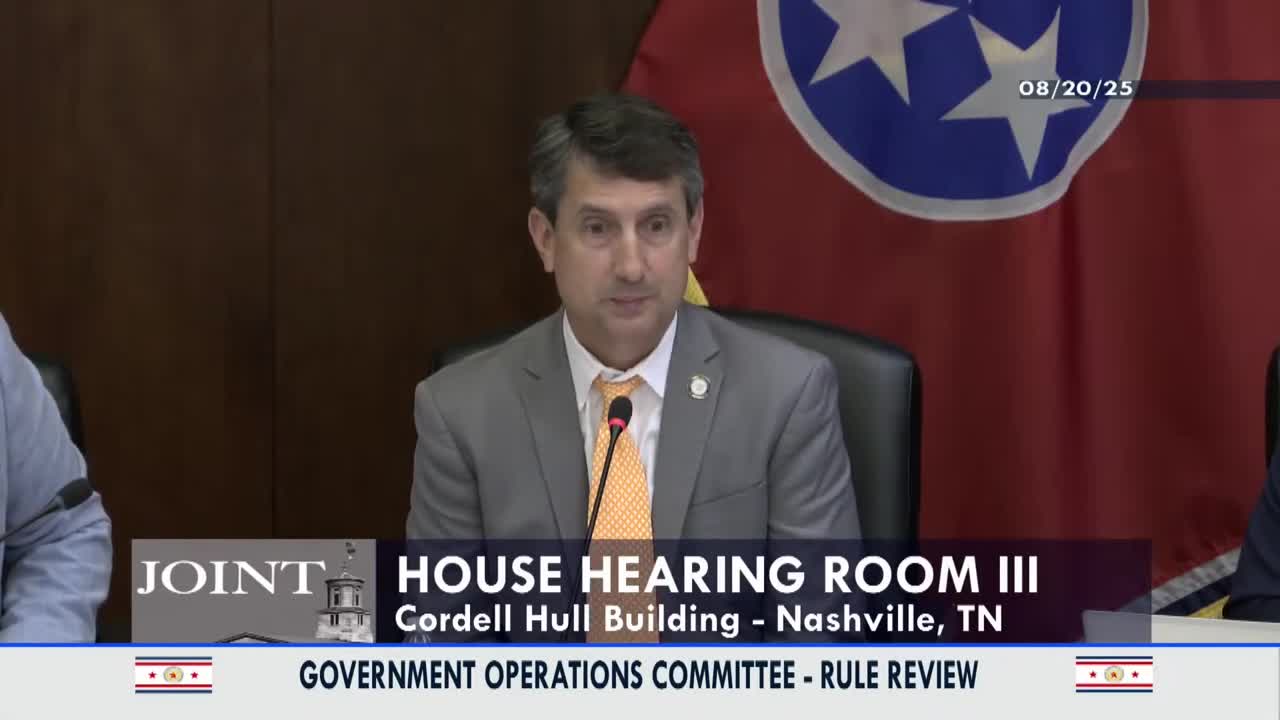
The Government Operations Committee advanced rule updates Aug. 20 for two separate chapters that govern outpatient buprenorphine treatment settings (OBOTs) and opioid treatment programs that dispense methadone (OTPs).
The Department of Mental Health and Substance Abuse Services said the OBOT chapter (chapter 9 40-5-35 as presented) addresses minimum program requirements for nonresidential office-based opioid treatment facilities, which typically prescribe buprenorphine. The presenter described the rules as a periodic review required by statute and said the department solicited and incorporated feedback from sister agencies, community stakeholders and a buprenorphine-treatment guidelines committee; a public rulemaking hearing was held on Dec. 18, 2023.
The presenter differentiated OBOTs and OTPs: “OBOTs primarily prescribe medication buprenorphine... whereas OTPs primarily dispense methadone... OTPs are more highly regulated. They're required to be certified by the federal government, have special registration through the DEA,” said Dr. Wes Gemin, the department’s chief pharmacist and state opioid treatment authority.
Why it matters: Both rule chapters set minimum program standards for treatment of opioid use disorder and affect how clinics, prescribers and highly regulated OTPs operate in Tennessee. Department officials said patient enrollment in OTPs has increased (from 5,800 individuals in 2020 to 9,380 in the most recent count presented) and noted TennCare coverage changes as a factor in increased enrollment.
Lawmakers asked whether the rules address how clinics interact with jails and sheriffs, community disruption planning, the use of naltrexone (Vivitrol) and whether certificate-of-need (CON) requirements limit expansion of OTPs. Officials said the OBOT chapter does not require a CON, but OTPs do; the CON process is a separate review outside the department’s licensing chapter. Officials also described community-relations requirements within the rules to limit loitering and trash, and said Vivitrol is an allowable, though not necessarily commonly used, option.
Formal action: Both OBOT and OTP rule chapters moved out of committee with positive recommendations. Roll-call tallies recorded ayes in both chambers during the hearing; presenters noted no public comment at the hearings for OBOTs and said OTP rule updates had received oral and written comments during the rulemaking process and were revised accordingly.
Provenance: Presentation and Q&A recorded at 1246.16–1331.135 (OBOT) and 2095.52–2179.8499 (OTP) in the committee transcript.