Get Full Government Meeting Transcripts, Videos, & Alerts Forever!
Get email alerts on the Rule Review Rollup topic
No spam. Unsubscribe anytime.
Government Operations committee advances multiple agency rule changes; many receive positive recommendations
Summary
The committee considered rule changes and administrative updates from state boards and agencies, advancing most items with positive recommendations from the House and/or Senate. Several items prompted questions about fiscal impact, public access, and school-choice implementation.
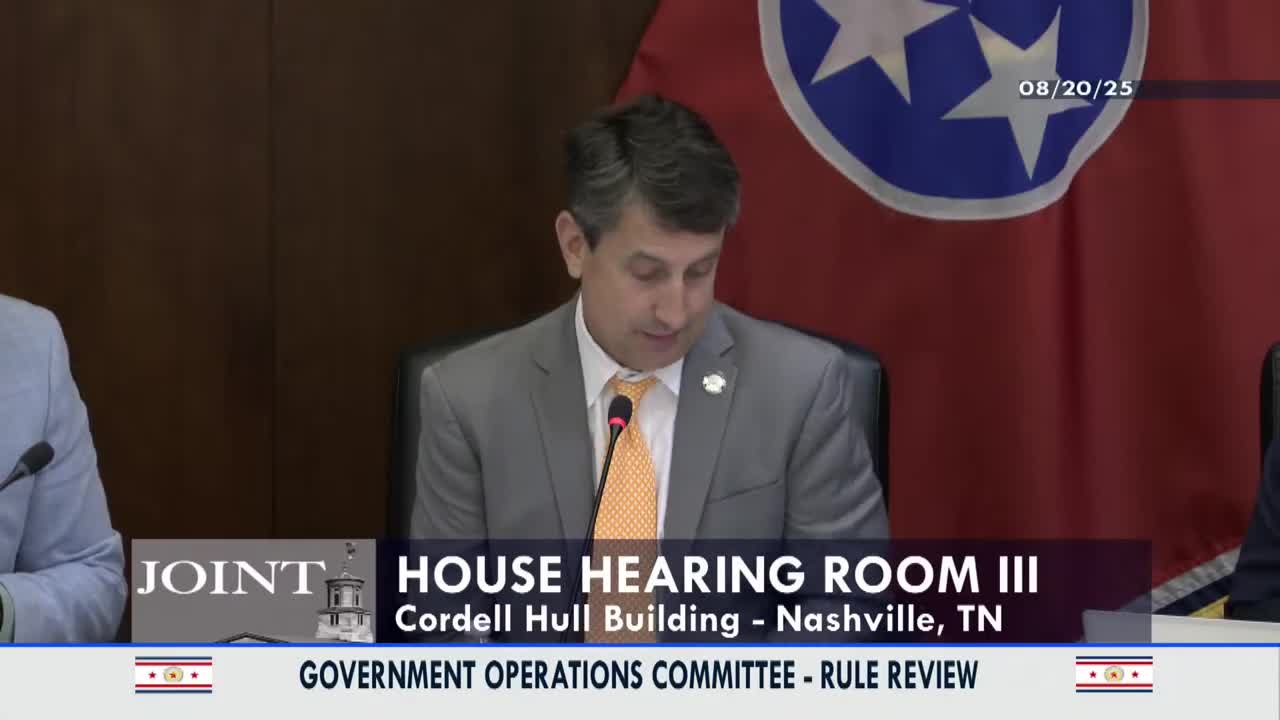
The Government Operations Committee met Aug. 20 and advanced a slate of rule amendments, fee changes and administrative rules from multiple state boards and agencies, with most items receiving positive recommendations from the House and/or Senate.
The package included emergency licensure rules from the Board of Medical Examiners, updates to body-piercing regulation, fee reinstatements at the Board of Nursing, new rules for outpatient and opioid treatment programs, increased licensing fees for the Tennessee Motor Vehicle Commission, a public records rule from the Tennessee Department of Veterans Services, retrospective updates from the Department of Commerce & Insurance (including the Collection Services Board and Real Estate Commission), appeals-and-hearings rule updates from the Department of Human Services, and education-related rules from the State Board of Education, including the Education Freedom Scholarship (EFS) rules.
Why it matters: These rules affect how professionals are licensed, how state boards fund their operations, how opioid treatment is regulated, how records requests are handled, and how a newly created school-choice program will be administered. Several items carried fiscal implications or raised questions about transparency and oversight.
Key outcomes (selected): - Emergency rule — Board of Medical Examiners (licensure categories, short-term/foreign training licenses): advanced with a positive recommendation in both chambers; clerk recorded senate ayes during roll call. - Board of Nursing (fee reinstatements): advanced with a positive recommendation; presenters said fee increases are intended to restore board self-sufficiency after multi‑year deficits and a large prior reserve draw-down. - Mental Health & Substance Abuse rules (OBOT and OTP chapters): both advanced with positive recommendations after departmental presentations describing clinical scope and federal alignment. - Tennessee Motor Vehicle Commission (50% fee increase across most licensing categories; changes to reconsideration timing and communications): advanced with positive recommendations; committee recorded one opposition in the House for this item. - State Board of Education items: the committee advanced (a) repeal of an older mission-statement ‘‘preface’’ from the rules, (b) textbook and instructional materials waiver procedures, and (c) rules implementing the Education Freedom Scholarship; notable debate occurred over the mission-statement repeal and EFS data and oversight.
Votes and tallies noted on the record: several presenters reported senate roll-call tallies during the meeting (commonly recorded as 5 ayes in the senate for many items); the Motor Vehicle Commission item recorded 6 senate ayes and one recorded opposition in the House. For the Education Freedom Scholarship rules, the committee proceeded with a House positive recommendation after the Senate lacked quorum; the clerk was to record senate votes later.
Meeting presenters included agency staff from the Department of Health, Department of Mental Health and Substance Abuse Services, Department of Commerce & Insurance, Department of Human Services, Tennessee Department of Education and the State Board of Education. Committee members raised questions about standards for verification in medical licensure, the Board of Nursing's reserves and fee history, community impacts of opioid treatment facilities, public-records procedures for veterans services, and data collection and access under the EFS program.
Next steps: Items that received positive recommendations will move forward to their next formal review as provided by legislative procedures. The State Board of Education’s EFS rules drew the most extended questioning and a procedural note that the Senate lacked quorum to record a full recommendation during this hearing; committee members asked for further clarification and documentation from staff.
Provenance: Topic coverage is drawn from the Government Operations Committee transcript, Aug. 20, 2025 (presentations and roll-call exchanges for agenda items 1–14).