Get Full Government Meeting Transcripts, Videos, & Alerts Forever!
Get email alerts on the Probate Heirs Property topic
No spam. Unsubscribe anytime.
Probate judge explains heirs property, delinquent-tax limits and intestacy rules to Hampton County Council
Summary
Probate Judge Shanna Parker briefed the council on heirs property, the limits of probate regarding delinquent taxes, and the intestacy statute, advising residents to consult an attorney for legal matters and explaining special-administrator certificates.
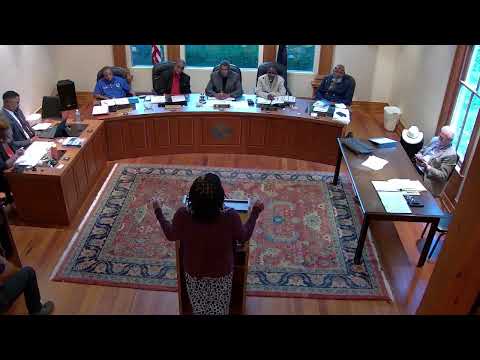
Judge Shanna Parker, accompanied by Deputy Judge Rachel Foster, briefed the Hampton County Council on Aug. 18 about probate procedures, common misconceptions about heirs property and how probate interacts with delinquent tax sales.
“While we are not attorneys ... we will always advise that you seek an attorney if you have any legal questions,” Parker told the council, opening the presentation. She said heirs property does not automatically transfer at death unless the deed indicates survivorship or a living trust; in most cases the property must pass through probate to change title.
Parker described survivorship deeds and living-estate arrangements as exceptions that allow property to transfer without probate. She said a will must still be probated to effect distribution of property and that in many cases families mistakenly assume ownership has passed immediately upon death.
On delinquent taxes, Parker said probate does not pause or prevent a tax sale. She described an “application for special administrator,” a temporary certificate that can give a person possession to gather property or retrieve personal effects while an estate is unresolved, but not ownership unless specifically stated. Parker noted one such certificate in the public packet was stamped June 2, 2025, and expired Aug. 2, 2025, and that the underlying deed in that case remained in the decedent’s name.
Parker also summarized intestacy rules as they apply in probate: if someone dies without a will and is married with no children, the spouse generally inherits everything; if married with children, the distribution typically divides 50% to the spouse and 50% among the children; if no spouse or children, probate looks to parents, and so on.
Council members asked clarifying questions about whether probate can delay tax sales and about deed preparation. Parker said probate cannot stop a delinquent tax sale and that deeds are executed outside the probate office, usually with attorney involvement.
Parker also reminded residents that probate provides access to public files, and that her office handles minor settlements, guardianships, marriage licenses, involuntary commitment hearings and the treatment court calendar.
Council members indicated they would follow up with staff on the specific decedent case discussed during the meeting; Parker said no full estate had been opened for that decedent other than the temporary administrator certificate referenced in the public records packet.
The presentation concluded before the council moved to public comment.