Get Full Government Meeting Transcripts, Videos, & Alerts Forever!
Get email alerts on the Renewable Energy topic
No spam. Unsubscribe anytime.
Council acknowledges Renewable Natural Gas evaluation with Black Hills Energy; MOU/NDA to be authorized
Summary
City staff and Black Hills Energy outlined an evaluation to convert landfill and wastewater methane to renewable natural gas (RNG); council acknowledged staff to proceed with a memorandum of understanding and nondisclosure agreement to allow a consultant‑led feasibility study at no cost to the city.
Rapid City staff and representatives of Black Hills Energy presented a proposal to evaluate producing renewable natural gas (RNG) from methane at the city’s closed landfill cells and the wastewater treatment facility and the council acknowledged staff to pursue an evaluation under a memorandum of understanding (MOU) and nondisclosure agreement (NDA).
Solid Waste staff member Stacy Titus described the background: recent work at the landfill and new equipment at the water reclamation facility have increased the potential volume of methane available for beneficial use. "RNG is the same as regular natural gas; it's greater than 90% methane," Titus said, describing how biogas is upgraded to pipeline specifications.
Paul Komack of Black Hills Energy Renewable Resources explained how federal and regional programs create additional value for RNG through RINs (renewable identification numbers under the federal Renewable Fuel Standard) and regional programs such as California's Low Carbon Fuel Standard. Komack described Black Hills Energy’s experience operating an RNG plant at a Dubuque, Iowa landfill that the company acquired and now operates.
Under the staff proposal, Black Hills Energy would fund a consultant evaluation at no cost to the city; the MOU would authorize the study and an NDA for shared technical data. If the study shows sufficient biogas and project feasibility, future agreements could cover bio‑gas rights, royalties and Black Hills Energy operating the plant and well field. Staff said the evaluation could be completed in 2026 and that the MOU includes a provision for a third‑party review of the evaluation for the city's benefit.
Stacy Titus told the council the city’s benefits would include a new revenue source from royalties, reduced management and operational cost for the gas collection system, and a local renewable energy source; Black Hills Energy would lead design, construction, operation and maintenance if the project proceeds.
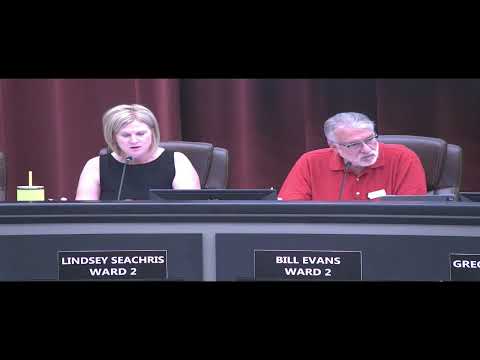
Councilman Bill Evans moved to acknowledge staff to proceed with the MOU/NDA evaluation; the motion carried. Staff said the evaluation will proceed with Black Hills Energy paying consultant costs and staff participation in the review.