Get Full Government Meeting Transcripts, Videos, & Alerts Forever!
Get email alerts on the Public Finance Sales Tax topic
No spam. Unsubscribe anytime.
Santa Rosa finance staff lays out how local sales tax is collected and shared
Summary
Deputy Director Scott Wagner explained the composition of sales tax receipts for Santa Rosa, clarified the Bradley‑Burns pass‑through and transaction/use tax differences, and described limits to local revenue driven by online sales and tax allocation rules.
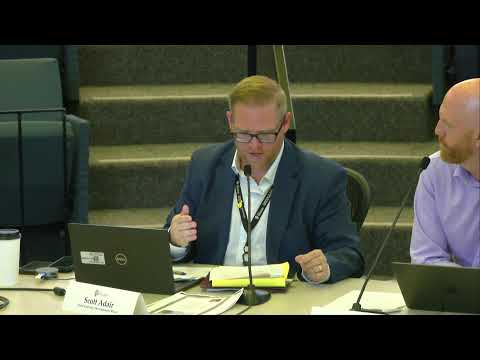
Deputy Director Scott Wagner of the Santa Rosa Finance Department gave the Economic Development Subcommittee a primer on how sales tax reaches the city and what local officials can and cannot control.
Wagner told the subcommittee that for a $100 taxable purchase in Santa Rosa the local government receives $1.75 — a direct city sales‑tax rate of 1.75% — and that sales tax provides roughly 35% to 40% of the city’s ongoing general‑fund revenue. He said the state and county also receive shares of sales tax and that the city’s total combined rate places Santa Rosa “towards the middle” compared with other county cities.
The presentation drilled into three revenue streams: the Bradley‑Burns pass‑through from the state (which Wagner said returns a 1% Bradley‑Burns share to the city), district transaction‑and‑use taxes (TUTs or city measures such as the 0.5% Measure Q and a 0.25% public‑safety measure discussed in the meeting), and county‑pool allocations for transactions without a clearly attributable jurisdiction.
Wagner warned that changes in how online sales are sourced and allocated have reduced local receipts. He used Amazon shipping as an example: if a resident in Santa Rosa buys an item that is shipped from another city, the TUT portion may go to the shipping jurisdiction while the Bradley‑Burns portion is allocated to the purchaser’s home jurisdiction. He said a city‑manager working group via the League of California Cities is studying the issue, but any statutory or administrative fix would take multiple legislative cycles.
The presentation and council questions clarified several practical points: automobile purchases are treated differently because the location of vehicle registration can drive allocation back to the buyer’s city; some changes during the COVID period corrected earlier errors but did not fully resolve the underlying allocation shifts; and the city does not yet have a single, precise dollar estimate of revenue lost to the online‑sales sourcing change.
“The Bradley‑Burns stream comes direct from the state,” Wagner said. “One percent comes directly back to us.”
Committee members asked for more context on the Wayfair decision and the COVID‑era corrections Wagner referenced. Wagner said he could not provide a detailed legislative history from memory and offered to follow up with documentation on the Wayfair case and the COVID‑period reallocation that partially fixed an error.
The subcommittee and staff agreed staff would follow up with more detail on the annual dollar impact of the city’s 0.5% general‑purpose measure and the working group’s efforts to model online sales impacts.
Wagner also noted administrative complexity: the state’s narrow taxable base means California has a relatively high tax rate but excludes many household expenditures taxed elsewhere, such as many services, utilities, and groceries. That narrower base magnifies the importance of what sales are taxable locally.
Ending: Wagner offered to return with follow‑up material and the subcommittee encouraged staff to prepare charts and timelines to help councilmembers and the public understand the fiscal implications and the path to potential legislative remedies.