Get Full Government Meeting Transcripts, Videos, & Alerts Forever!
Get email alerts on the Urban Forest Policy topic
No spam. Unsubscribe anytime.
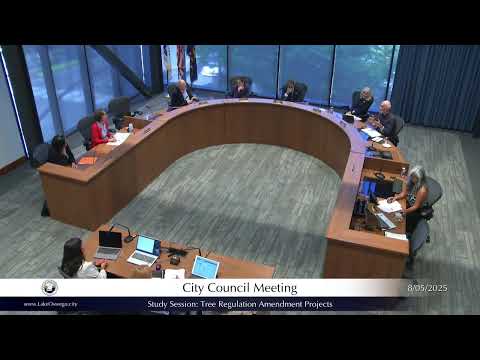
Council hears kickoff for tree regulation update aligned with urban and community forestry plan
Summary
Staff and consultants introduced a yearlong project to revise Lake Oswego's tree-related development code to align with the recently adopted Urban and Community Forestry Plan. The scope includes clear-and-objective standards, mitigation options, street-tree guidance, and public outreach.
City staff and consultants presented the kickoff for a tree regulation update project the council placed on its 2025 work program. The update follows the city's June 2024 Urban and Community Forestry Plan (UCFP) and will focus on targeted amendments to the Community Development Code to clarify permit standards, improve mitigation approaches, and support long-term urban forest sustainability.
Project scope and purpose: Community Development Director Jessica Numanalou and Cascadia Partners consultant Sachi Arakawa described a roughly yearlong effort to (1) create clear, objective standards where state housing law requires them; (2) align permitting between development and nondevelopment tree removals; (3) design incentives for preservation; (4) set soil-volume standards for street trees and parking lots; (5) review mitigation rules and require large mitigation trees where feasible; and (6) evaluate wildfire-safe landscaping options and other topics raised in the UCFP.
Engagement and schedule: The project will include a best-practices review, a stakeholder tree task force, community focus groups, at least one public open house, and multiple council briefings. The consultant described code-concept alternatives and said draft code amendments would be reviewed by advisory boards, planning commission, and council before final action.
Council feedback: Council members highlighted street-tree planting and canopy preservation, expressed interest in options to balance property rights and tree protections, and raised wildfire risk and hazard-tree removal as subjects to address. Council members asked staff to consider costs and housing production implications when crafting mitigation requirements and to provide examples of clear-and-objective standards used elsewhere. The consultant said the team will include peer-city models and recommended practices from around the region.
Next steps: Staff will form the tree task force and begin engagement with stakeholders. The council liaison to the project was identified and staff will return with code concepts, draft amendments and public outreach plans over the coming year.