Lifetime Citizen Portal Access — AI Briefings, Alerts & Unlimited Follows
San Francisco rolls out large-vehicle strategy: outreach, permits and vehicle buyback to address rising vehicular homelessness
Loading...
Summary
HSH and the mayor's task force described a multi-department plan combining outreach, a peer-based casework team, a vehicle buyback program, housing offers that preserve autonomy, and a large-vehicle refuge permit tied to services; the MTA and Board of Supervisors approved parking changes including a 2-hour citywide limit for oversized vehicles.
San Francisco officials on Aug. 6 outlined a citywide strategy to address the rising number of people living in vehicles, combining outreach, housing offers that reflect the autonomy of vehicle dwellers, a vehicle buyback option and a permitting scheme that temporarily shields individuals engaged in services from parking enforcement.
HSH Executive Director Shereen McSpadden said the department and the Mayor's Office convened more than 10 departments to craft the plan, which the mayor's task force described as having three goals: create better housing and service options for people living in vehicles, restore public spaces for neighborhoods, and coordinate a data-driven response across city agencies.
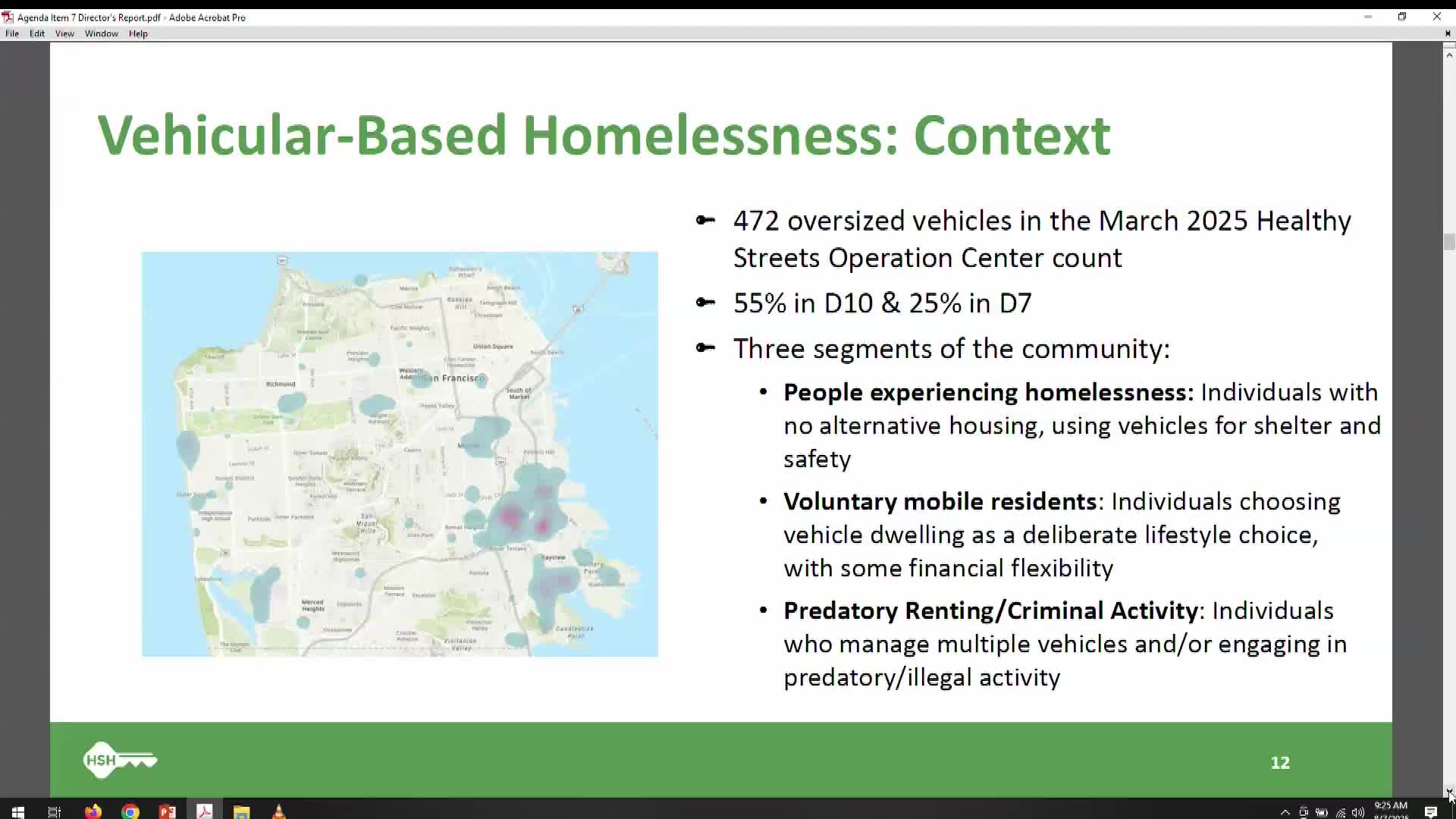
HSH cited March 2025 counts that found 472 occupied oversized vehicles and a 2024 point-in-time estimate of 1,444 households living in cars or vans, a 37% increase since 2022. The department said the vehicles are geographically concentrated: roughly 55% of occupied RVs were in District 10 and 25% in District 7 in the March count.
The city emphasized that offers to vehicle dwellers must be at least as attractive as vehicle living, citing autonomy, safety and privacy as central reasons some people choose vehicles. HSH laid out three population categories that call for different responses: people who are unsheltered and have no alternative; voluntarily mobile residents who choose vehicle living as a lifestyle; and people who operate predatory rental schemes or commit crimes from vehicles.
Four core service components named in the plan are:
- Outreach and case management: a dedicated, peer-based outreach team made up of people with lived experience of vehicular homelessness to assess needs, determine homelessness status and connect people to housing resources.
- Vehicle buyback program: targeted voluntary buybacks that recognize the vehicle as a significant asset and pair relinquishment with housing assistance and financial compensation.
- Appropriate housing or shelter offers: units and subsidies designed to replicate the privacy and autonomy of vehicle dwelling where feasible, including non-congregate shelter options and time-limited rental subsidies.
- Large-vehicle refuge permits: a permitting tool administered by the San Francisco Municipal Transportation Agency (MTA) that would allow households actively engaged in services to park without facing the new two-hour oversized-vehicle parking limit.
McSpadden said the MTA and the Board of Supervisors voted to approve transportation-code changes limiting citywide parking for oversized vehicles to two hours, to create a large-vehicle refuge permit and to define large vehicles by dimensions. HSH said it will contract with providers to run outreach, case management, buyback and housing placement components and that the city has completed the legislative stage and is moving into outreach and implementation.
Advocates and public commenters at the meeting urged caution: they asked for clear, multilingual notices about permits, protections against revocation of permits for legitimate refusal of service, and safeguards so that newly prioritized resources do not displace single adults with higher acuity who are sleeping on the street. HSH said the strategy was designed using best practices, that enforcement will be paired with services, and that the program will draw upon newly funded resources and existing shelter and subsidy capacity where appropriate.
HSH indicated that MTA will roll out the refuge permit program and that contracting for program operators will proceed in the next implementation phase.