Get Full Government Meeting Transcripts, Videos, & Alerts Forever!
Get email alerts on the Family Shelter Policy topic
No spam. Unsubscribe anytime.
HSH tightens family shelter length-of-stay rules, standardizes extensions at 90 days
Summary
San Francisco's Department of Homelessness and Supportive Housing said it will keep a 90-day shelter goal for families, change provider-authorized extensions to 90 days, and require HSH authorization for subsequent extensions; the department said it will publish new communications, trainings and a grievance process before the policy takes effect.
The San Francisco Department of Homelessness and Supportive Housing (HSH) on Aug. 6 detailed changes to the family shelter length-of-stay policy, saying the department will maintain a 90-day initial length-of-stay goal and standardize extensions to 90 days.
HSH Executive Director Shereen McSpadden told the Homelessness and Oversight Commission the department will allow an initial 90-day stay for families in shelter. The first extension'previously 30 days in some cases'will be changed to a 90-day extension that can be directly authorized by the shelter provider; further extensions will be for 90 days and require HSH authorization. HSH said there is no numerical limit on the number of extensions if families continue to meet eligibility criteria.
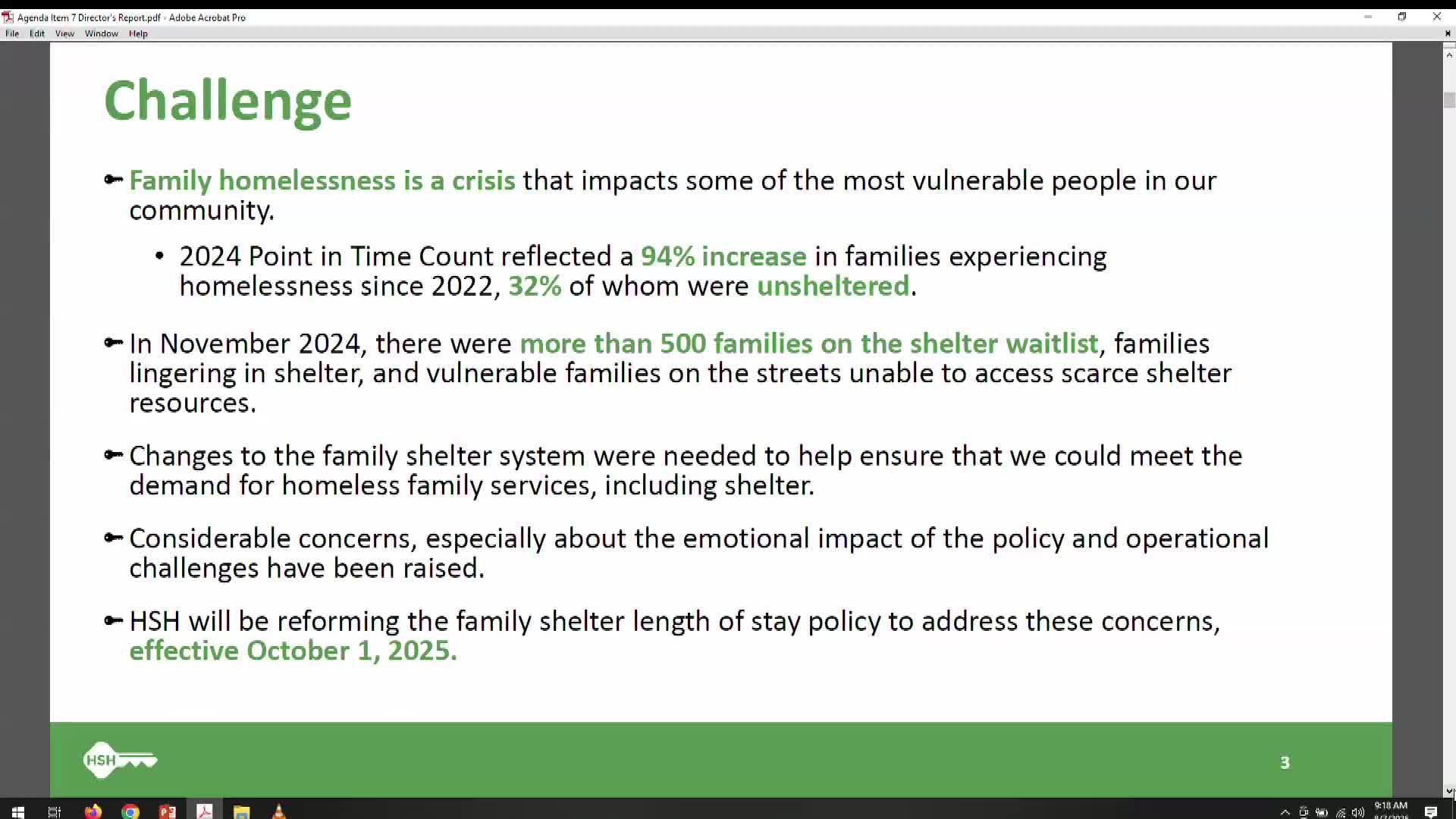
HSH framed the change as an attempt to balance emergency shelter capacity with fair access. The department said family homelessness has risen sharply: its 2024 point-in-time counts showed a 94% increase in families experiencing homelessness since 2022 and that 32% of those families were unsheltered. HSH said that, in November 2024, more than 500 families were on the family shelter wait list.
Under the revised policy, HSH said a family must meet clarified criteria to be eligible for an extension. Those criteria include consistent engagement with a case manager and active participation in housing search; having a medical condition under active treatment; a pending shelter, transitional or permanent housing placement (for example, rapid rehousing or permanent supportive housing); or housing barriers outside the family's direct control, such as immigration or criminal-background barriers. HSH also said it will provide clearer guidance and trainings for shelter staff about the criteria and how to document eligibility for extensions.
McSpadden said the department will run a human-centered design process with the Mayor's Office of Innovation and people with lived experience to rewrite client-facing communications (letters, flyers, translations) and staff trainings before implementation. HSH also said it will finalize a grievance process for families to appeal provider denials of requested extensions and that it will report to the Board of Supervisors every six months on the policy's impact.
HSH said that until the updated policy is fully rolled out, families already in shelter were given a 90-day extension so no household is immediately subject to the new limit.
Public commenters and commissioners raised concerns about implementation and transparency. Transitional-age-youth providers and advocates urged HSH not to classify two-year transitional housing programs as short-term shelter in public reporting, saying those programs operate differently and should be displayed separately from emergency shelter wait lists. Other commenters asked that HSH disaggregate reasons families are removed from wait lists (for example, decline of offer, non-response, housed elsewhere) to better target solutions.
HSH said additional implementation details'including the finalized grievance process and the training schedule'will be included in the materials distributed to providers and shelter guests prior to the policy taking effect.