Get Full Government Meeting Transcripts, Videos, & Alerts Forever!
Get email alerts on the Autonomous Vehicles topic
No spam. Unsubscribe anytime.
Austin reviews state AV rulemaking, local deployments and incident reporting as DMV rules near finalization
Summary
Transportation and Public Works staff reviewed SB 2807 rulemaking at the Texas DMV that will permit and regulate commercial autonomous vehicle operations, described local AV deployments and explained the city's incident reporting, first-responder coordination and data limitations.
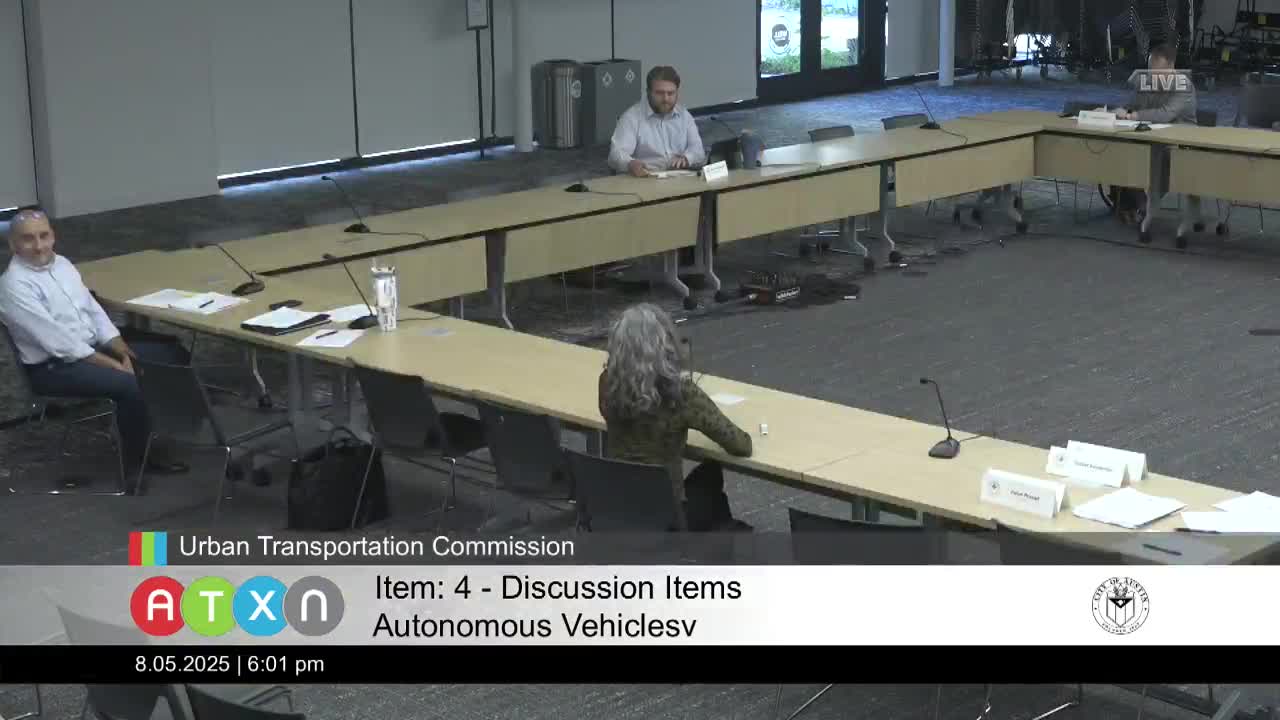
City staff on Tuesday told the Urban Transportation Commission that the Texas Department of Motor Vehicles’ (TxDMV) proposed rules to implement SB 2807 will create a permit regime for commercial autonomous vehicle (AV) operations in Texas but leave significant operational detail to state and company practice. TPW staff also summarized local AV activity and an incident log the city has been maintaining since July 2023.
Kristen Bray, a TPW business process consultant, told commissioners the state’s SB 2807 — a law enacted by the Legislature this year — grants the TxDMV authority to permit commercial AV operations and to suspend, revoke or cancel permits. The proposed rules published in the Texas Register (public comment period closed Aug. 25) specify application elements such as vehicle identification (VIN numbers, make, model, year), an authorization holder for each fleet, and a requirement that companies provide a first-responder plan to the Texas Department of Public Safety describing how first responders may communicate with fleet support and how to remove or tow AVs.
"A way for first responders to recognize whether the AV is in autonomous mode is a really big deal," Bray said. She added that the regulatory framework remains in an early stage and that additional DPS- or TxDMV-level rules may follow.
Bray described Austin’s local experience: five AV companies operating in Austin at the time of the presentation, with two considered deployed (Waymo and Tesla) and others testing or mapping. The city’s locally compiled incident dashboard — updated July 25 — showed 128 reported incidents since July 2023; staff said these reports are based on direct reports to the city and not a broad social-media sweep. TPW uses the incident data to identify hotspots (notably areas with heavy pedestrian traffic and event-related diversions) and to provide operational feedback to companies.
Bray said the city convenes an autonomous vehicle safety working group including APD, AFD, EMS, TPW, airport staff and the law department to coordinate first-responder training and company communication. When high-priority emergency responses occur, TPW asks companies to geofence the location (typically a 1,000-foot radius for one hour) to avoid AVs driving through active scenes. TPW also coordinates pre-event briefings with AV companies for major special events and football games so companies can avoid closures and staging areas.
On enforcement, staff explained that issuing a moving violation to an AV requires an affidavit and extra administrative steps because there is no human driver to cite; parking violations are more straightforward to issue to a vehicle. Commissioners raised concerns about ad hoc data sharing from companies. Bray said some deployed companies share operational summaries, vehicle counts and collision reports (Waymo posts certain collision reports to NHTSA), but comprehensive real-time data such as vehicle miles traveled is not consistently provided. TPW staff said they welcome more proactive data sharing but currently rely on collaboration and voluntary disclosures in the absence of a stronger statutory data mandate.
Commissioners discussed whether the city should submit comments on the proposed TxDMV rules; staff noted that the city-level intergovernmental relations office was coordinating a consolidated city comment and that individuals on the commission could submit private comments directly. Commissioners asked for periodic updates; several suggested another commission briefing in six months because deployment and rulemaking remain active and evolving.
TPW provided reporting channels for the public: report incidents via 311 or the non-emergency vehicle issues option in the 311 app, or email COAVworkinggroup@austintexas.gov to reach the city’s AV working group. Bray emphasized that the city’s incident dashboard is populated only with reports that city staff can verify with date, time and location to allow company follow-up.