Get Full Government Meeting Transcripts, Videos, & Alerts Forever!
Get email alerts on the Emergency Management topic
No spam. Unsubscribe anytime.
TPW details emergency management role: winter weather, debris and training plans
Summary
Austin Transportation and Public Works described its emergency management structure, winter weather and severe weather responses, debris management coordination, new liquid brine units and incident-command training to improve response and recovery.
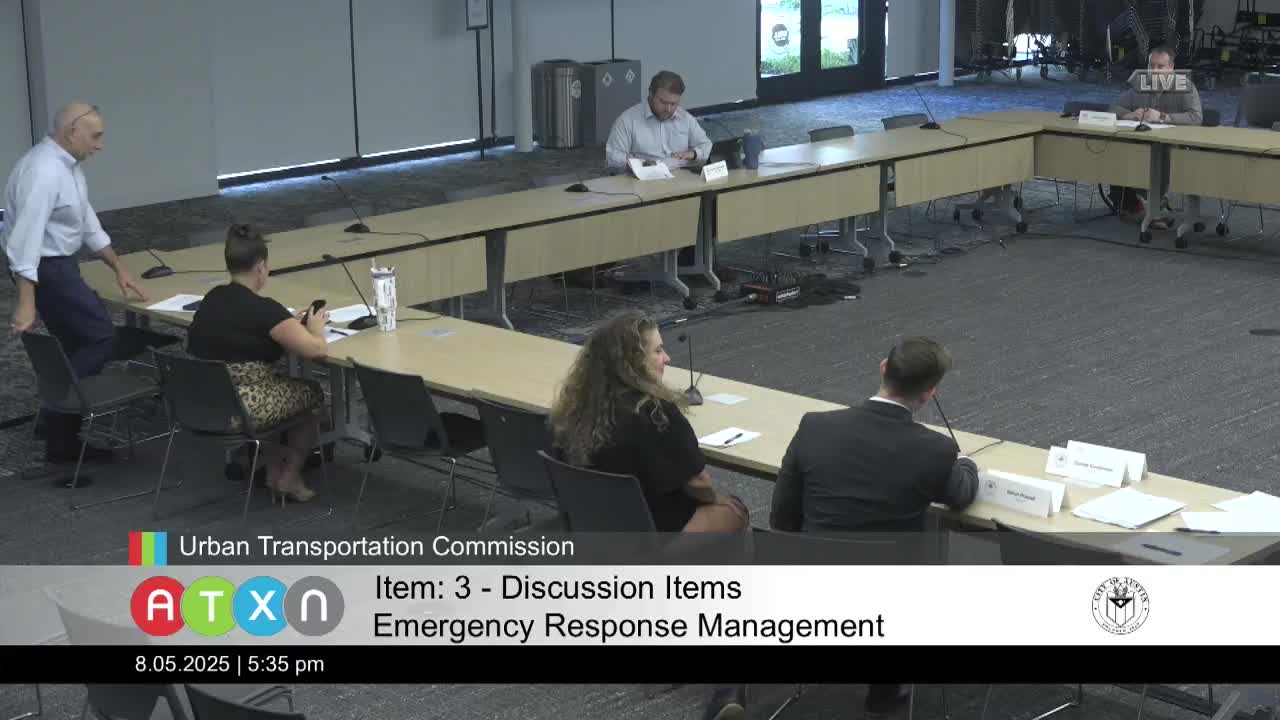
Transportation and Public Works (TPW) staff on Tuesday presented an overview of the department’s emergency management program, outlining responsibilities for road treatment, debris clearing, signal resiliency and interagency coordination for winter storms, severe weather and large special events.
Dan Walbrach, assistant director for TPW, said the emergency management (EM) program comprises a small core team that maintains plans and training, larger operational crews that perform field response, and support functions (public information, data technology services, logistics, safety and finance) that enable a sustained response. "They're responsible for clearing roadways, treating roadways, taking care of debris management, ensuring that signals are working and that signs are up," Walbrach said.
Kimmy McMinn, TPW emergency manager, described recent activations: two Austin-Travis County Emergency Operations Center (EOC) activations during the winter season, one TPW-only department operations center activation in February, and multiple severe-weather activations in spring and summer. TPW supports debris management in coordination with Austin Resource Recovery (ARR) and assists Watershed Protection on barricading low-water crossings when the flood early warning system indicates risk.
TPW staff highlighted investments and operational practices intended to improve response time and resiliency. These include use of battery backup units and portable generators at signals to avoid long outages, remote reset capability for signals from the Mobility Management Center to reduce crew dispatch, and three new liquid brine application units to improve and make more precise winter-weather roadway treatment.
McMinn outlined technology tools used for situational awareness: an on-call dashboard listing critical on-call contacts, a road-conditions dashboard fed by sensors, mapping of critical assets (substations, treatment plants, hospitals), real-time signal status and a SharePoint-based emergency communications hub that links maps, hydro data and service requests. TPW is exploring a virtual EOC tool already used by other departments to coordinate debris management and recovery.
Longer-term recovery and resilience work includes debris-management planning and staging of equipment (trailers, type-3 barricades, cones, lights) for wildfire evacuation support; regular equipment training and exercises; and updating a consolidated TPW continuity of operations plan (COOP) that will include appendices for fire, evacuation, winter weather, flood response and debris management. McMinn said the department also will expand Incident Command System (ICS) and National Incident Management System (NIMS) training across operational and support staff so TPW can coordinate seamlessly with public safety.
Staff said they coordinate regularly with Austin Fire, Austin Police, Austin Energy, Austin Water, TxDOT, Travis County and regional partners through CAPCOG and Homeland Security Emergency Management to align response and resource allocation. Jim Dale, TPW deputy director, said bond-funded projects have been used to upgrade signal communications and resiliency and that the department is seeking opportunities to better coordinate treatment responsibility with neighboring agencies.
Commissioners asked about long-term resiliency and how TPW handles immediate roadway threats. McMinn said debris management is a long-duration recovery effort after storms and TPW is developing a debris-management dashboard with ARR and Austin Fire. Dale added that police are typically first on scene; if an obstruction is an immediate public-safety hazard, APD may request TPW assistance to remove it.
TPW staff said the department will continue quarterly exercises, maintain winter-readiness statements for executives, and refine staging and deployment plans for evacuations and large events. Staff also noted that TPW will coordinate the distribution and timing of ICS/NIMS training and work on liaisons with TxDOT to improve coordination on state-owned roadways.