Get Full Government Meeting Transcripts, Videos, & Alerts Forever!
Get email alerts on the Historic Preservation topic
No spam. Unsubscribe anytime.
San Antonio panel approves elevated Riverwalk terrace at 235 East Commerce with conditions after neighbor objections
Summary
The San Antonio Historic and Design Commission on Aug. 6 approved a proposal to add an elevated restaurant terrace and pedestrian bridge above Crockett Street at 235 East Commerce, subject to staff stipulations and a condition that the applicant work with the adjacent hotel to explore mitigation measures.
The San Antonio Historic and Design Commission on Aug. 6 approved a proposal to add an elevated restaurant terrace and pedestrian bridge above Crockett Street at 235 East Commerce, subject to staff stipulations and a condition that the applicant work with the adjacent hotel to explore mitigation measures.
The project, presented by architect Don McDonald, is intended to create a multi-level restaurant terrace that would extend above Crockett Street and connect into the Riverwalk area. Don McDonald, architect for the proposal, said the design aims to “extend the street level into the Riverwalk” and to “activate both Crockett and the upper spaces,” describing plan elements such as stairways, an existing elevator and large planter boxes intended to be long-lived and low-maintenance.
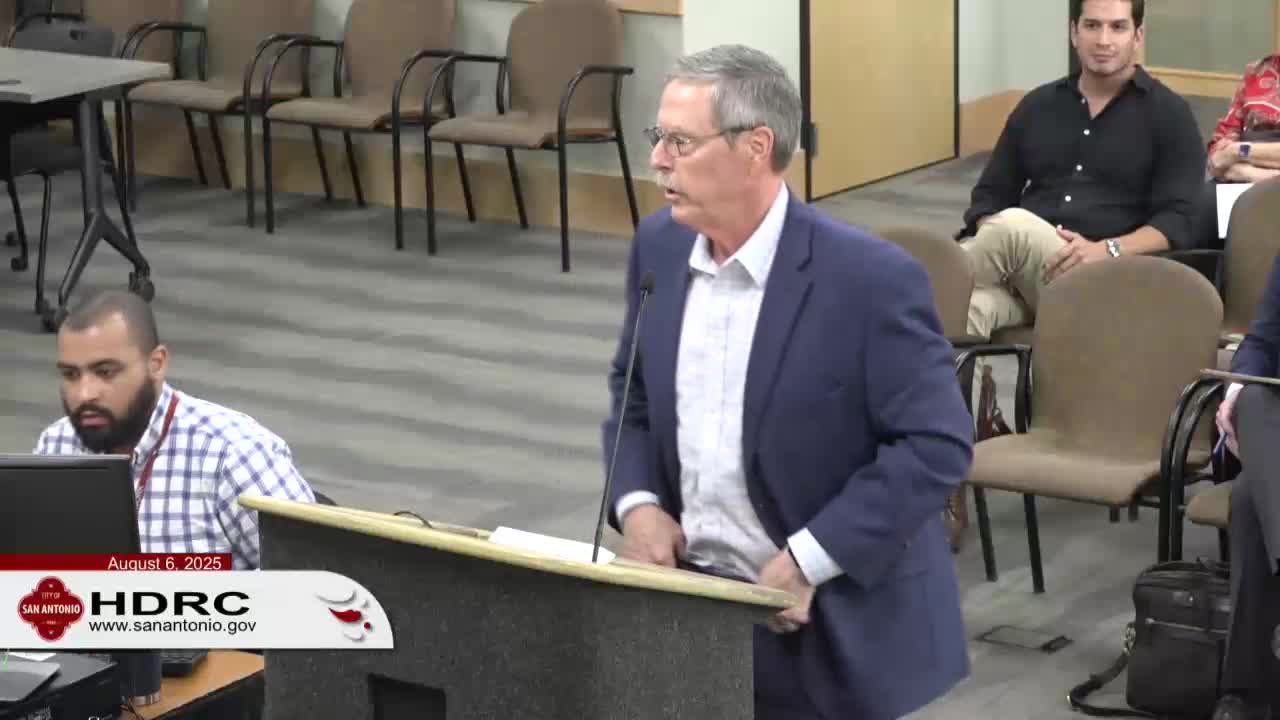
The proposal drew sustained opposition from nearby hotel representatives who said the elevated platform would harm the hotel’s character, views and quiet. Rusty Wallace, managing director of Mansión del Río, said the structure would “destroy the tranquil environment” near the hotel and argued the terrace would put a “barrier” between hotel balconies and the Riverwalk. Nikki Stinberg, identified as a hotel administrator, said the proposed bridge and modern structure would “interrupt the historic view” and risk the city’s heritage and tourist appeal.
Michael Kim, identified in the record as representing the applicant’s client and associated with Windsepici, told the commission the concern was not with the entire application but specifically with the elevated restaurant platform, which he said would sit about “60 feet” above the Riverwalk and would be “out of scale” with the façade. Kim noted the building had been nominated as a national historic landmark in 1996 and said the side facing Commerce and the Riverwalk had “relatively not changed for many years.”
Commissioners pressed the applicant on several technical points during the review: how rooftop runoff and rain would be handled so it would not drain directly into the river; how the design would control noise for adjacent residents and hotel guests; the materials and transparency of the roof structure; and whether the proposal increased fire risk by adding a wooden structure above an existing façade. Staff noted prior conceptual approval (recorded as a conceptual approval with findings on Feb. 5) included guidance that materials for terraces should be visually compatible with the Riverwalk.
Several commissioners expressed concern about outreach to the adjacent hotel. Commissioners noted the applicant had met with multiple neighborhood groups and made design changes in response to feedback but had not had sustained dialog with the adjacent hotel operator until shortly before the hearing. One commissioner said the project team had “more than half a dozen” attempts to contact the hotel but only limited corporate follow-up.
During deliberations a motion to deny the application was made and seconded; that motion failed on a roll-call vote. The commission then approved the application with staff stipulations and an added requirement that the applicant “work with the adjacent neighbor to explore mitigation for their concerns.” Commissioners stressed that the stipulations and further design work must address drainage, noise mitigation and façade presence.
The final approval passed on a roll call in which the transcript records: Mena — yes; Se vino — yes; Mizuca — yes; Grove — yes; Cervantes — no; Setzetter — yes; Gibbs — yes. The commission directed the applicant to continue coordination with staff and the adjacent property owner; staff will follow up as part of the certificate-of-appropriateness process.
Why it matters: the Riverwalk is one of San Antonio’s highest-traffic historic and tourist corridors; changes to scale, sightlines and nighttime activity can affect adjacent historic resources, hotel operations and pedestrian character. The commission’s added requirement to work directly with the neighboring hotel aims to provide a path for additional mitigation before final permitting.
Next steps: the applicant will return to staff with revised details consistent with the commission’s stipulations; the commission noted that the certificate of appropriateness and final permit documentation will follow the staff-review process and that any required permit must address the drainage and noise items discussed at the hearing.
Votes and formal actions recorded for this item appear in the meeting record.