Get Full Government Meeting Transcripts, Videos, & Alerts Forever!
Get email alerts on the Onsite Sewage topic
No spam. Unsubscribe anytime.
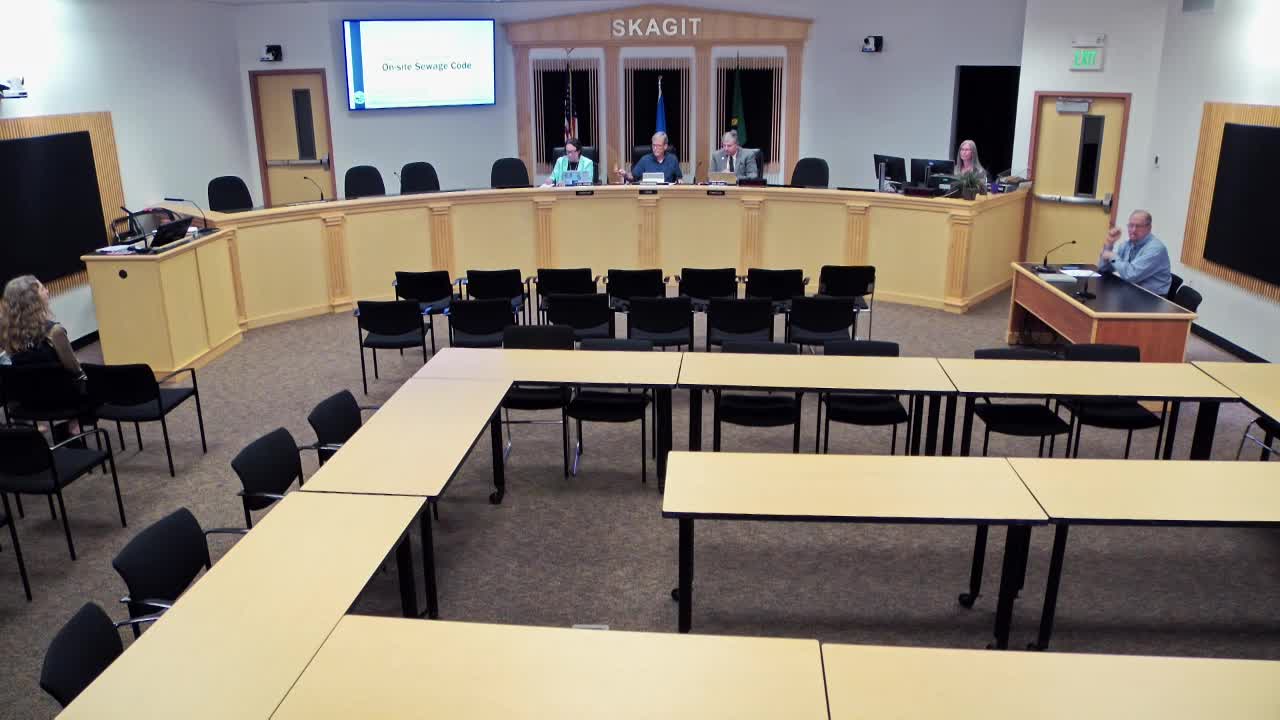
Skagit County Board of Health closes public comment on proposed on-site sewage code updates
Summary
The Skagit County Board of Health closed the public comment period July 28 on proposed revisions to Title 12.05 (on-site sewage) that align local rules with recent state updates; staff said a SEPA nonproject review remains before the board will deliberate adoption.
The Skagit County Board of Health closed the public comment period July 28 on proposed revisions to Title 12.05, the county code governing on-site sewage systems, and staff said a State Environmental Policy Act (SEPA) nonproject review must be completed before the board returns to deliberate adoption.
County public-health staff told the board the draft local code updates are intended to align Skagit County requirements with revisions the State Board of Health adopted in January 2024 and that most state changes took effect in April 2025. Staff said they received written comment and will complete SEPA review before bringing the code back for final action.
Keith Hickman, identified by staff as director, opened the presentation by summarizing the purpose: "We've been having an ongoing conversation with the board for some time now. We have solicited, public input and public comment." Bridal Baff Dutton, who presented the staff summary of comments, told the board the county received two written comment submissions in July from on-site sewage providers and that those comments fell into three broad categories: process questions, issues tied to existing code language, and concerns about proposed changes.
Dutton told the board that two written comment dates were July 5 and July 16 and that six substantive comment topics were raised by providers. She said the county is not recommending changes to the current draft based on those comments: "We are not recommending any revisions to the draft as it stands." Dutton also outlined several common topics raised by providers, including: the need to include elevations in design documents (staff said elevations must be referenced to a vertical datum but do not require a licensed surveyor); tank-sizing conventions (staff said the draft uses manufacturer-available tank sizes and cited examples in the draft — 1,080 gallons for a three-bedroom and 1,440 gallons for a four-bedroom minimums used for sizing calculations); inspection-request timing (the draft asks for two working days' notice for final inspections); inspection-report deadlines (staff said 30 days is the expected submission timeline for required reports); and proposed certification training requirements (the draft proposes 16 continuing-education units and recognizes prior relevant work experience for credentialing).
On process-related questions — for example, locating reserve areas before final inspection or whether inspection fees should be paid through CivicAccess or public-health channels — Dutton said the draft's language allows the department to work on a site-by-site basis and that many process issues are better addressed through routine provider meetings and guidance rather than by prescriptive code language.
Board members asked about timeliness of inspections and workload. Hickman said the department aims to perform routine septic inspections within 24 to 48 hours of a request and that staff will work with providers if on-site conditions or scheduling cause delays. He also said, when needed, the county can bring in the Washington State Department of Health’s certified designers as a third-party resource to help resolve difficult site-design questions.
A commissioner moved to close the public-comment portion of the hearing; another commissioner seconded. The board voted in favor; the motion carried. Staff told the board a SEPA nonproject review (which includes a 15-day public comment opportunity) remains outstanding, and the department said it expects to schedule the item for a future Board of Health meeting once the SEPA process is complete — staff listed the board’s regular August 19 meeting as a possible date but said publication timing will determine the actual schedule.
The board took no final action to adopt the code revisions at the July 28 meeting. The public record for this item will include the written comments received July 5 and July 16 and the hearing testimony; staff will return with SEPA documentation and a recommendation once that process is complete.