Get Full Government Meeting Transcripts, Videos, & Alerts Forever!
Get email alerts on the Utilities Regulatory topic
No spam. Unsubscribe anytime.
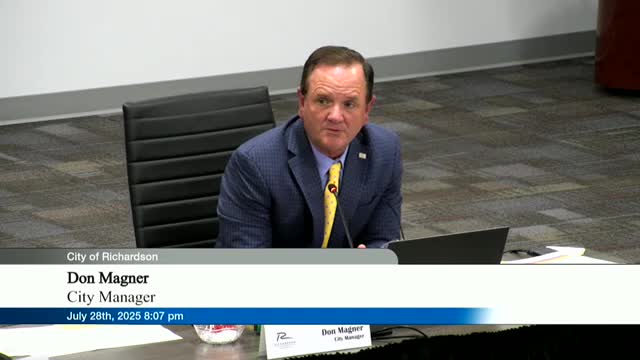
After‑action: Richardson upgrades SCADA, training and staffing steps after November boil‑water notice
Summary
Public services outlined corrective actions following a November 2024 boil‑water notice after a transient pressure loss: a new SCADA system, alarm reconfigurations, added hydrant monitors, enhanced instrument calibration, tabletop and functional exercises, and a planned staffing and consultant review.
City staff briefed council on actions taken after a November 6, 2024 boil‑water notice in South‑Southwest Richardson that followed a brief pressure loss in the system.
Eric Robeson, director of public services, said the city lost pressure below 20 PSI for approximately five minutes on the 767 West pressure plane and that the Texas Commission on Environmental Quality (TCEQ) required a boil‑water notice and follow‑up sampling. “Although the pressure was only lost for a short period of time and we had some confidence that the system was safe, still had to issue that notice,” Robeson said.
What staff changed The department implemented several technical and procedural changes during the six‑month after‑action review: - Replaced and commissioned a new SCADA (supervisory control and data acquisition) system with improved human‑machine interface screens, updated alarm thresholds and escalation paths, and an internal development server for operator training. The new SCADA went live as the primary system on June 25, 2025. - Enhanced instrumentation checks and calibration schedules, including semi‑annual third‑party calibrations and monthly integrator visits for updates and verification of roughly 1,724 SCADA input/output points. - Deployed additional independent hydraulic pressure monitors on hydrants (cellular devices) to provide redundancy outside of the city’s fiber/SCADA network. - Expanded partnership and joint exercises with the fire department and emergency management: tabletop exercises and an expanded functional emergency exercise were completed to test SOPs, roles and cross‑department communications. - Engaged an external water‑system consultant under a master services agreement to review SOPs, SCADA implementation and field operations and to document institutional knowledge and training needs. First task orders include SOP review and a benchmarking and findings report.
Staffing and training Public services proposed staffing enhancements including additional SCADA/system operators, a facility specialist for station and pump maintenance, and a compliance manager to centralize water‑quality oversight and training. Robeson said the department is developing “a training program that goes above and beyond what the state requires” to build deeper instrumentation, simulation and hands‑on capability.
Testing timeframe and communications Robeson explained the length of boil‑water sampling: EPA‑approved test methods require an incubation period (the shortest accredited method the city uses has an 18‑hour incubation), so the testing and lab turnaround contribute to the time before a notice can be lifted. Staff said they will explore parallel/unofficial testing approaches to give earlier internal signals but noted that official regulatory clearance still requires approved lab methods.
Ending Council members thanked staff for the thorough after‑action work and asked staff to continue outreach to renters and large multifamily managers to maximize opt‑in to the city’s emergency notification system. Staff said the consultant will deliver an operations‑focused findings report and additional SOP updates this fall.