Get Full Government Meeting Transcripts, Videos, & Alerts Forever!
Get email alerts on the Housing Policy topic
No spam. Unsubscribe anytime.
Planning Commission reviews housing‑element rezoning program tied to state RHNA; public comment criticizes mandates
Summary
City staff presented a housing‑element rezoning program covering about 261 parcels to meet Upland’s 2021–2029 RHNA allocation of 5,686 units; the commission was asked to recommend the rezonings to council. Council member James Breitling addressed the commission during oral communications, calling the state mandate unrealistic and unfunded.
City planning staff presented a housing‑element rezoning program that would rezone roughly 261 parcels across Upland to implement the sites identified in the city’s adopted housing element and secure final state certification.
Planner Joshua Winter and consultant Shannon told the Planning Commission the rezoning package implements sites identified in the housing element adopted by the city council and conditionally accepted by the California Department of Housing and Community Development (HCD). Winter said the city must adopt the proposed plan and zone changes and submit them to HCD to receive final certification and avoid developer “builder remedy” risks tied to an un‑certified housing element.
Winter said the rezoning program responds to the state’s Regional Housing Needs Allocation (RHNA) for Upland of 5,686 units for the 2021–2029 planning cycle. He described key elements of the package: creation of an RM‑40 designation (40 dwelling units per acre), a transit overlay near the Montclair Transit Center, modest general plan text edits and implementing zoning code changes. Winter emphasized that the hearing was limited to zoning changes and that no development projects were proposed or approved at the meeting.
The rezoning sites were selected based on owner interest, site suitability (vacancies, low building‑to‑land ratios or aging structures), proximity to transit and the requirement to affirmatively further fair housing by distributing sites across the city. Winter noted the RM‑40 designation would generally require at least a one‑acre parcel to encourage lot consolidation and would allow mid‑rise and townhome building types in appropriate locations.
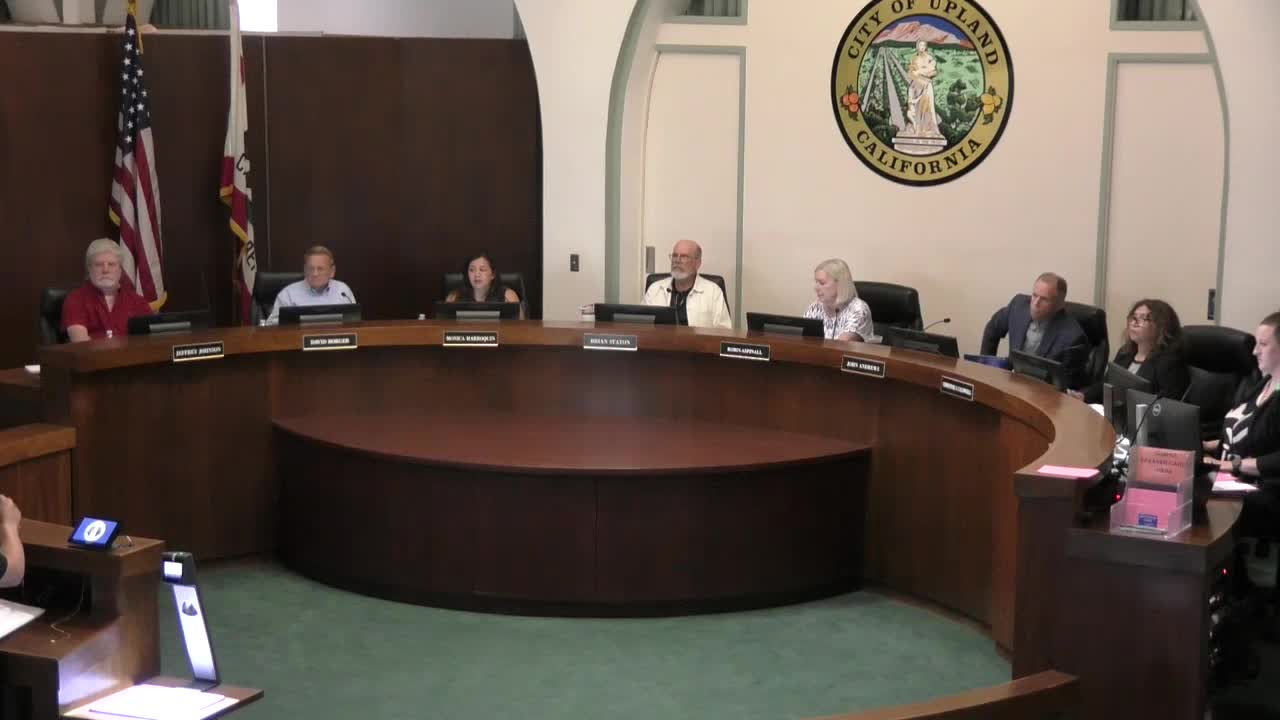
During oral communications before the public hearings, Council member James Breitling addressed the commission and urged residents to hold state legislators accountable, calling the RHNA allocation and related housing mandates “unfunded mandates” that are unrealistic for a built‑out city with limited infrastructure. “The number is wildly unrealistic for the city of Upland, a built out city with finite land, aging infrastructure, and limited resources,” Breitling said, and warned that without a certified housing element developers could pursue “builder remedy” projects he said would be “not guided by our general plan or community input.”
Commissioners asked staff clarifying questions about site selection standards, parking impacts for potential projects and the limited role of the commission as a recommending body to the council. Staff said the city began the rezoning process in 2020, received a letter of conditional compliance from HCD, and must adopt the rezones to secure final certification. Staff also said some individual parcels already have project applications pending and that many of the conceptual building types shown in the staff presentation were illustrative rather than approvals.
No formal rezoning ordinance was adopted at the meeting; the commission’s role is to make a recommendation to the city council on the proposed rezoning and code amendments.