Get Full Government Meeting Transcripts, Videos, & Alerts Forever!
Get email alerts on the Urban Forest topic
No spam. Unsubscribe anytime.
Planning commission hears update on Fairfax City Urban Forest Master Plan
Summary
Consultants and city staff presented Phase 1 findings and preliminary objectives for Fairfax City's first Urban Forest Master Plan, highlighting outreach, canopy data, six draft objectives and next steps toward a final plan due this year.
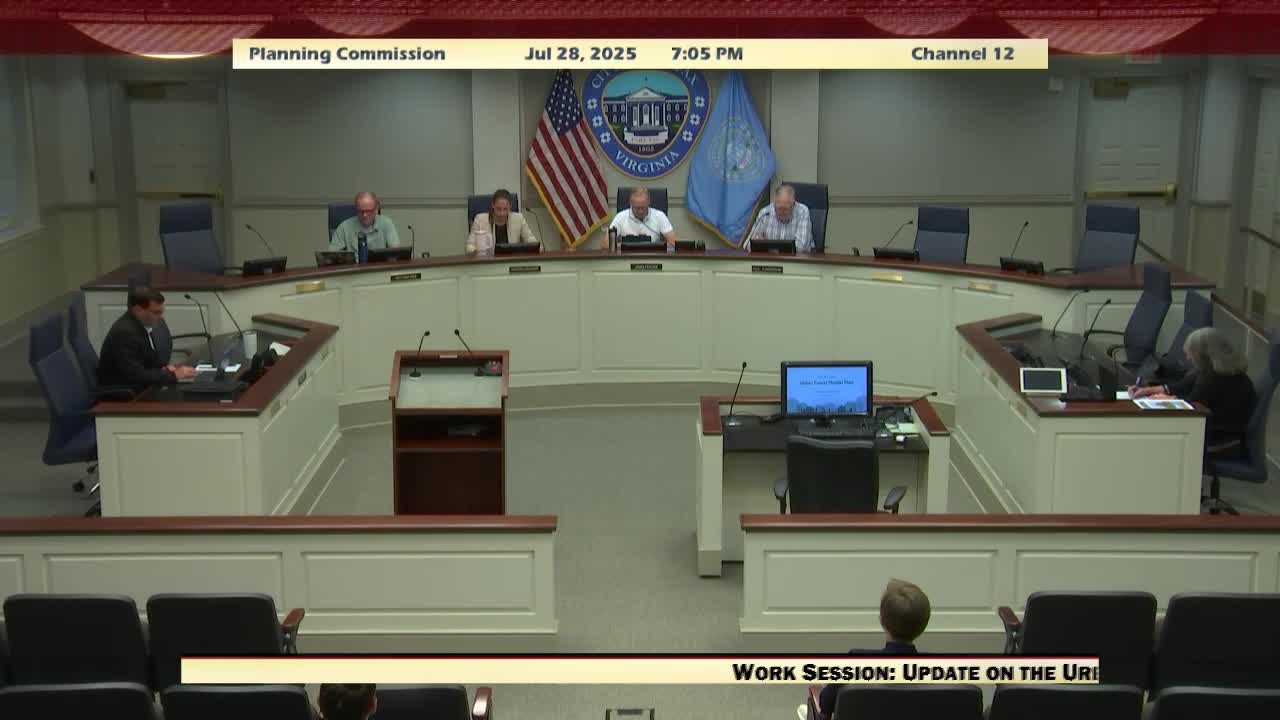
Fairfax City Planning Commission members received an update July 28 on the draft Urban Forest Master Plan, a two‑phase effort that consultants said will guide tree management, policy and community stewardship across the city for the next 20 years.
The presentation summarized Phase 1 outreach and analyses — more than 100 stakeholder interviews, an 83‑response public survey, multiple public meetings and canopy mapping — and introduced six draft objectives that include stronger tree protections, a long‑term planting and maintenance plan, and creation of a centralized urban forestry division. Staff and the consultant said a final plan is slated for city adoption before the end of 2025, with the Planning Commission expected to consider an endorsement in November or December.
The master plan process is intended to translate public input and technical data into implementable policies. Dr. Garrett Wolf, engagement lead for the Davie Resource Group, said the project’s outreach and data work “forms the basis for the master plan’s goals and objectives.” City staff described Phase 1 as primarily information gathering; Phase 2 will refine objectives, identify implementation actions and produce the final plan.
Consultants and staff reviewed key findings from Phase 1. Canopy mapping based on 2023 imagery showed 37.86% tree canopy citywide, with the city noting that 76% of that canopy is on private property and 61% of plantable area is on single‑family residential lots. Staff emphasized limits in the data, including possible overcounting where invasive species appear as canopy and the difficulty of detecting pest‑driven declines from aerial imagery.
The draft plan frames three high‑level goals — build a resilient and equitable urban forest, increase the city’s capacity to care for public trees, and strengthen community support and involvement — supported by six objectives. Those objectives would: - improve protection of existing trees and forested areas; - strengthen tree protection policy and enforcement (staff described lack of a public tree protection ordinance and inconsistent enforcement as current gaps); - expand tree planting and species diversity across neighborhoods; - establish a dedicated urban forestry division to centralize responsibilities now spread across multiple departments; - deepen public engagement and stewardship opportunities; and - use regular, accurate data to guide decisions and measure progress.
Staff and consultants walked commissioners through policy options under Objective 2, which addresses regulatory content and enforcement mechanisms. The consultants said strategies prioritized by public meeting voters included promoting tree preservation and planting through existing or new policies (for example green‑street standards) and improving internal processes for policy implementation and data tracking. Dr. Wolf noted that public meeting number 3, held in June and supplemented by one week of online voting, drew roughly 100 participants who ranked strategies by priority.
Commissioners pressed staff on technical and operational details. Staff said current urban forestry responsibilities are shared across three departments (right‑of‑way/public works, parks maintenance, and community development/planning) and estimated those combined activities total roughly three full‑time equivalent staff. Staff and commissioners discussed enforcement limits under state code, the practical role of code enforcement for hazardous trees near public rights‑of‑way, and the city’s ability — within state law — to set replacement fees or fines for unauthorized removal of regulated trees.
Commissioners also asked about the accuracy and timing of canopy data. Staff said the city uses Fairfax County NAIP imagery and 2‑foot resolution land cover data for canopy tracking; the 2023 dataset is the most recent available. Staff noted analysis is able to identify canopy over impervious surface and other classes; consultants flagged that future NAIP imagery with near‑infrared bands and possible supplemental drone/LiDAR surveys could improve detection of species, invasives and tree health on the ground.
Staff outlined next steps: continuing Phase 2 public outreach (tabling and one remaining public meeting), refining objectives based on steering‑committee feedback, completing the draft implementation plan, and returning the final draft to the Planning Commission in November or early December before presentation to City Council. Anna (city staff, urban forestry lead) said staff will coordinate further steering committee and public review and incorporate feedback into the plan.
The commission’s discussion included operational suggestions — creating a public, searchable inventory of notable or specimen trees, using grant funds and partnerships for data collection, and clarifying how zoning and small‑area planning tools should reflect canopy goals. No formal action was taken; staff said the draft remains under internal review.
The project team asked for feedback on draft regulatory strategies and said the final plan will include short‑, medium‑ and long‑term actions and an implementation timeline. Public meeting number four is planned for late fall, when the draft master plan will be presented to the community prior to Council consideration.