Get Full Government Meeting Transcripts, Videos, & Alerts Forever!
Get email alerts on the Agritourism Code Amendments topic
No spam. Unsubscribe anytime.
Skagit County planning commission reviews proposed agritourism code; sets public comment and hearing schedule
Summary
The Skagit County Planning Commission on Sept. 16 reviewed proposed agritourism code amendments that would create a three-tier permit structure, new limits on events in agricultural zones and a voluntary compliance pathway for existing large operators, and set a public comment period and schedule leading to a county decision by year'end.
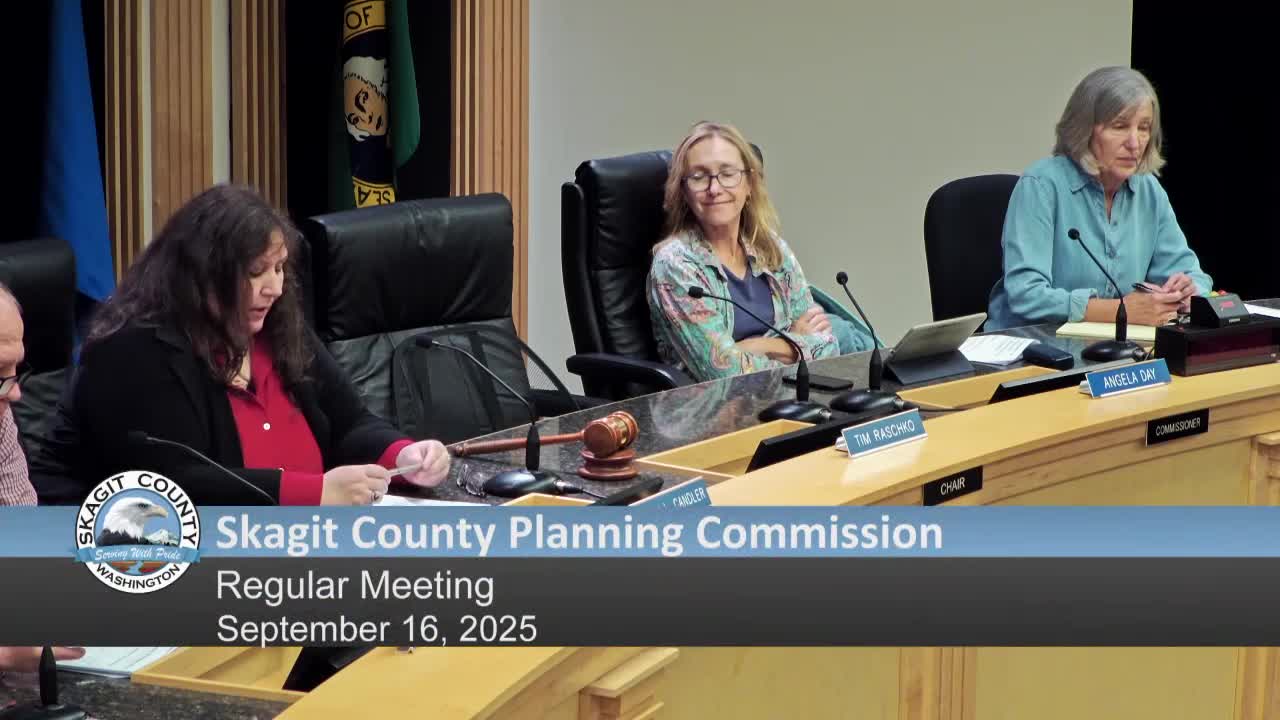
SKAGIT COUNTY, Wash. — The Skagit County Planning Commission heard a work session Sept. 16 on proposed agritourism code amendments that would establish three intensity levels for farm-based visitor activities, new limits on events in agricultural natural resource lands and related rural zones, and a voluntary compliance pathway for existing large operators.
Planning and Development Services (PDS) staff, represented in the meeting by Jack Moore, told commissioners the draft code would define agritourism, set performance standards (parking, noise, lighting, nonconversion of farmland) and create three review tracks based on attendance and frequency: Agritourism 1 would be a permitted use limited to 25 guests per day and 10 days per year; Agritourism 2 would require an administrative special-use permit, limited to 100 guests per day and 24 days per year; Agritourism 3 would be the highest-intensity review and require a hearing-examiner special-use permit with conditions (capacity and days to be set in the approval).
The draft also includes a seasonal exception for operators participating in the county's Tulip Festival: between March 15 and May 15 those permitted agritourism operators may operate up to 30 consecutive days in addition to limits set by their categorization and permit conditions. The proposal would prohibit certain uses in the Ag NRL zone, including non-ag limited event venues, restaurants and regularly occurring celebratory gatherings such as weddings.
Why it matters: The county said the amendments aim to protect working farmland and surrounding farm operations while allowing farm-linked visitor activities that diversify farm income and increase public awareness of agriculture. PDS described the draft as focused on impacts'number of visitors, frequency of events and on-site improvements'rather than attempting to list every permitted activity.
Key details
- Definition and intent: Agritourism is framed as activities on a working farm or ranch tied to agricultural production for education, enjoyment or recreation and that may generate income. The draft emphasizes agritourism must be secondary to the primary farm operation and not cause conversion of farmland.
- Intensity levels: Agritourism 1: permitted use, up to 25 guests/day and 10 days/year. Agritourism 2: administrative special-use, up to 100 guests/day and 24 days/year. Agritourism 3: hearing-examiner special use with conditions; capacity and days set per approval.
- Operator eligibility and monitoring: Higher-intensity (level 2 and 3) applicants must show the primary agricultural use generated an average gross income of at least $500 per acre per year over the previous three years, as verified by PDS; applicants must submit an annual self-certification (Skagit County code cited in the draft as 14.51.080) and the county may inspect and revoke permits for noncompliance.
- Performance standards and limits: Proposed rules require on-site parking (no use of a road right-of-way), conformance with county road access and level-of-service standards, limits on lighting and noise consistent with existing code, and potential SEPA review and mitigation conditions.
- Zones: The draft would allow agritourism in agricultural and certain rural resource zones that already permit farming, including Ag NRL, rural resource natural resource lands, rural reserve and rural intermediate; the proposal does not add agritourism allowances to industrial, commercial or other zones where agriculture is not an intended use.
- Existing operators and voluntary compliance: PDS described a voluntary compliance agreement process for existing, large-scale operators identified by the county (PDS said it has identified about 18'19 such operators). The voluntary-compliance path is a one-time opportunity for existing operators to document and record their current operations on the property record; PDS said one voluntary pathway is transferable (can be sold with the business) and another is nontransferable and would remain tied to current ownership.
Questions and concerns raised
Commissioners pressed staff on clarity and enforcement. Commissioner Degg asked how a farmer could plan when attendance is uncertain, saying, "If I grow wheat and I say I'm going to give a demonstration of how to mill this wheat and bake bread and I advertise it and 50 people show up, but I don't have an agritourism permit, how can I plan for that?" PDS replied the code focuses on intensity and frequency as the measure of impact and that small, infrequent demonstrations would fit in lower-intensity review while recurring, larger-scale operations would require higher review and mitigation for traffic, parking and impacts to neighbors.
Commissioners asked about permit costs and timelines. PDS estimated administrative special-use review would take roughly three to four months and the hearing-examiner process about six months; staff said hearing-examiner fees would likely be in the "few thousand dollar" range and administrative permits would be lower. Commissioners also asked about enforcement capacity; PDS said the county has two code compliance officers and said the county could inspect and verify annual self-certifications.
PDS also described the voluntary compliance agreement as legally binding, recorded on the property, and subject to oversight; if an operator exceeds the recorded limits, the county could require compliance or cessation of the activity.
Public process and timeline
PDS set a public written comment period from Sept. 25 to Oct. 16, 2025, and advised interested residents to review the draft code on the county website. The planning commission will hold a public hearing (PDS described this as occurring "next month" from the Sept. 16 meeting); the commission planned deliberations on Nov. 18, 2025, a Board of County Commissioners work session on Nov. 24, 2025, and a tentative county-commission consideration or action on Dec. 23, 2025.
What commissioners said
Multiple commissioners thanked staff for the work and urged outreach to residents in rural reserve and other zones that could see impacts from added visitor activity. Commissioners asked staff to return with permit fees, data on how many temporary-use permits the department has processed in recent years (staff estimated on the order of a dozen per year), and more examples of how different agritourism levels would be applied in practice.
Next steps
PDS encouraged operators and neighbors to review the draft code and provide comments during the public comment window. Existing operators who want to secure a recorded voluntary compliance agreement must decide whether to pursue the transferable pathway or the nontransferable option within the one-time window PDS described.
A procedural item: minutes approved
At the start of the Sept. 16 meeting the commission approved the Aug. 19 minutes by voice vote. The motion to approve was moved and seconded and the chair called the motion approved after an "aye" vote was recorded; no roll-call tally was provided in the meeting record.
The commission adjourned after the department gave updates and introduced a new long-range planner.