Get Full Government Meeting Transcripts, Videos, & Alerts Forever!
Get email alerts on the Visit Eau Claire Contract topic
No spam. Unsubscribe anytime.
Council hears Visit Eau Claire contract proposal, then votes to enter closed session for negotiations
Summary
Visit Eau Claire presented a proposed 2026 contract that includes funding for a two‑year destination master plan and a city destination development fund. After an extended public comment period largely in support, the council voted to enter closed session to provide negotiation direction under s.19.85(1)(e) Wisconsin Statutes.
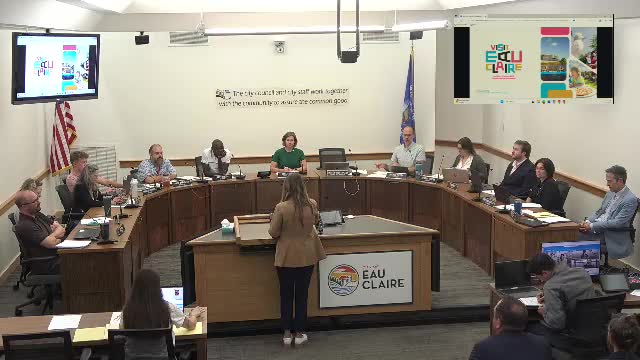
Visit Eau Claire's executive director presented a proposed contract for 2026 and beyond and outlined a plan to fund a two‑year destination master plan and a city destination development fund. After public comment in support of Visit Eau Claire, the council voted to enter closed session to provide negotiation direction on the contract.
Executive director Kenzie Haplicek told the council Visit Eau Claire is a 45‑year regional tourism organization serving Eau Claire and neighboring municipalities. Haplicek summarized the organization's results and the proposal: tourism had a reported $461 million total economic impact in Eau Claire County in 2024, visitors spent about $286 million, the industry supported roughly 3,900 jobs and produced an estimated $31 million in state and local taxes. Haplicek said the city collected about $2.9 million in room tax in 2024; under state statute the municipality may retain up to 30% while a minimum of 70% is forwarded to a tourism entity for tourism promotion and development.
Haplicek outlined a proposed financial model for 2026 (based on a 2.5% projected increase in room tax receipts): an allocation to fund a two‑year destination master plan at about 3% in 2026, a proposed city destination development fund at roughly 2% (about $50,000) in 2026, with the remaining allocation keeping a 49% share for Visit Eau Claire operations and 21% for community partners (Pablo Center, Chippewa Valley Museum, Sonantec Center) and grant programs. "Our role is to be a catalyst that keeps the cycle of community vitality spinning," Haplicek said.
Legal counsel Zach Bemis of Godfrey & Kahn responded to council interest in additional public oversight and recommended preserving a membership‑derived nonprofit board structure to remain compliant with federal tax rules that govern 501(c)(6) organizations. Bemis recommended ex‑officio, non‑voting participation for municipal representatives on Visit Eau Claire committees and board meetings rather than giving city officials voting seats on the nonprofit board. He said that structure maintains the legal distinction between the taxing unit and the tourism entity while allowing robust information flow and city input.
Public comment and stakeholder support The council heard a lengthy public comment period focused largely on Visit Eau Claire's value to the local economy. Nineteen speakers (and additional people through an extended comment period) included event organizers, hoteliers, cultural institutions and regional partners. - Joe Lustick and Leighton Hahn, organizers of the Clearwater Jazz and Art Festival, credited Visit Eau Claire for early grant support and promotion that helped the festival grow to multi‑thousand attendance and increased hotel stays. - Dan Kron, vice president of asset management for Movement Hospitality, said Visit Eau Claire ranks among the best destination marketing organizations he has worked with in 16 states and provided a back‑of‑the‑envelope return‑on‑investment estimate for hotel taxable revenues. - Representatives from Pablo Center, Chippewa Valley Museum, the Children's Museum, Visit Eau Claire board members and regional DMOs urged council to maintain the contract and described benefits including event attraction, grant wins, national press placements and region‑wide collaboration.
Council action: closed session for negotiation direction Toward the end of the meeting councilmember Brewster moved that the council go into closed session "to provide negotiation direction for competitive bargaining or bargaining reasons and consider the investment of public funds regarding the Visit Eau Claire contract, pursuant to s.19.85(1)(e) of the Wisconsin Statutes." The motion was seconded by Councilmember Mboga (recorded as Mvoga at the microphone). A roll‑call vote was held and the motion passed; the clerk recorded all council responses as aye and the body recessed to clear the chamber before entering closed session.
What this means The vote sends the Visit Eau Claire contract negotiations into a closed session forum where council members will provide negotiation direction to staff. The council did not take a public vote to approve or reject the contract terms at this meeting. City staff and Visit Eau Claire representatives said they plan to continue negotiations consistent with state law and the city's interests.
Ending Visit Eau Claire asked the council to approve a shorter initial contract (three years) with automatic one‑year renewals unless 12‑month notice is given and to fund a two‑year destination master plan and a continuing destination development fund. The council moved the discussion into closed session for negotiation direction under state statute; any final contract action is expected to return to public session for a vote in a subsequent meeting.